
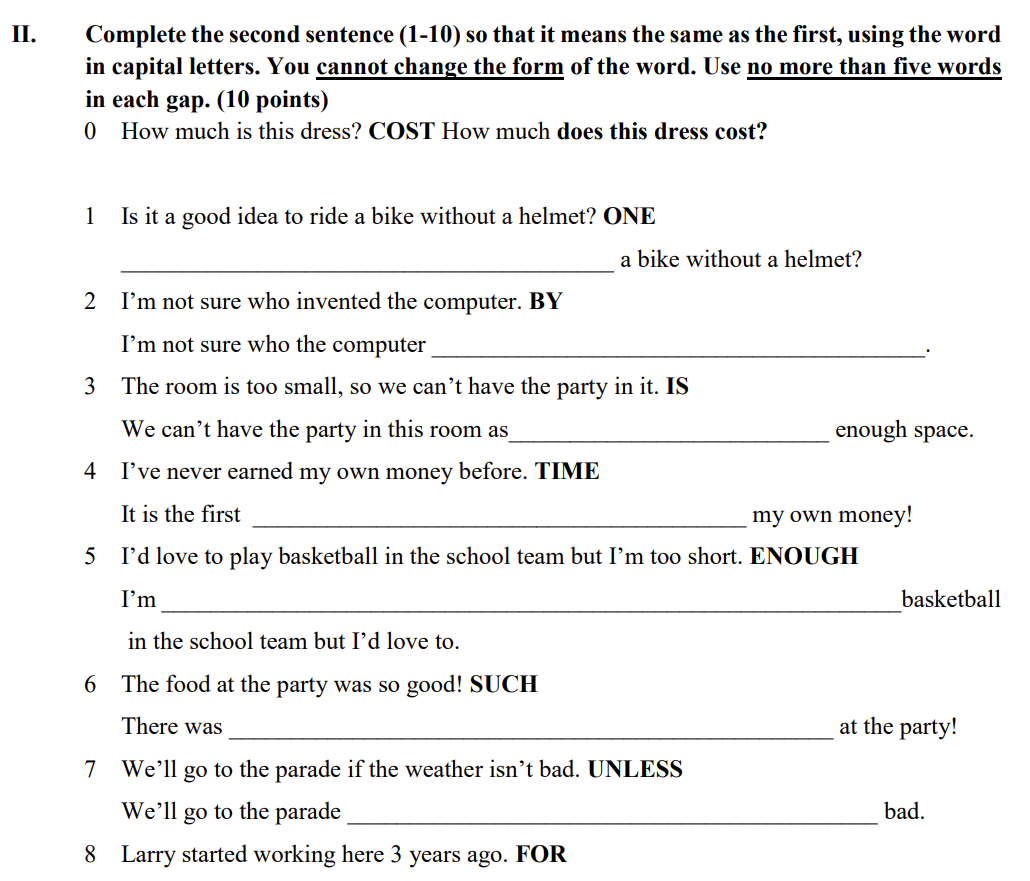
Przykład (0): How much is this dress? COST — How much does this dress cost?
1.
Is it a good idea to ride a bike without a helmet? ONE
Odpowiedź: Should one ride a bike without a helmet?
2.I’m not sure who invented the computer. BY
Odpowiedź: I’m not sure who the computer was invented by.
Wyjaśnienie: Tworzymy stronę bierną w pytaniu zależnym: “was invented by + osoba”. Słowo BY wprowadza wykonawcę czynności w stronie biernej.
3. The room is too small, so we can’t have the party in it. IS
Zdanie: The room is too small, so we can’t have the party in it. IS Odpowiedź: We can’t have the party in this room as it is not big enough. Wyjaśnienie: Zmiana “too small” na równoważnik “not big enough”. Użycie is zgodnie z poleceniem; konstrukcja “be + not + adjective + enough” wyraża brak wystarczającego rozmiaru.
4. I’ve never earned my own money before. TIME
Zdanie: I’ve never earned my own money before. TIME
Odpowiedź: It is the first time I have earned my own money. Wyjaśnienie: Konstrukcja “It is the first time + Present Perfect” opisuje doświadczenie po raz pierwszy. Używamy Present Perfect (“have earned”) dla związku z teraźniejszością.
5. I’d love to play basketball in the school team but I’m too short. ENOUGH
Odpowiedź: I’m not tall enough to play basketball in the school team. Wyjaśnienie: Przekształcamy “too short” na “not tall enough”. Konstrukcja “not + adjective + enough + to + bezokolicznik” wyraża niewystarczającą cechę do wykonania czynności.
6. The food at the party was so good! SUCH
Odpowiedź: There was such good food at the party!
Wyjaśnienie: Zamiana “so + adjective” na “such + adjective + noun”. Struktura “such + good + food” jest poprawna, bo such łączy się z rzeczownikiem.
7. We’ll go to the parade if the weather isn’t bad. UNLESS
Zdanie: We’ll go to the parade if the weather isn’t bad. UNLESS Odpowiedź: We’ll go to the parade unless the weather is bad. Wyjaśnienie: Unless oznacza “chyba że”. Zmieniamy przeczenie: “if … isn’t bad” → “unless … is bad”. Zdanie znaczy to samo.
8. Larry started working here 3 years ago. FOR
Odpowiedź: Larry has worked here for 3 years.
Wyjaśnienie: Zmieniamy Past Simple z “ago” na Present Perfect z “for” dla trwania do teraz: “has worked … for 3 years”.