
Categories
Category: Lekcje klasa 5
Categories
Present Continuous
Klasa 5
Present Continuous
1. Kiedy używamy?
- gdy mówimy o czynnościach dziejących się teraz, w tej chwili
- o sytuacjach tymczasowych (np. tylko dziś, tylko w tym tygodniu)
- o planach na najbliższą przyszłość
Przykłady:
- I am reading now.
- She is playing at the moment.
- We are meeting after school.
2. Jak tworzymy?
am / is / are + czasownik z końcówką -ing
- I am playing.
- You / We / They are playing.
- He / She / It is playing.
3. Przeczenia
am not / isn’t / aren’t + czasownik -ing
- I am not eating.
- He isn’t sleeping.
- They aren’t doing homework.
4. Pytania
Am / Is / Are + osoba + czasownik -ing?
- Are you listening?
- Is she cooking?
- Am I doing it right?
5. Słowa sygnałowe
- now
- at the moment
- right now
- today
- this week
Notatka do zeszytu
Present Continuous
- Użycie: czynność dzieje się teraz.
- Budowa: am/is/are + czasownik -ing.
- Przykłady:
- I am reading.
- She is playing.
- They are eating.
Categories
Adverbs of frequency
Klasa 5
Adverbs of frequence
1. Co to są?
To przysłówki częstotliwości – mówią, jak często coś robimy.
always, usually, often, sometimes, never
2. Gdzie stoją w zdaniu?
A. Zwykłe czasowniki (play, eat, go…)
👉 PRZED czasownikiem
- I always eat breakfast.
- They often play football.
- She never watches TV.
B. Po „to be” (am, is, are)
👉 PO am / is / are
- I am always happy.
- She is never late.
- They are usually tired.
3. Mini‑ściąga
- always → zawsze
- usually → zwykle
- often → często
- sometimes → czasami
- never → nigdy
PRZED czasownikiem PO am/is/are
Notatka do zeszytu
Adverbs of frequency
- Mówią, jak często coś robimy.
- always, usually, often, sometimes, never
- PRZED zwykłym czasownikiem.
- PO am / is / are.
Przykłady:
- I always play.
- She is never late.
Categories
Present Simple
Klasa 5
Present Simple
1. Kiedy używamy?
- gdy mówimy o czynnościach regularnych
- o tym, co robimy codziennie / zwykle / często
- o faktach i rzeczach zawsze prawdziwych
Przykłady:
- I play football every day.
- She likes pizza.
- The sun rises in the east.
2. Zdania twierdzące
- I / You / We / They → czasownik bez zmian They play games.
- He / She / It → czasownik + -s She plays games.
3. Zdania przeczące
- I / You / We / They → don’t + czasownik I don’t like milk.
- He / She / It → doesn’t + czasownik He doesn’t play football.
(Po don’t/doesn’t czasownik jest w podstawowej formie.)
4. Pytania
- Do + I/you/we/they + czasownik Do you like cats.
- Does + he/she/it + czasownik Does she play tennis.
5. Słowa sygnałowe
- always
- usually
- often
- sometimes
- never
- every day / every week
Notatka do zeszytu
Present Simple
czynności regularne, fakty.
Budowa: he/she/it + -s, reszta bez zmian.
Przykłady:
- I play.
- He plays.
- They like.
Categories
Can
Klasa 5
⭐ CAN – co to znaczy?
CAN używamy, żeby powiedzieć, że ktoś potrafi coś zrobić albo ma możliwość coś zrobić.
To jest bardzo łatwy czasownik modalny — nie zmienia się, nie ma końcówek, nie ma -s w 3. osobie.
⭐ Jak budujemy zdania?
✔️ Zdanie twierdzące
CAN + osoba + czasownik (bez -s!)
- I can swim.
- She can dance.
- They can play football.
✔️ Zdanie przeczące
CAN’T + osoba + czasownik
- I can’t speak German.
- He can’t drive a car.
- We can’t play computer games every day.
✔️ Pytania
CAN + osoba + czasownik?
- Can you swim?
- Can your mum cook?
- Can your grandma drive a car?
✔️ Odpowiedzi
- Yes, I can.
- No, I can’t.
- Yes, she can.
- No, she can’t.
⭐ Najważniejsze zasady
- Po can zawsze dajemy czasownik w podstawowej formie (bez -s, bez -ing).
- Can nie zmienia się — jest takie samo dla wszystkich osób.
- W pytaniach can idzie na początek.
- W przeczeniach używamy can’t.
1. CAN YOU SPEAK GERMAN?
YES, I CAN.
2. CAN YOU PLAY COMPUTER GAMES EVERY DAY?
NO, I CAN’T.
3. CAN YOUR MUM SWIM?
YES, SHE CAN.
4. CAN YOUR GRANDMA DRIVE A CAR?
NO, SHE CAN’T.
Categories
There is / There are
Klasa 5
There is używamy, gdy mówimy o jednej rzeczy. There are używamy, gdy mówimy o wielu rzeczach.
🧠 Wyjaśnienie
1. Co to znaczy „There is / There are”?
To są zwroty, które mówią że coś gdzieś jest.
- There is = jest (1 rzecz)
- There are = są (więcej niż 1 rzecz)
🟦 2. Kiedy używamy „There is”?
Używamy, gdy mówimy o jednej rzeczy.
- There is a cat in the garden. → W ogrodzie jest kot.
- There is a book on the table. → Na stole jest książka.
- There is a problem. → Jest problem.
🟩 3. Kiedy używamy „There are”?
Używamy, gdy mówimy o wielu rzeczach.
- There are two cats in the garden. → W ogrodzie są dwa koty.
- There are some books on the table. → Na stole są jakieś książki.
- There are many students in the classroom. → W klasie jest wielu uczniów.
🔄 4. Pytania
- Is there a cat in the garden? → Czy jest kot w ogrodzie?
- Are there any books on the table? → Czy są jakieś książki na stole?
❌ 5. Zdania przeczące
- There isn’t a cat in the garden. → Nie ma kota w ogrodzie.
- There aren’t any books on the table. → Nie ma żadnych książek na stole.
🎯 6. Proste triki
- 1 rzecz → There is
- 2+ rzeczy → There are
- Jeśli widzisz s, many, two, three, some → prawie zawsze There are
- Jeśli widzisz a / an / one → There is
7. Krótkie ćwiczenie – There is / There are
Uzupełnij zdania: There is / There are / Is there / Are there
-
________ a dog in the park.
Odpowiedź
There is a dog in the park. -
________ two dogs in the park.
Odpowiedź
There are two dogs in the park. -
________ a computer on the desk.
Odpowiedź
There is a computer on the desk. -
________ some pencils on the desk.
Odpowiedź
There are some pencils on the desk. -
________ any students in the classroom?
Odpowiedź
Are there any students in the classroom?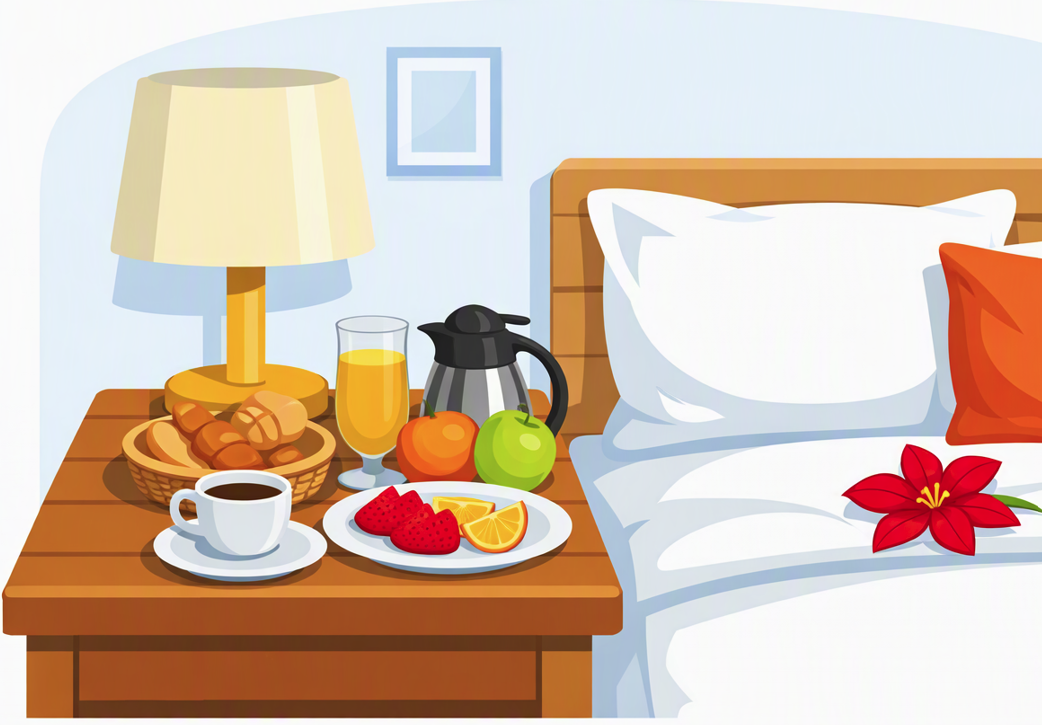
- There is some coffee in the cup.
- There is a cup of coffee next to the bread.
- There is a flower on the bed.
- There is a lamp next to the bed.
- There is some juice near the bread and the fruit.
- There aren’t any bananas on the plate.
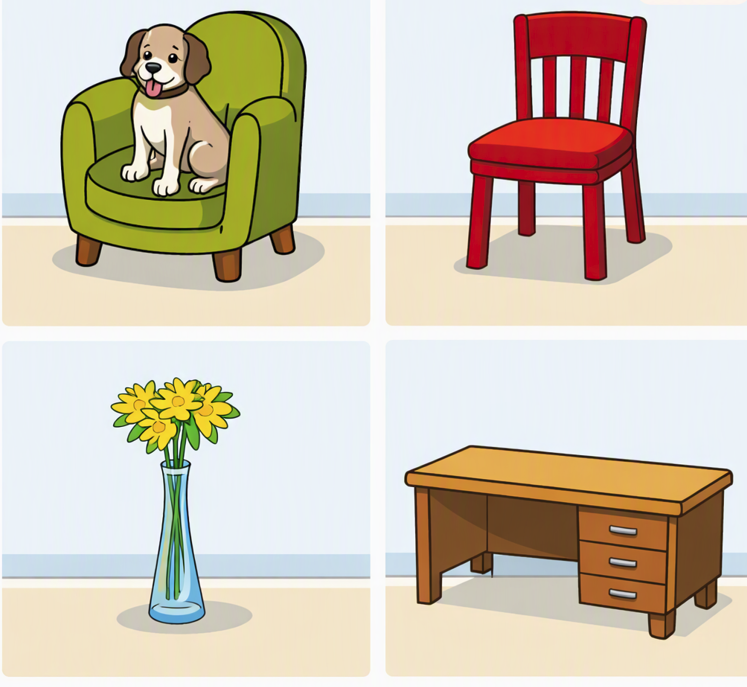
Yes, there is. (There is a dog on the armchair.)
No, there aren’t. (There aren’t any mice under the chair.)
No, there isn’t. (There isn’t a red flower in the vase.)
No, there aren’t. (There aren’t any books on my desk.)
Categories
A / AN / SOME / ANY
Klasa 5
🍎 1. A / AN – używamy z rzeczownikami policzalnymi w liczbie pojedynczej
A – przed wyrazami zaczynającymi się od spółgłoski
- a banana
- a sandwich
- a chocolate bar
- a bottle of water
AN – przed wyrazami zaczynającymi się od samogłoski (a, e, i, o, u)
- an apple
- an orange
- an egg
👉 Używamy, gdy mówimy o jednej rzeczy.
Przykłady:
- I have a banana.
- She wants an apple.
- He bought a bottle of water.
🥛 2. SOME – używamy w zdaniach twierdzących
Do rzeczy niepoliczalnych i policzalnych w liczbie mnogiej.
✔️ SOME + uncountable (niepoliczalne)
- some milk
- some water
- some juice
- some rice
- some pasta
✔️ SOME + countable plural (policzalne, liczba mnoga)
- some apples
- some bananas
- some biscuits
👉 Używamy, gdy mówimy, że czegoś jest trochę / jakieś.
Przykłady:
- There is some milk in the fridge.
- I have some apples in my bag.
- She bought some biscuits.
❓ 3. ANY – używamy w pytaniach i przeczeniach
✔️ ANY w pytaniach
- Do you have any apples?
- Is there any milk
- Are there any bananas
✔️ ANY w przeczeniach
- I don’t have any apples.
- There isn’t any milk.
- They don’t have any water.
👉 ANY = czy są jakieś / nie ma żadnych
🗣️ 4. Proste porównanie dla klasy 5
| Słowo | Kiedy używamy? | Przykład |
|---|---|---|
| a / an | jedna policzalna rzecz | a banana, an apple |
| some | twierdzenia: trochę, jakieś | some milk, some apples |
| any | pytania i przeczenia | any milk, any apples |
Categories
Countable and uncountable nouns
Klasa 5
🍎 1. Countable nouns (rzeczowniki policzalne)
To rzeczy, które możemy policzyć: 1, 2, 3…
- mają liczbę pojedynczą (one apple)
- mają liczbę mnogą (two apples)
- możemy używać a / an (a banana, an apple)
✔️ Przykłady z koszyka (policzalne):
- apple / apples
- banana / bananas
- carrot / carrots
- sandwich / sandwiches
- chocolate bar / chocolate bars
- bottle of water / bottles of water
- egg / eggs
- roll / rolls
👉 Możemy powiedzieć: three apples, a banana, two sandwiches, five eggs
🥛 2. Uncountable nouns (rzeczowniki niepoliczalne)
To rzeczy, których nie możemy policzyć pojedynczo. Nie mają liczby mnogiej. Nie używamy a / an.
✔️ Przykłady z koszyka (niepoliczalne):
- milk
- water
- juice
- rice
- pasta
- sugar
- flour
- honey
- jam
- ketchup
- mustard
- chocolate (jako masa, nie baton!)
👉 Nie mówimy: ❌ two milks ❌ a sugar
Mówimy: ✔️ some milk ✔️ some rice ✔️ a bottle of water (bo liczymy butelkę, nie wodę!) ✔️ a bar of chocolate (bo liczymy baton, nie czekoladę jako masę)
🧺 3. Jak łatwo rozpoznać?
Policzalne → to, co widzisz jako pojedyncze sztuki
🍎 apple, 🥚 egg, 🥖 roll, 🍌 banana
Niepoliczalne → to, co jest „masą”, „płynem”, „proszkiem”
🥛 milk, 💧 water, 🍚 rice, 🍝 pasta, 🍫 chocolate (masa)
Categories
Possessive adjectives
Klasa 5
Possessive Adjectives (przymiotniki dzierżawcze)
Possessive adjectives to słowa, które mówią, do kogo coś należy (czyj to przedmiot). W języku polskim odpowiadają np. “mój”, “twój”, “jego”, “jej”, “nasz”, “wasz”, “ich”.
Tabelka – zaimki osobowe i przymiotniki dzierżawcze
| I | my | mój / moja / moje |
| you | your | twój / twoja / twoje |
| he | his | jego |
| she | her | jej |
| it | its | jego / jej (o rzeczach / zwierzętach) |
| we | our | nasz / nasza / nasze |
| you (l.mn.) | your | wasz / wasza / wasze |
| they | their | ich |
Ważna zasada
Possessive adjective zawsze stoi przed rzeczownikiem – tak jak w polskim mówimy “mój pies”, tak po angielsku mówimy “my dog”.
⚠️ Uwaga: forma nie zmienia się w zależności od tego, czy rzeczownik jest w liczbie pojedynczej czy mnogiej:
- my dog (mój pies)
- my dogs (moje psy)
Przykłady zdań
- This is my book. – To jest moja książka.
- Is this your pencil? – Czy to jest twój ołówek?
- He loves his cat. – On kocha swojego kota.
- She is talking to her friend. – Ona rozmawia ze swoją przyjaciółką.
- The dog is wagging its tail. – Pies macha ogonem.
- We live in our house. – Mieszkamy w naszym domu.
- Is this your car? (do grupy) – Czy to jest wasz samochód?
- They are playing with their toys. – Oni bawią się swoimi zabawkami.
Częsty błąd uczniów
Dzieci często mylą:
- it’s (skrót od “it is”) ❌
- its (possessive – “jego/jej”) ✅
Przykład: The cat licks its paw. (Kot liże swoją łapę.) – bez apostrofu!
Categories
Preposition of place
Klasa 5
Categories
Question words
Klasa 5
Categories
People
Klasa 5
Categories
Countries and nationalities
Categories
Sport
Klasa 5
🟦 PLAY – używamy z grami zespołowymi i sportami z piłką
PLAY = gdy jest piłka, drużyna, mecz, boisko.
✔️
- basketball → play basketball
- volleyball → play volleyball
- football → play football
- baseball → play baseball
- tennis → play tennis (bo to gra, ma zasady, punkty, mecz)
👉
Jeśli możesz mieć drużynę albo mecz → PLAY.
🟩 GO – używamy z sportami zakończonymi na -ing
GO = gdy sport jest czynnością, ruchem, aktywnością fizyczną, zwykle kończy się na -ing.
✔️
- skiing → go skiing
- ice skating → go ice skating
- sailing → go sailing
- running → go running
- swimming → go swimming
- cycling → go cycling
- horse riding → go horse riding
👉
Jeśli kończy się na -ing → GO.
🟧 Super‑prosto
PLAY = gry z piłką i drużynowe
basketball, volleyball, football, baseball, tennis
GO = sporty z -ing
skiing, ice skating, sailing, running, swimming, cycling, horse riding
Categories
FOOD
Klasa 5
Categories
Free time
Klasa 5
Klasa 5
My house
There are six rooms in my house: a kitchen, a living room, a bathroom and three bedrooms.
In the kitchen there is a big table in the middle of the room. The fridge is next to the cooker and there are some cups on the shelf above the sink.
The living room is my favourite room. There is a sofa opposite the TV and a small table in front of the sofa. My cat often sleeps under the table. There are two pictures on the wall, between the window and the door.
My bedroom is small. There is a bed near the window and a desk behind the door. My schoolbag is on the floor beside the bed and my posters are on the wall.
The bathroom is at the end of the corridor.
Categories
The London Eye
Klasa 5
The London Eye is a big wheel in London. It stands next to the River Thames. It is very tall. People can ride in special glass capsules and see the city from above.
The wheel has 32 capsules. Each capsule can take many people. The London Eye moves slowly, so passengers can get on and off safely. One ride takes about 30 minutes.
The wheel looks like a big bicycle wheel. It was made by people from different European countries.
From the top, you can see the River Thames, the Houses of Parliament and other famous places in London. Many tourists visit the London Eye every year.
O czym jest tekst?
Tekst opisuje London Eye – bardzo duże koło w Londynie. Stoi obok rzeki Tamizy. Ludzie jeżdżą w szklanych kapsułach i oglądają miasto z góry. Przejażdżka trwa około 30 minut.
Słownictwo z tekstu
wheel – koło
capsule – kapsuła
river – rzeka
city – miasto
famous places – słynne miejsca
tourists – turyści
from above – z góry
slowly – powoli
Gramatyka w tekście
Present Simple – opis faktów
Tekst używa czasu Present Simple, bo opisuje stałe informacje:
- It is very tall.
- The wheel moves slowly.
- People can ride in capsules.
Kiedy używamy? Do opisywania faktów, miejsc, wyglądu, działania rzeczy.
„Can” – możliwości
Choć nie ma ich dosłownie, tekst opisuje rzeczy, które można łatwo wyrazić tymi strukturami:
- There is a big wheel in London.
- There are 32 capsules.
Trudności w wymowie
Słowa, które mogą sprawiać problem
- London – /ˈlʌndən/ (nie london po polsku)
- Eye – /aɪ/ (jak „aj”)
- Thames – /temz/ (nie czytamy „th” i „es”)
- capsule – /ˈkæpsjuːl/
- bicycle – /ˈbaɪsɪkəl/
- tourists – /ˈtʊərɪsts/
- famous – /ˈfeɪməs/
Na co uważać?
- „th” w Thames NIE brzmi jak „th” → czytamy temz.
- „Eye” to jedno długie aj.
- W „bicycle” nie czytamy „y” jako „y”, tylko aj.
Ważne informacje z tekstu
London Eye stoi obok rzeki Tamizy.
Ma 32 kapsuły.
Jedna przejażdżka trwa około 30 minut.
Koło porusza się powoli.
Z góry widać całe miasto i słynne miejsca.
To bardzo popularna atrakcja turystyczna.
EN Questions
1.What is the London Eye?
2.Where is it located?
3.What can people see from the top?
4.How long does one ride take?
5.How does the wheel move?
6.What are the capsules made of?
7.Why do tourists visit the London Eye?
8.What does the wheel look like?
9.How many capsules does it have?
10.Is it a popular place?
EN Answers
It is a big wheel in London.
It is next to the River Thames.
You can see the city and famous places.
It takes about 30 minutes.
It moves slowly.
They are made of glass.
Because they want to see London from above.
It looks like a big bicycle wheel.
It has 32 capsules.
Yes, it is very popular.
Categories
Destination (3)
Klasa 5 Wendy’s plans
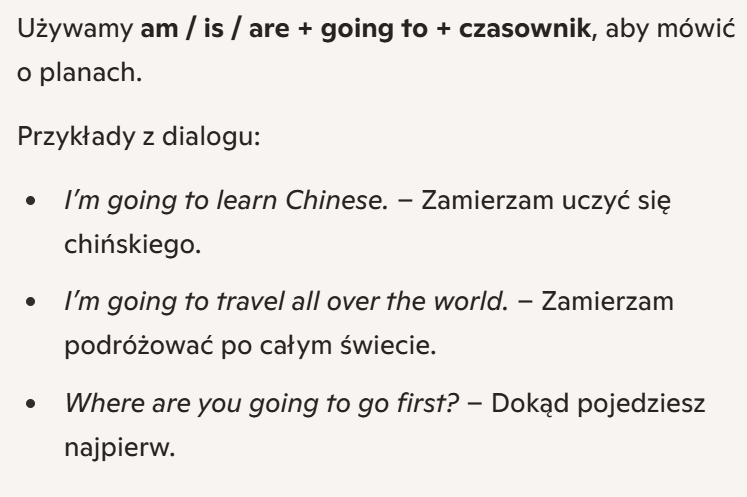
Wendy: When I grow up, Mum, I’m going to travel all over the world.
Mum: Where are you going to go first?
Mum: Well, how about going to Europe first? You’re learning French and German at school, so you can talk to people in France and Germany.
Wendy: I don’t know. I look at this globe every day but I don’t know where I’m going to start my journey!
Wendy: Good idea. But I’m going to learn Chinese too, so I can visit China!
Tłumaczenie
Wendy: Kiedy dorosnę, mamo, zamierzam podróżować po całym świecie.
Mum: Dokąd pojedziesz najpierw?
Mum: A może najpierw pojedziesz do Europy? Uczysz się francuskiego i niemieckiego, więc możesz rozmawiać z ludźmi we Francji i Niemczech.
Wendy: Nie wiem. Patrzę na ten globus codziennie, ale nie wiem, gdzie zacząć moją podróż.
Wendy: Dobry pomysł. Ale zamierzam też uczyć się chińskiego, żeby móc odwiedzić Chiny!
O czym jest dialog?
Useful words (ważne słowa)
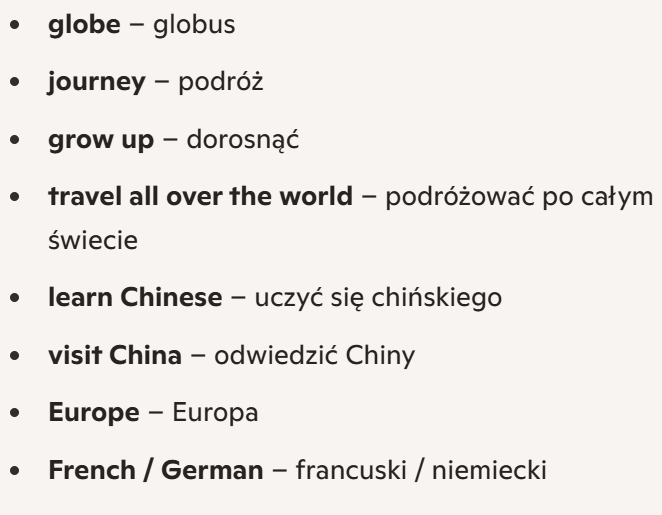
Present Continuous – plany na przyszłość
Categories
Destination (2)
Klasa 5
What is a destination?

Useful phrases
Grammar focus – going to (plany)
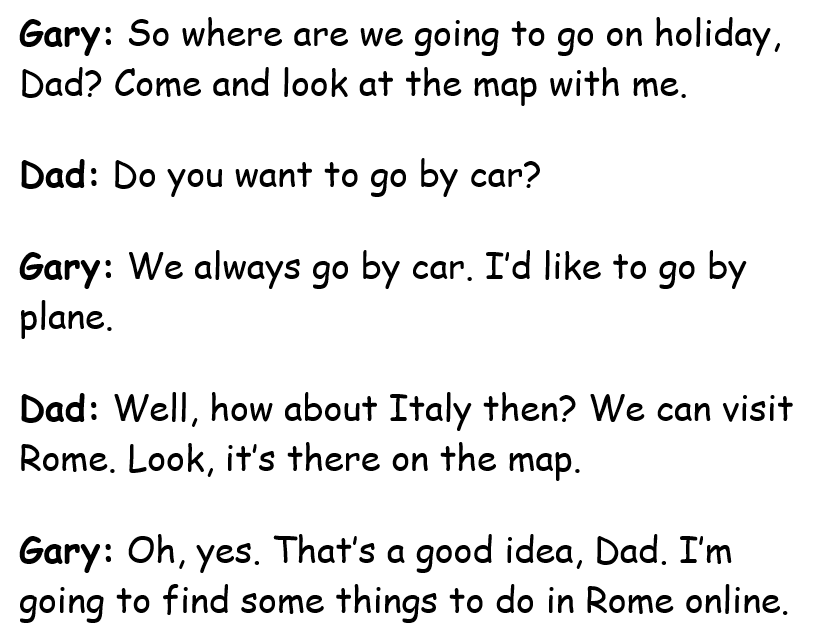
Mini‑dialog (z lekcji – uproszczony)
Vocabulary – miejsca i kierunki podróży
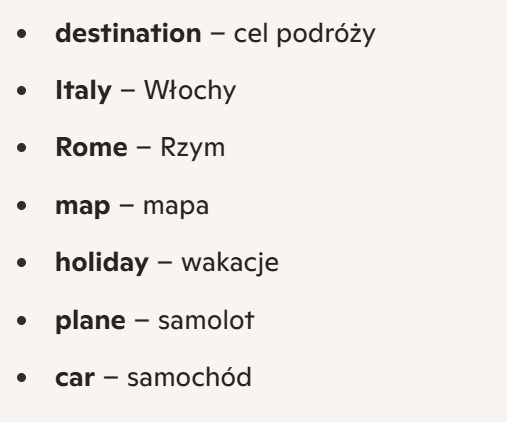
Krótkie wyrażenia językowe
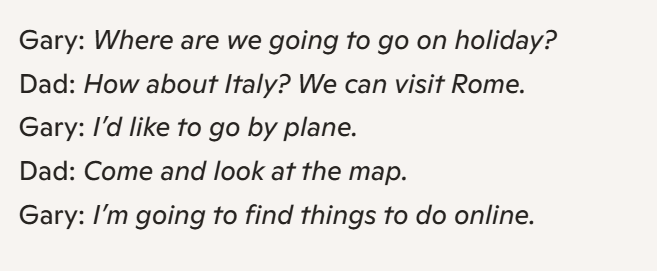
go on holiday – jechać na wakacje
go by car – jechać samochodem
go by plane – lecieć samolotem
look at the map – patrzeć na mapę
come and look – chodź i zobacz
how about Italy – a może Włochy
visit Rome – odwiedzić Rzym
find things to do – znaleźć rzeczy do zrobienia
on the map – na mapie
good idea – dobry pomysł
where are we going to go – dokąd pojedziemy
I’d like to – chciałbym
that’s a good idea – to dobry pomysł
go on a trip – jechać na wycieczkę
choose a destination – wybrać cel podróży
plan the holiday – planować wakacje
look online – szukać w internecie
travel to Italy – podróżować do Włoch
find a place – znaleźć miejsce
look at the map with me – popatrz na mapę ze mną
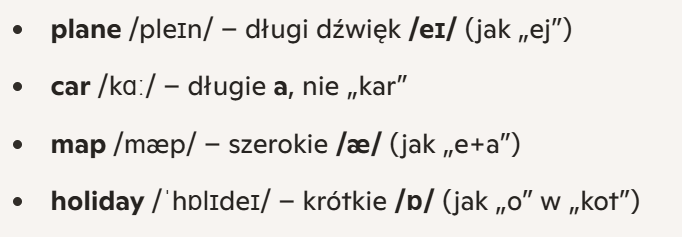
Trudności w wymowie
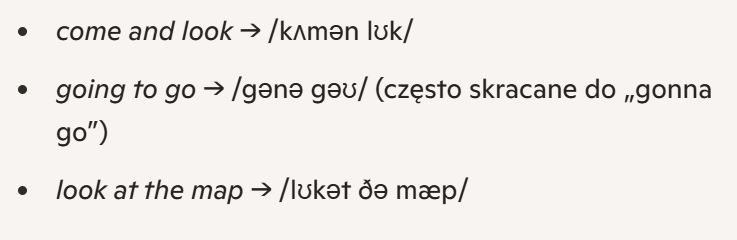
Łączenie wyrazów w mowie
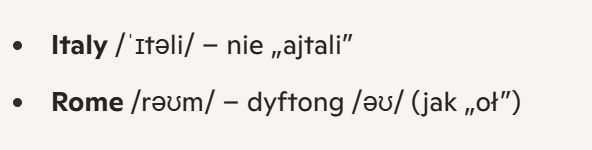
Nazwy własne
Categories
Destination (1)
Klasa 5
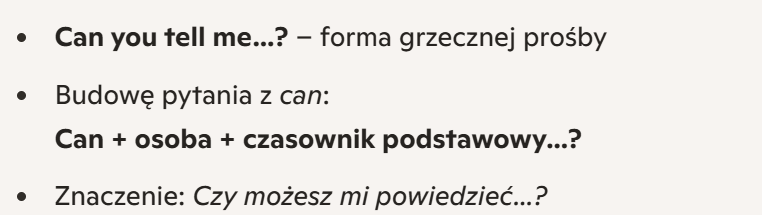
Girl: Excuse me. Can you tell me the way to the museum?
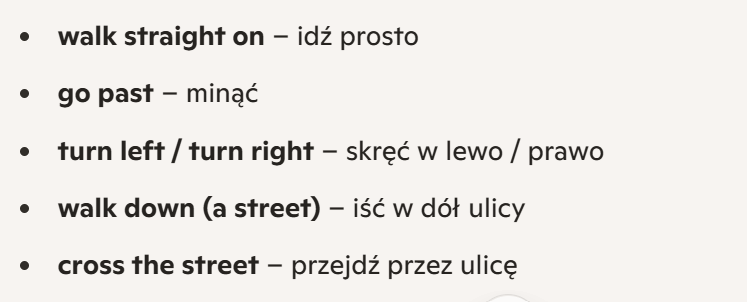
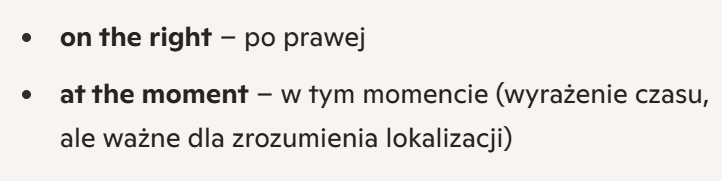
Woman: Of course. You are here at the moment. Walk straight on and go past the park. Then turn left and walk to the traffic lights and cross the street. Turn right and walk down North Street for about five minutes. The museum is on the right.
b. Trisha: Thank you!
Tłumaczenie
Dziewczyna: Przepraszam. Czy może mi pani powiedzieć, jak dojść do muzeum?
Kobieta: Oczywiście. Jesteś teraz tutaj. Idź prosto i minij park. Potem skręć w lewo i idź do świateł, a następnie przejdź przez ulicę. Skręć w prawo i idź w dół North Street przez około pięć minut. Muzeum jest po prawej stronie.
Dziewczyna: Dziękuję!
Can – pytania o możliwość / prośby o pomoc
Przyimki i wyrażenia kierunku (prepositions of movement)
Przyimki miejsca (prepositions of place)
Wyrażenia czasu i dystansu

Prosty czas teraźniejszy w instrukcjach (imperative)
Zaimki osobowe i podstawowe struktury
Categories
The Grand Canyon (2)
Klasa 5
Categories
Grand Canyon
This summer I’m going to travel around the USA with my family. We’re going to visit the Grand Canyon. I can’t wait!
Tego lata zamierzam podróżować po USA z moją rodziną. Zamierzamy odwiedzić Wielki Kanion. Nie mogę się doczekać!
The Grand Canyon is one of the world’s seven natural wonders. It’s a long deep valley of the Colorado River. It is in Arizona, in the USA. The canyon is 446 kilometres long and, in some places, it is two kilometres deep.
Wielki Kanion jest jednym z siedmiu cudów natury na świecie. To długa, głęboka dolina rzeki Kolorado. Znajduje się w Arizonie, w USA. Kanion ma 446 kilometrów długości, a w niektórych miejscach ma dwa kilometry głębokości.

The view from the top of the canyon is amazing. There is a glass bridge called Skywalk and you can walk on it and look down and see the bottom of the canyon under you. The rocks have got beautiful colours there. Some visitors like hiking and explore the canyon on foot and others go down the river by boat. You can even go rafting on the river.
Widok ze szczytu kanionu jest niesamowity. Jest tam szklany most o nazwie Skywalk i możesz po nim chodzić oraz spojrzeć w dół, żeby zobaczyć dno kanionu pod sobą. Skały mają tam piękne kolory. Niektórzy odwiedzający lubią wędrować i zwiedzać kanion pieszo, a inni spływają w dół rzeki łodzią. Można nawet popłynąć pontonem (rafting).
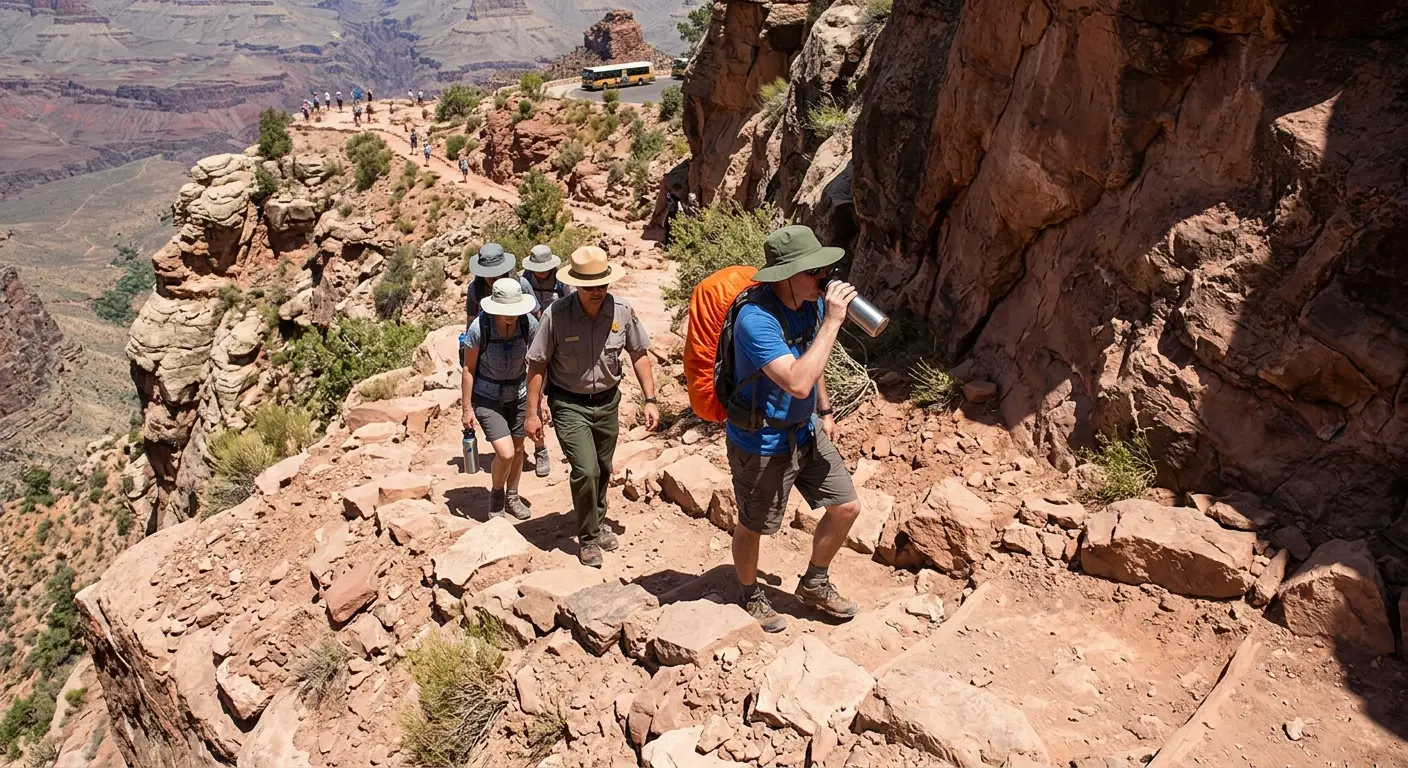
About four million people visit the Grand Canyon every year. But you must be careful there. It is a dangerous place because the rocks are very hard to climb. Also the sun is very hot in the canyon, and there is not a lot of shade. You have to take a bottle of water with you and a hat.
Około czterech milionów ludzi odwiedza Wielki Kanion każdego roku. Ale trzeba tam uważać. To niebezpieczne miejsce, ponieważ skały są bardzo trudne do wspinania. Słońce w kanionie jest też bardzo gorące, a cienia jest niewiele. Trzeba zabrać ze sobą butelkę wody i kapelusz.
Pytania
Where is the Grand Canyon?
It is in Arizona, in the USA.
How long is the Grand Canyon?
It is 446 kilometres long.
How deep is the canyon in some places?
It is two kilometres deep.
What is the Skywalk?
It is a glass bridge where you can look down and see the bottom.
What can visitors do in the Grand Canyon?
They can hike, explore on foot, go by boat, or go rafting.
How many people visit the Grand Canyon every year?
About four million people.
Why must visitors be careful?
Because the rocks are hard to climb and the sun is very hot.
What should visitors take with them?
A bottle of water and a hat.
Klasa 5
Present Simple vs Present Continuous
Poniżej znajdziesz rozszerzone wyjaśnienia, przykłady, tłumaczenia i uzasadnienia.
1. Present Simple – kiedy używamy?
Używamy Present Simple, gdy mówimy o czynnościach stałych, rutynowych, powtarzających się lub o faktach.
Pokaż przykłady
I get up at 7 o’clock. – Wstaję o 7.
Uzasadnienie: codzienna rutyna.
She plays tennis every weekend. – Ona gra w tenisa w każdy weekend.
Uzasadnienie: czynność regularna, powtarzalna.
They live in London. – Oni mieszkają w Londynie.
Uzasadnienie: stały fakt, nie tymczasowy.
The sun rises in the east. – Słońce wschodzi na wschodzie.
Uzasadnienie: fakt naukowy.
We often watch films. – Często oglądamy filmy.
Uzasadnienie: częstotliwość → Present Simple.
2. Present Continuous – kiedy używamy?
Używamy Present Continuous, gdy mówimy o czynnościach dziejących się teraz, sytuacjach tymczasowych lub planach na najbliższą przyszłość.
Pokaż przykłady
I am reading now. – Czytam teraz.
Uzasadnienie: czynność trwa w tej chwili.
She is staying with her aunt this week. – Ona mieszka u cioci w tym tygodniu.
Uzasadnienie: sytuacja tymczasowa.
We are meeting after school. – Spotykamy się po szkole.
Uzasadnienie: ustalony plan na najbliższą przyszłość.
They are working on a project today. – Oni pracują dziś nad projektem.
Uzasadnienie: jednorazowa sytuacja.
He is eating his lunch. – On je swój lunch.
Uzasadnienie: czynność w trakcie.
3. Jak odróżnić oba czasy?
Najprostsza zasada: czy czynność jest stała, czy tymczasowa?
Pokaż przykłady
She works in a school. – Ona pracuje w szkole.
Uzasadnienie: stała praca → Present Simple.
She is working in a café this month. – Ona pracuje w kawiarni w tym miesiącu.
Uzasadnienie: praca tymczasowa → Present Continuous.
I live in Gdańsk. – Mieszkam w Gdańsku.
Uzasadnienie: stałe miejsce zamieszkania → Present Simple.
I am living with my friend for a few weeks. – Mieszkam u kolegi przez kilka tygodni.
Uzasadnienie: sytuacja przejściowa → Present Continuous.
He usually walks to school. – On zwykle chodzi do szkoły pieszo.
Uzasadnienie: nawyk → Present Simple.
He is walking to school today. – On idzie dziś pieszo do szkoły.
Uzasadnienie: wyjątkowa sytuacja → Present Continuous.
4. Typowe wyrażenia
Pokaż listę
Present Simple:
always, usually, often, sometimes, never, every day/week, on Mondays
Present Continuous:
now, right now, at the moment, today, this week
5. Krótka ściąga
Pokaż ściągę
Present Simple: rutyna, fakty, nawyki.
Present Continuous: teraz, tymczasowo, plany bliskie.
Simple = stałe
Continuous = w trakcie / tymczasowe
Categories
Present Continuous – klasa 5
Kiedy używamy Present Continuous?
Poniżej znajdziesz rozszerzone wyjaśnienia z przykładami, tłumaczeniem i uzasadnieniem.
1. Czynności dziejące się teraz, w tej chwili
Używamy Present Continuous, gdy czynność trwa dokładnie w momencie mówienia. Typowe wyrażenia: now, at the moment, right now.
Pokaż przykłady
I am reading now. – Czytam teraz.
Uzasadnienie: czynność odbywa się w tej chwili.
She is talking on the phone. – Ona rozmawia przez telefon.
Uzasadnienie: widzimy ją w trakcie rozmowy.
They are playing football at the moment. – Oni grają teraz w piłkę.
Uzasadnienie: wyrażenie „at the moment” wskazuje na „teraz”.
We are doing homework right now. – Robimy teraz pracę domową.
Uzasadnienie: „right now” to sygnał czasu ciągłego.
He is eating his lunch. – On je swój lunch.
Uzasadnienie: czynność trwa w momencie mówienia.
2. Sytuacje tymczasowe
Używamy Present Continuous, gdy mówimy o czymś, co trwa przez krótki okres, ale nie jest stałe. Typowe wyrażenia: this week, these days, today, this month.
Pokaż przykłady
She is staying with her aunt this week. – Ona mieszka u cioci w tym tygodniu.
Uzasadnienie: sytuacja przejściowa, tylko na tydzień.
I am living in Warsaw for a few months. – Mieszkam w Warszawie przez kilka miesięcy.
Uzasadnienie: pobyt jest czasowy, nie na stałe.
They are working on a school project these days. – Oni pracują nad projektem w ostatnich dniach.
Uzasadnienie: projekt trwa tylko przez pewien okres.
We are learning about animals this month. – Uczymy się o zwierzętach w tym miesiącu.
Uzasadnienie: temat lekcji jest tymczasowy.
He is studying at his friend’s house today. – On uczy się dziś u kolegi.
Uzasadnienie: wyjątkowa, jednorazowa sytuacja.
3. Plany na najbliższą przyszłość
Używamy Present Continuous, gdy mówimy o konkretnych, ustalonych planach na niedaleką przyszłość. Typowe wyrażenia: tomorrow, tonight, next week, this afternoon.
Pokaż przykłady
We are meeting after school. – Spotykamy się po szkole.
Uzasadnienie: plan jest ustalony – wiadomo kiedy i z kim.
I am visiting my grandparents tomorrow. – Jutro odwiedzam dziadków.
Uzasadnienie: jest data i konkretne ustalenie.
She is having a piano lesson this afternoon. – Ona ma lekcję pianina dziś po południu.
Uzasadnienie: zaplanowane wydarzenie.
They are travelling to Kraków next weekend. – Oni jadą do Krakowa w następny weekend.
Uzasadnienie: podróż jest zaplanowana.
He is meeting his friends tonight. – On spotyka się dziś wieczorem z przyjaciółmi.
Uzasadnienie: konkretne ustalenie na dziś.
Categories
Be going to
Klasa 5
Be going to – kiedy używamy?
Poniżej znajdziesz rozszerzone wyjaśnienia z przykładami, tłumaczeniem i uzasadnieniem.
1. Plany na przyszłość
Używamy „be going to”, gdy mówimy o planach, które już podjęliśmy. Decyzja została podjęta wcześniej.
Pokaż przykłady
I am going to visit my cousin. – Zamierzam odwiedzić kuzyna.
Uzasadnienie: plan został wcześniej ustalony.
She is going to buy a new bike. – Ona zamierza kupić nowy rower.
Uzasadnienie: decyzja już zapadła.
We are going to clean the house this evening. – Zamierzamy posprzątać dom dziś wieczorem.
Uzasadnienie: zaplanowana czynność.
They are going to start a new project. – Oni zamierzają rozpocząć nowy projekt.
Uzasadnienie: plan jest ustalony.
He is going to learn Spanish. – On zamierza uczyć się hiszpańskiego.
Uzasadnienie: świadoma decyzja o przyszłości.
2. Zamiary – coś, co chcemy zrobić
Używamy „be going to”, gdy mówimy o intencjach – o tym, co ktoś planuje lub chce zrobić.
Pokaż przykłady
I am going to help you. – Zamierzam ci pomóc.
Uzasadnienie: wyrażenie zamiaru.
She is going to start exercising. – Ona zamierza zacząć ćwiczyć.
Uzasadnienie: mówi o swoim planie i chęci.
We are going to cook dinner together. – Zamierzamy ugotować razem obiad.
Uzasadnienie: wspólny zamiar.
They are going to visit us soon. – Oni zamierzają nas wkrótce odwiedzić.
Uzasadnienie: intencja odwiedzin.
He is going to read more books. – On zamierza czytać więcej książek.
Uzasadnienie: osobisty zamiar.
3. Przewidywania oparte na dowodach
Używamy „be going to”, gdy przewidujemy przyszłość, bo widzimy oznaki lub mamy dowody.
Pokaż przykłady
Look at the clouds! It is going to rain. – Spójrz na chmury! Będzie padać.
Uzasadnienie: widać oznaki deszczu.
Be careful! You are going to fall. – Uważaj! Zaraz upadniesz.
Uzasadnienie: sytuacja wskazuje na upadek.
He is going to crash the bike! – On zaraz się przewróci na rowerze!
Uzasadnienie: widzimy, że traci równowagę.
That glass is going to break. – Ta szklanka zaraz się stłucze.
Uzasadnienie: stoi na krawędzi stołu.
The team is going to win. – Drużyna wygra.
Uzasadnienie: grają bardzo dobrze i prowadzą.
Categories
The Gold Horn of Good Fortune
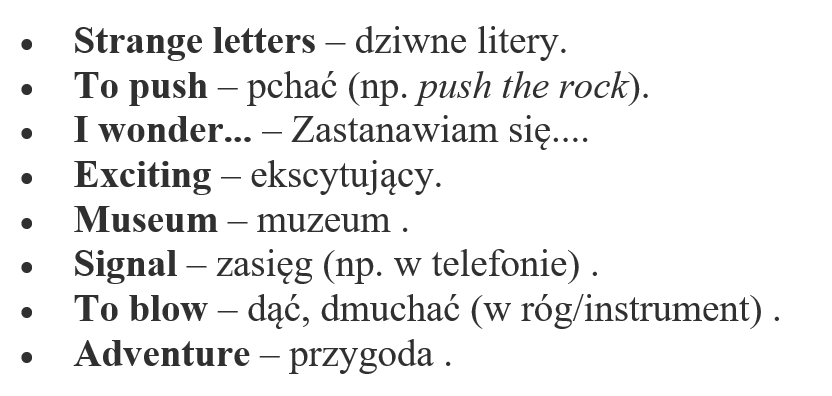
1. 🔍 Trudne wyrazy i zwroty
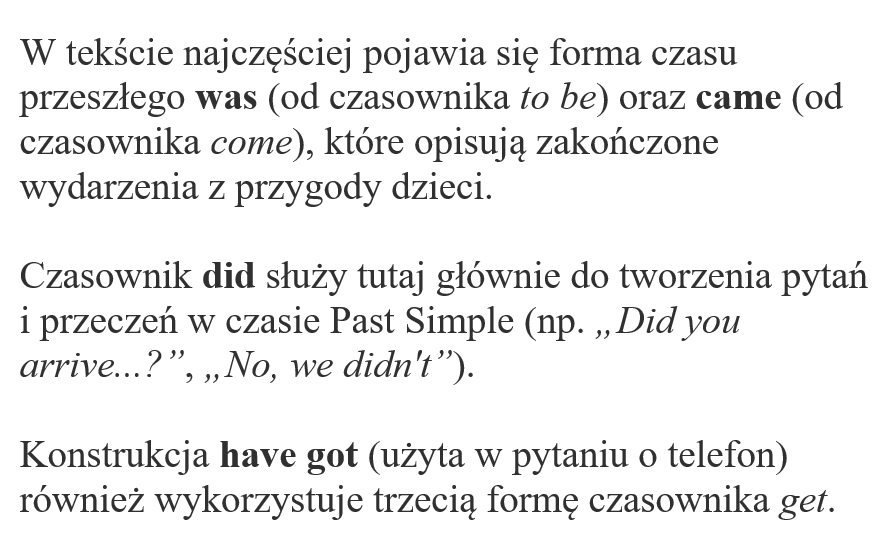
2. ⚙️ Zagadnienia z gramatyki
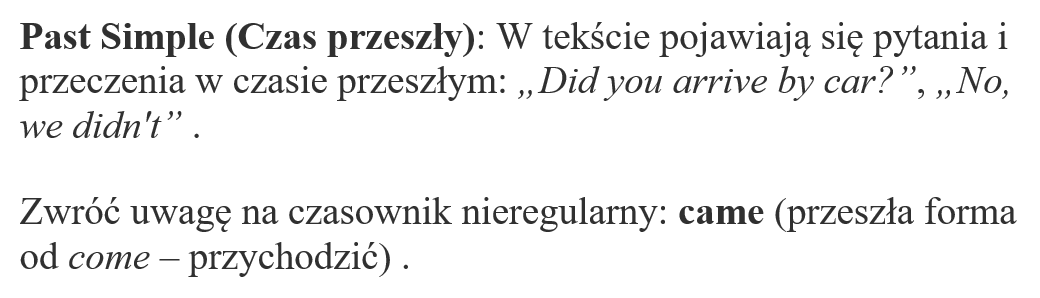



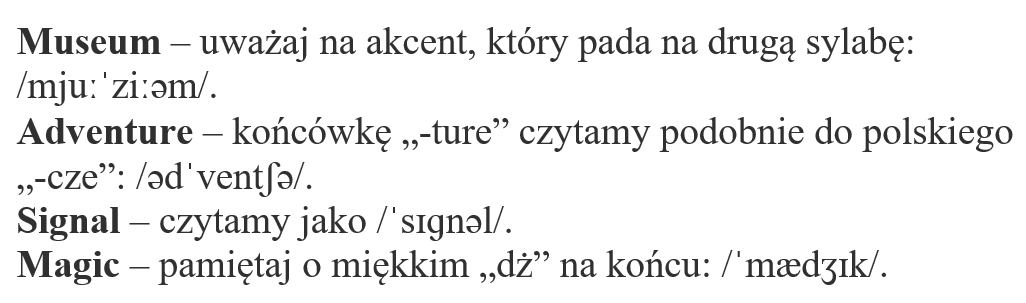
3. 🗣️ Trudności z wymową
4. ✨ Inne ciekawe aspekty


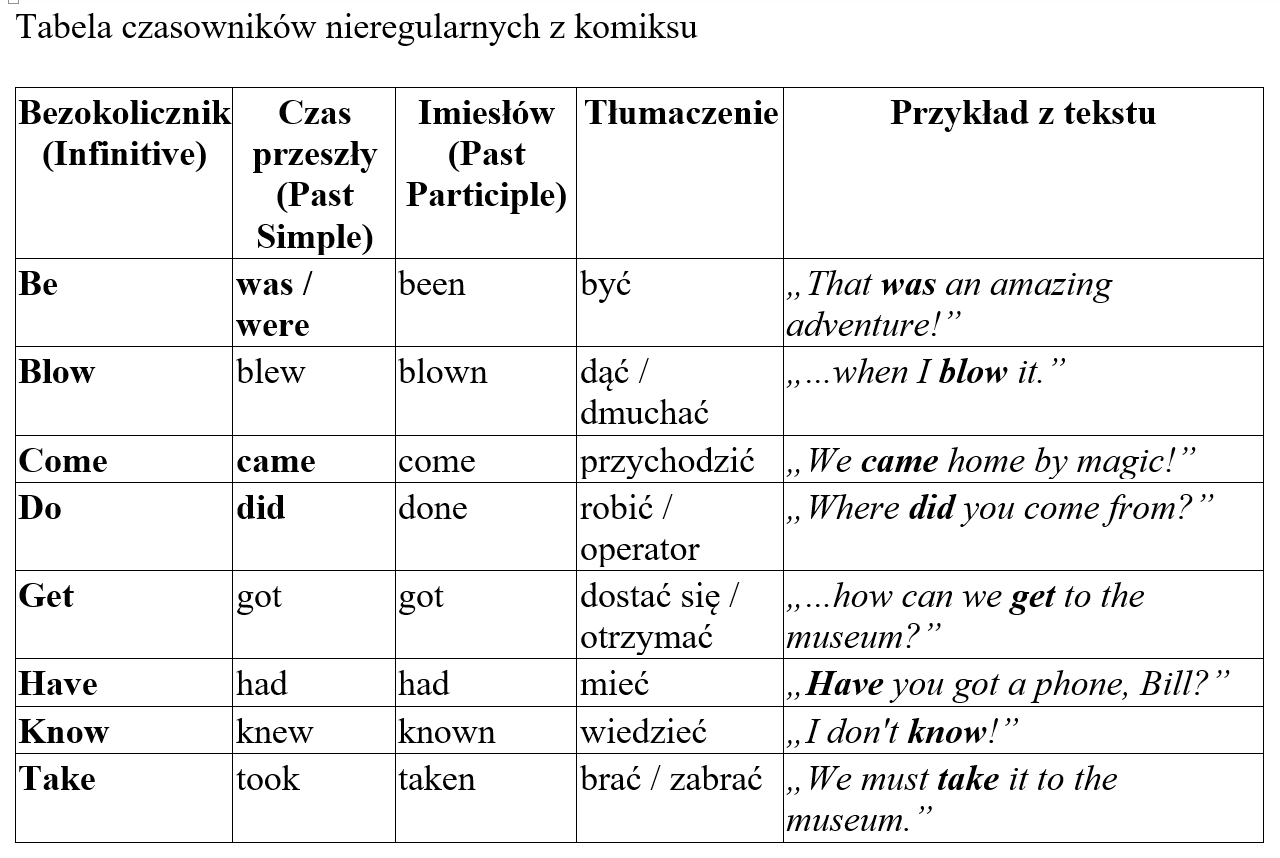
Warto zapamiętać:
The Gold Horn of Good Fortune – Full Quiz
Sprawdź swoją wiedzę z lekcji!
Categories
Test Unit 7
Klasa 5
PRACA KLASOWA: DZIAŁ 7 (GRUPA DEMONSTRACYJNA)
Czas: 30 minut | Maksymalna liczba punktów: 20
1. Wybierz poprawną nazwę sportu (3 pkt)
- a) You use a sail and a board for: A. windsurfing / B. go-karting / C. parachuting
- b) You need water and an oar for: A. rock climbing / B. rafting / C. show jumping
- c) You use a board to slide down a slope in: A. sailing / B. snowboarding / C. tennis
2. Dopasuj wyrażenia do ich znaczeń (3 pkt)
1. feel over the moon ___
2. join a club ___
3. take part in ___
A. brać udział w zawodach | B. być bardzo szczęśliwym | C. zapisać się do klubu
3. Napisz podane liczebniki porządkowe słowami (3 pkt)
- 4th – ……………………………………..
- 9th – ……………………………………..
- 22nd – …………………………………….
4. Wstaw czasownik w nawiasie w formie Past Simple (4 pkt)
- a) I ……………….. (feel) a bit scared yesterday.
- b) We ……………….. (buy) new equipment last week.
- c) He ……………….. (drink) some mint tea.
- d) They ……………….. (take) some pills and felt better.
5. Czy podane zdania są prawdziwe (True) czy fałszywe (False)? (4 pkt)
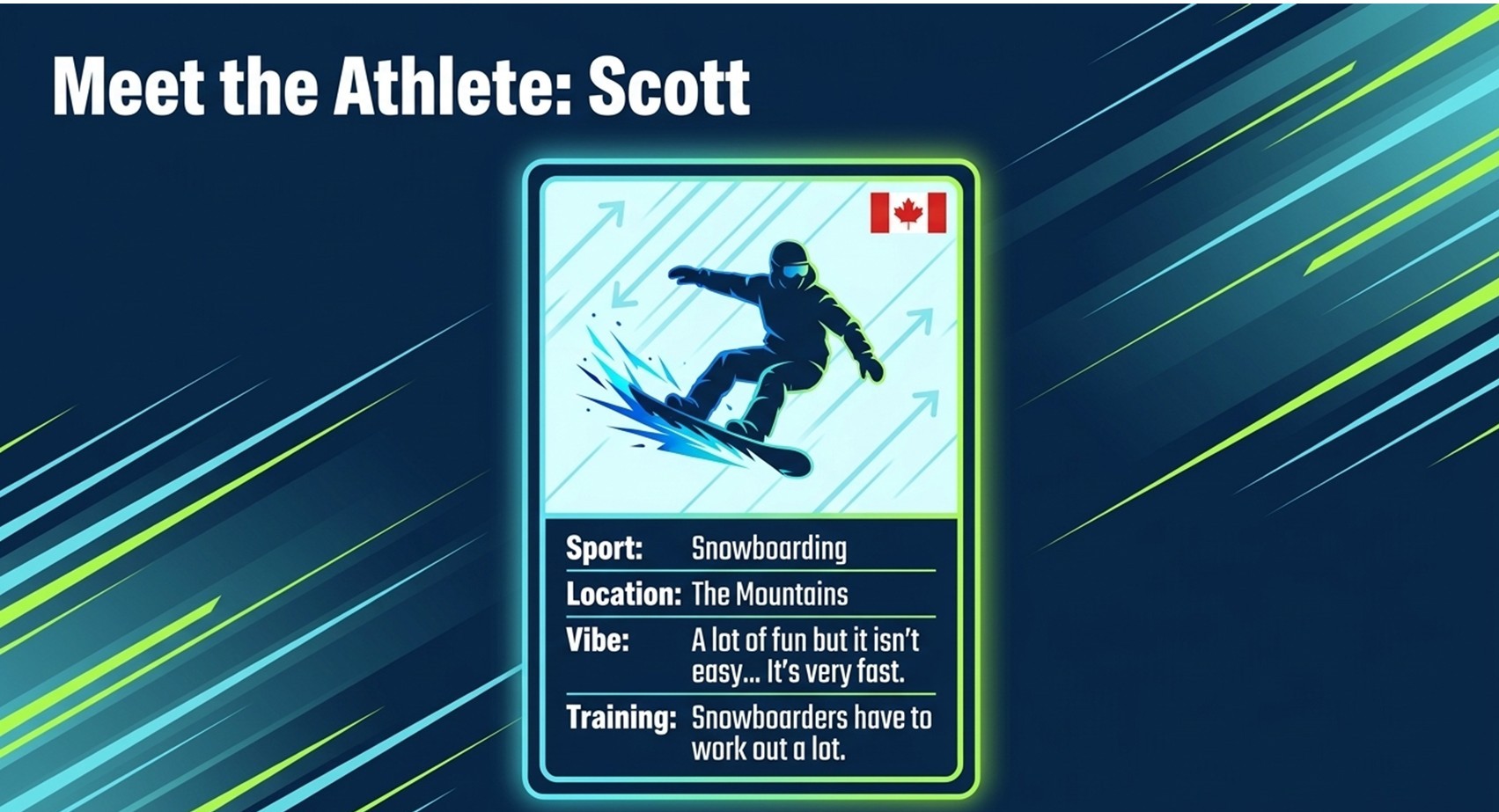
| a) Scott is from Canada and likes snowboarding. | T/F |
| b) Joanne was 10 when she had her first climb outdoors. | T/F |
| c) In tennis, the ball can bounce three times. | T/F |
| d) Mickey found a secret path behind the waterfall. | T/F |
6. Ułóż pytania z rozsypanych wyrazów (3 pkt)
- a) you / did / see / Who / yesterday?
_________________________________________ - b) What / eat / they / did / for lunch?
_________________________________________ - c) did / Where / go / she?
_________________________________________
ZADANIE DLA CHĘTNYCH (+2 pkt): Napisz po angielsku, jak nazywa się sprzęt zabezpieczający (uprząż), którego używa Joanne podczas wspinaczki.
Odpowiedź: ……………………………………………
Odpowiedź: ……………………………………………
KLUCZ ODPOWIEDZI: GRUPA DEMONSTRACYJNA (E)
Sprawdź swoje odpowiedzi i policz punkty! Za każdą poprawną odpowiedź otrzymujesz 1 punkt.
1. Nazwy sportów (3 pkt)
- a) A (windsurfing) [żagiel + deska]
- b) B (rafting) [ponton + wiosło]
- c) B (snowboarding) [deska + stok]
2. Wyrażenia i idiomy (3 pkt)
- 1 — B (feel over the moon — być bardzo szczęśliwym)
- 2 — C (join a club — zapisać się do klubu)
- 3 — A (take part in — brać udział w)
3. Liczebniki porządkowe (3 pkt)
- 4th: fourth
- 9th: ninth
- 22nd: twenty-second
4. Czasowniki Past Simple (4 pkt)
- a) felt
- b) bought
- c) drank
- d) took
5. Prawda czy Fałsz? (4 pkt)
- a) True (Scott pochodzi z Kanady i lubi snowboard)
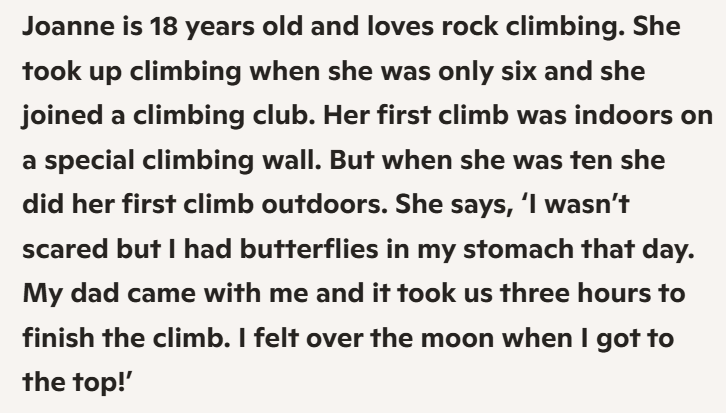
- b) True (Joanne wspinała się na zewnątrz po raz pierwszy w wieku 10 lat)
- c) False (W tenisie piłka może odbić się tylko raz)
- d) False (To Susie znalazła ścieżkę, a nie Mickey)
6. Układanie pytań (3 pkt)
- a) Who did you see yesterday?
- b) What did they eat for lunch?
- c) Where did she go?
ROZWIĄZANIE ZADANIA DLA CHĘTNYCH:
Sprzęt zabezpieczający używany przez Joanne to: harness (uprząż).
Sprzęt zabezpieczający używany przez Joanne to: harness (uprząż).
Twoja punktacja:
20 pkt: 6 | 18-19 pkt: 5 | 15-17 pkt: 4 | 11-14 pkt: 3 | 7-10 pkt: 2
Categories
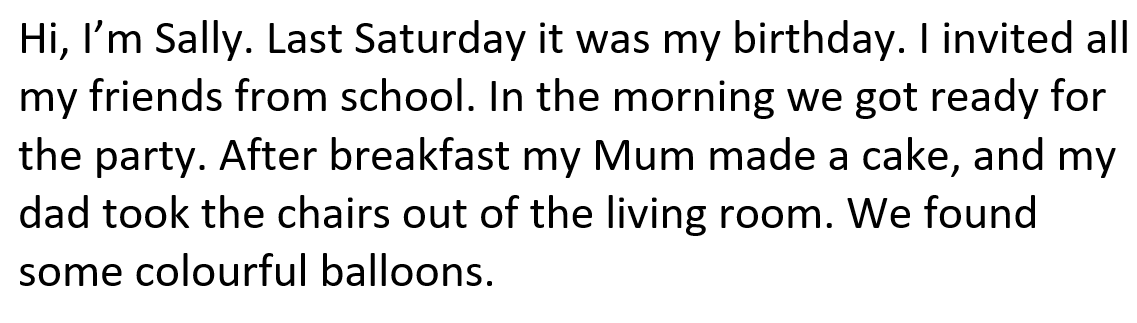
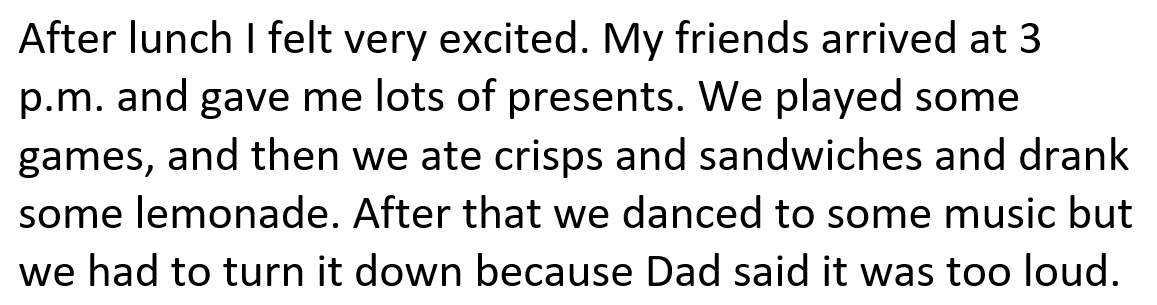
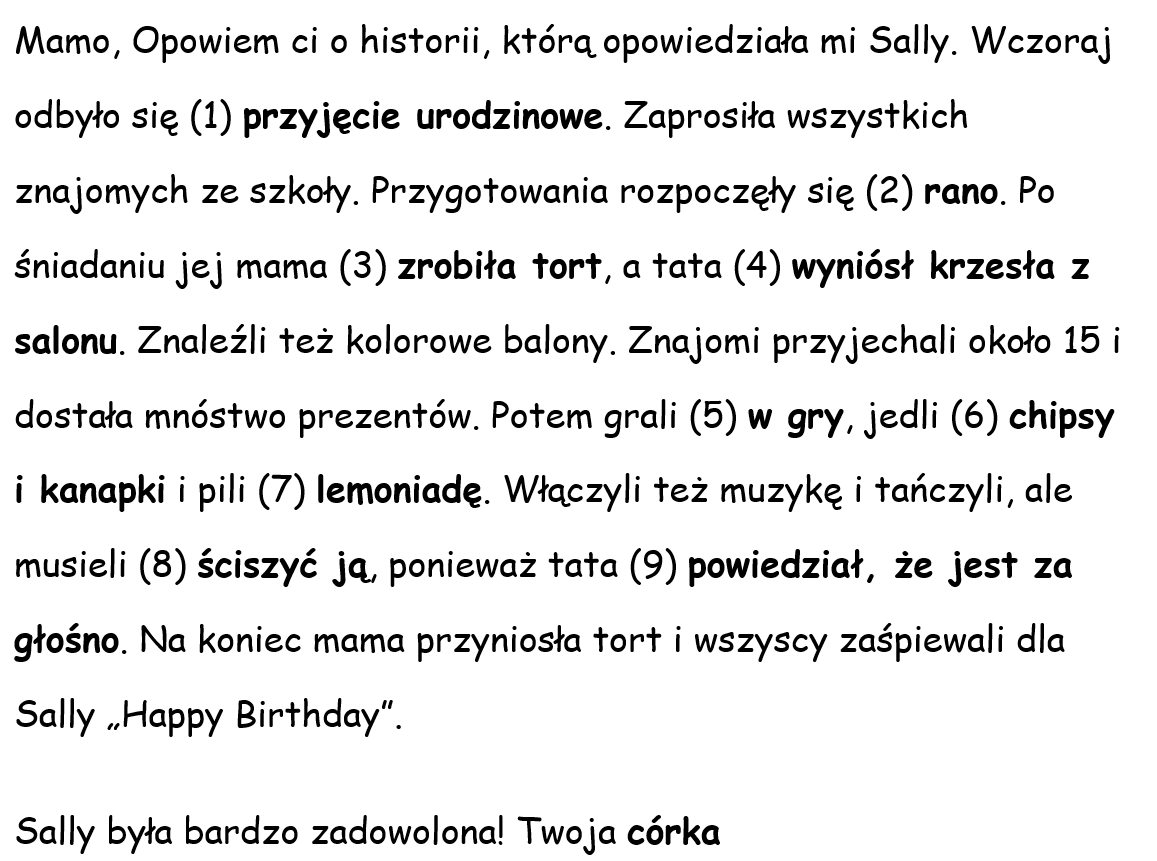
Sally’s Birthday

1. Krótkie streszczenie
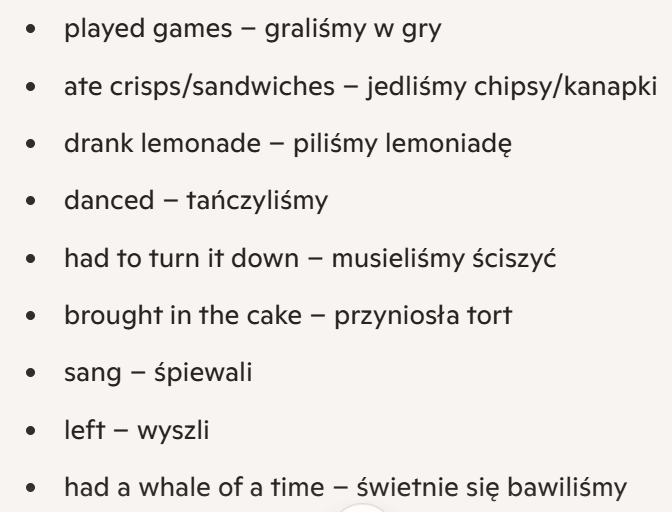
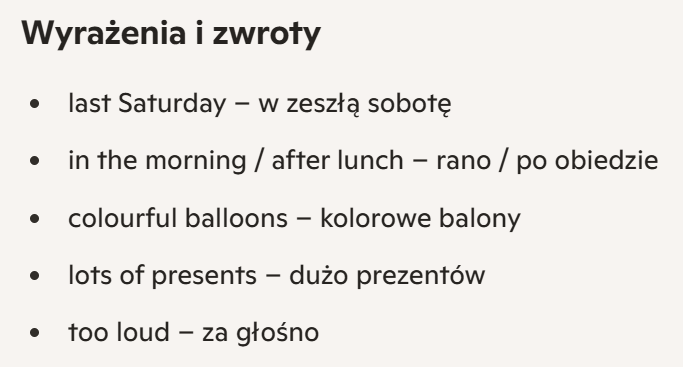
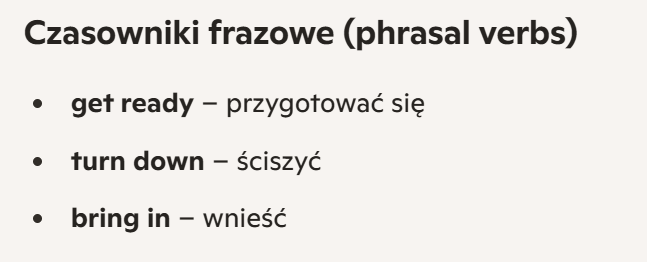
Słownictwo – najważniejsze wyrażenia z tekstu
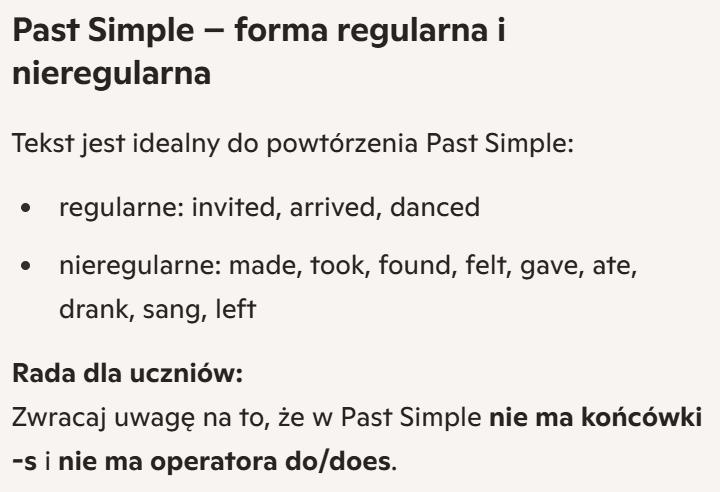
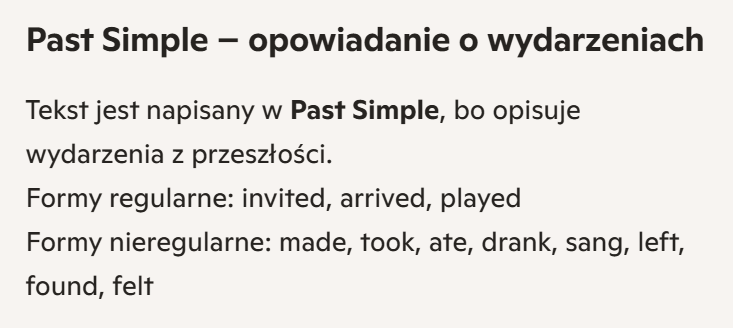
Gramatyka
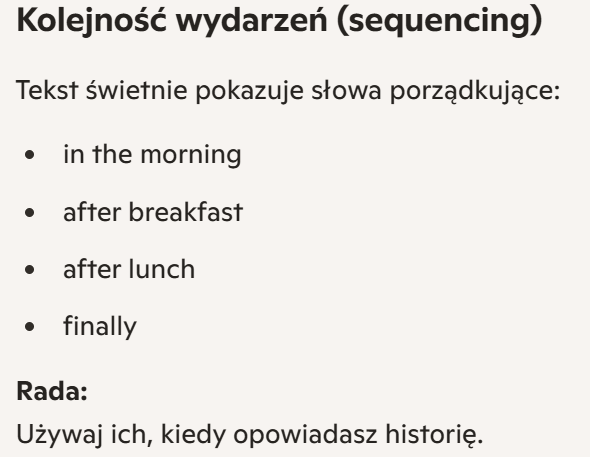
Kolejność wydarzeń (sequencing)
Trudniejsze słowa
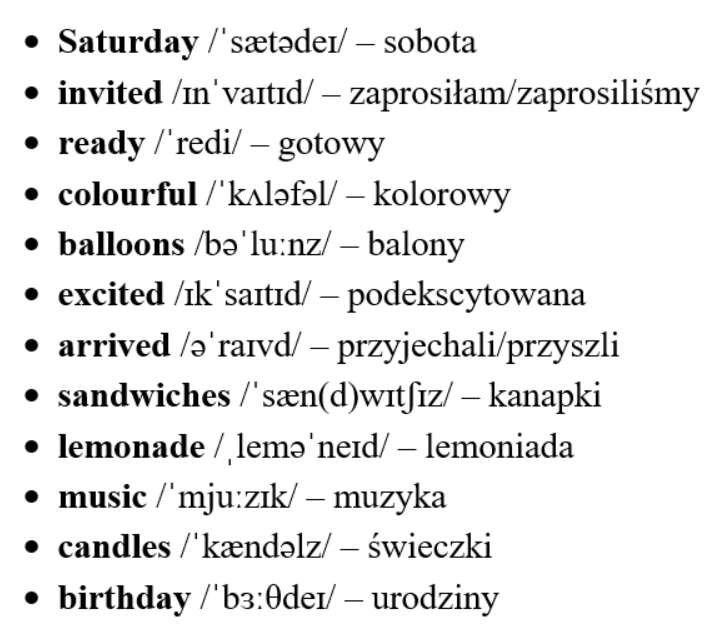
Wymowa
Klasa 5
Categories
TEST YOURSELF 7
Klasa 5
Zadanie 1
Zadanie 2
Zadanie 2
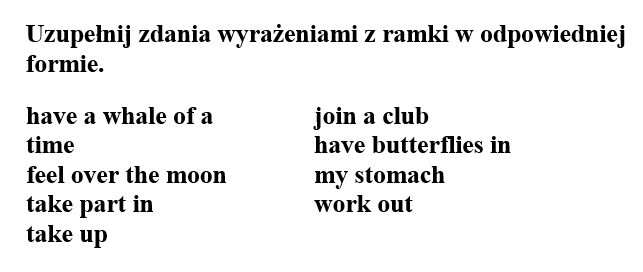
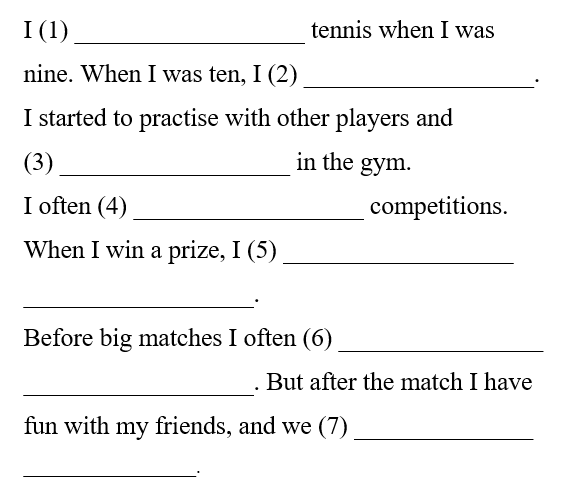
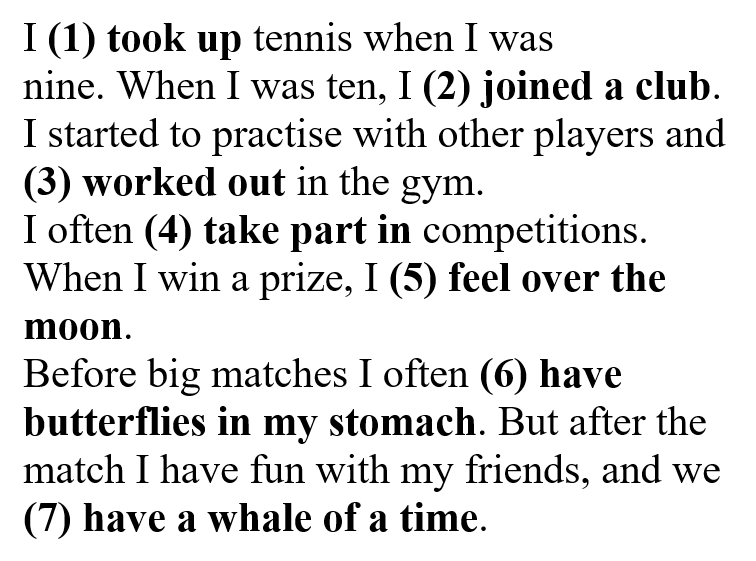
Jak opowiadać o pasjach i emocjach? Wskazówki do ćwiczenia
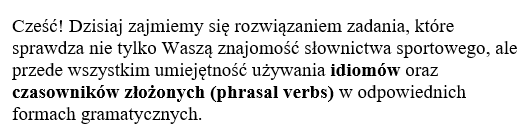
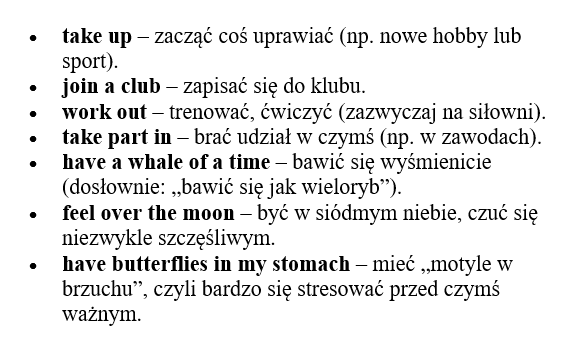
1. Kluczowe słownictwo i idiomy
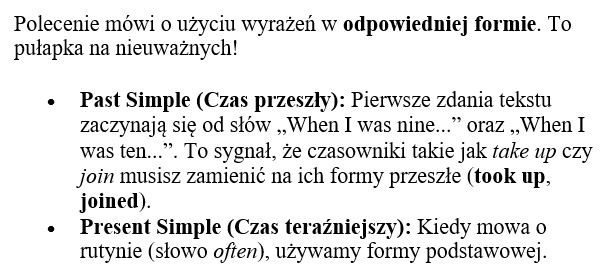
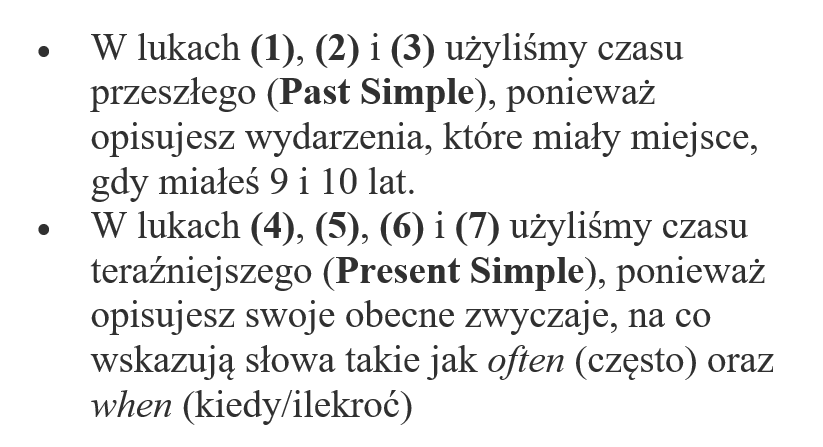
2. Gramatyka: Zwróć uwagę na czas!
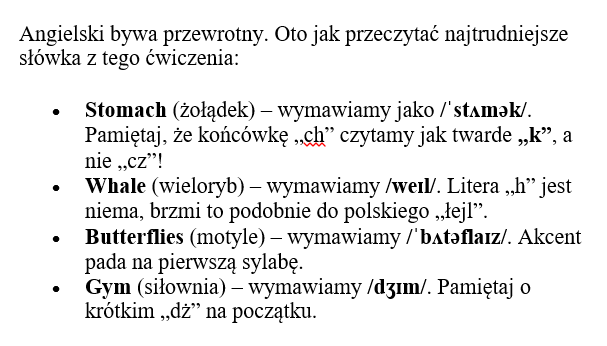
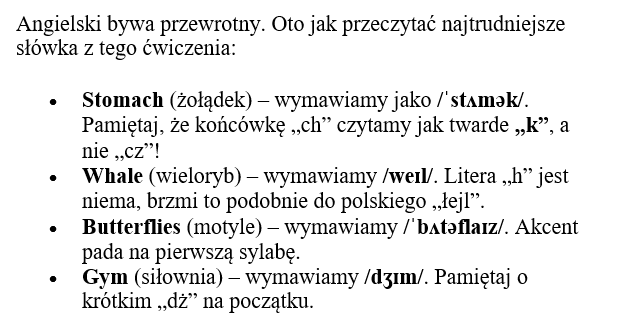
3. Wymowa trudnych wyrazów
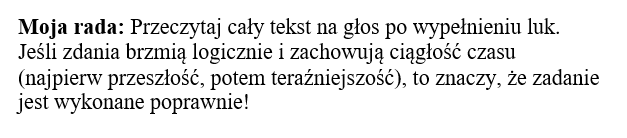
Moja rada
Odpowiedź
Zadanie 3
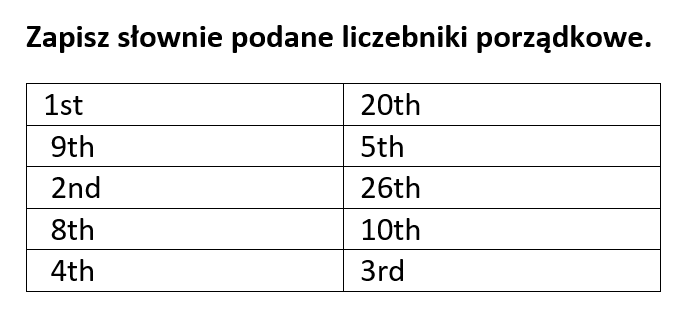
Zadanie 4
Zadanie 5
I did my homework last night.
I didn’t do my homework last night.
I went to the park yesterday.
I didn’t go to the park yesterday.
I bought a new pair of trainers last week.
I didn’t buy a new pair of trainers last week.
I saw Star Wars last weekend.
I didn’t see Star Wars last weekend.
I found a small kitten last month.
I didn’t find a small kitten last month.
I swam in a lake last summer.
I didn’t swim in a lake last summer.
Zadanie 6
| początek pytania | czynność | wyrażenie czasu |
| Did you Did your mum Did your best friend Did your friends | go on holiday visit your grandparents do your homework play football | yesterday on Saturday last night last summer |
Zadanie 7
Zadanie 8
1. I ate an apple yesterday. HAD
I had an apple yesterday.
2. I started snowboarding last winter. TOOK UP
I took up snowboarding last winter.
3. Did you fly to a different country last year? ABROAD
Did you fly abroad last year?
4. I felt happy this morning. SAD
I didn’t feel sad this morning.
Zadanie 9

Słówka i zwroty z tekstu
Aspekty gramatyczne
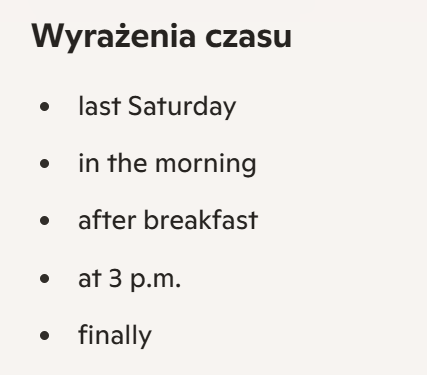

Odpowiedź
Categories
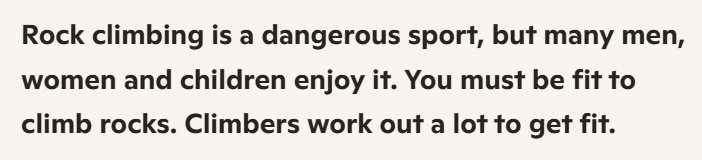
Rock climbing
Klasa 5
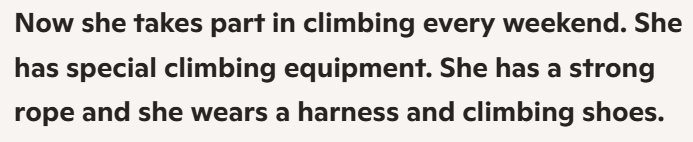
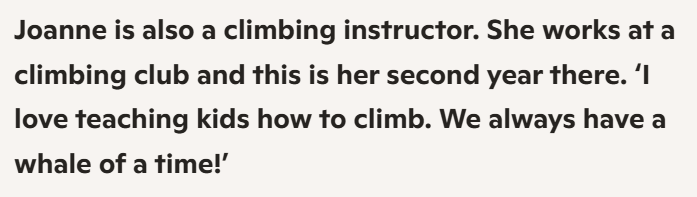
Pytanie:
Odpowiedź:
Categories
Klasa 5 Sports rules
The sport zone

Categories
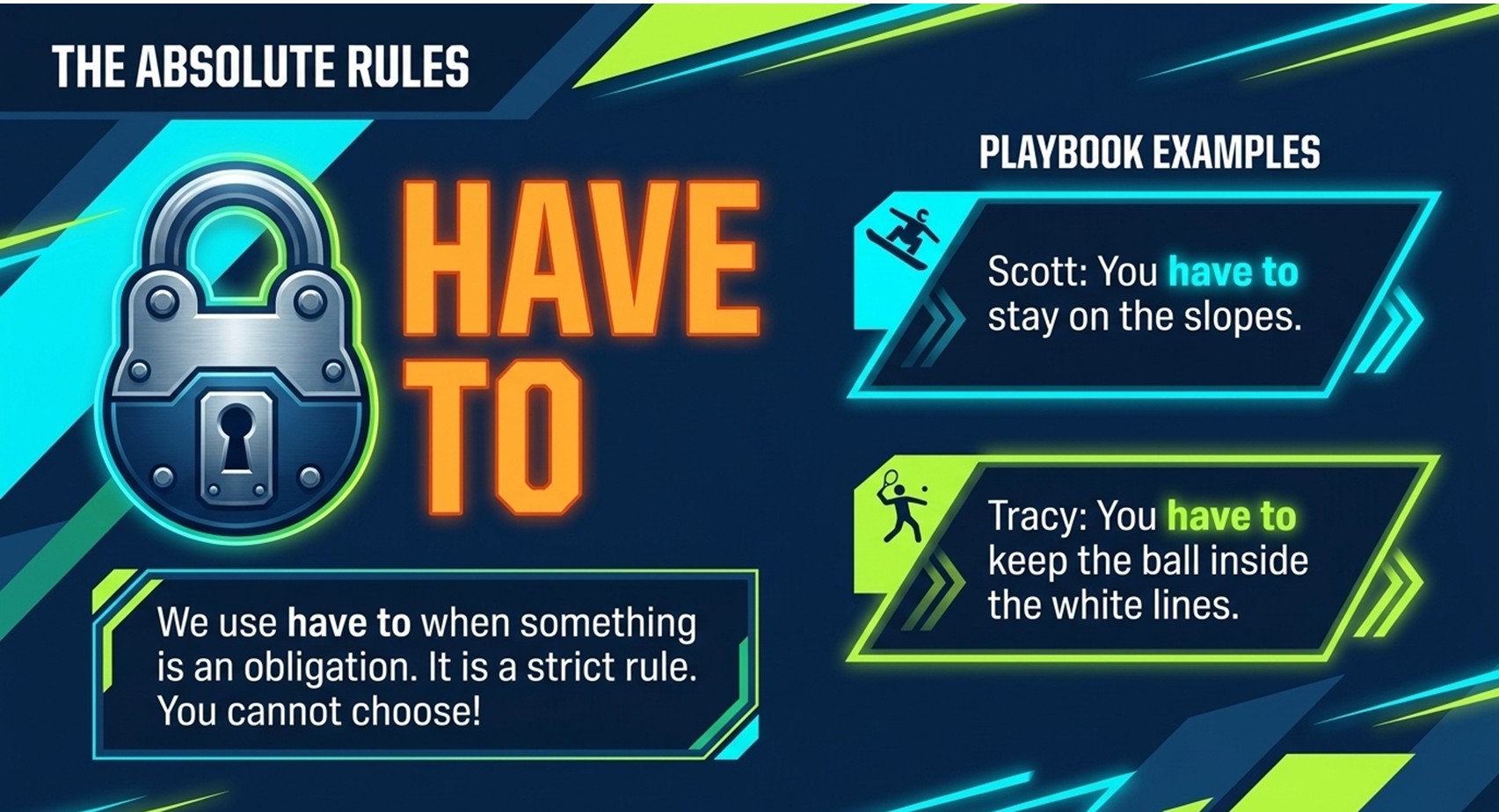
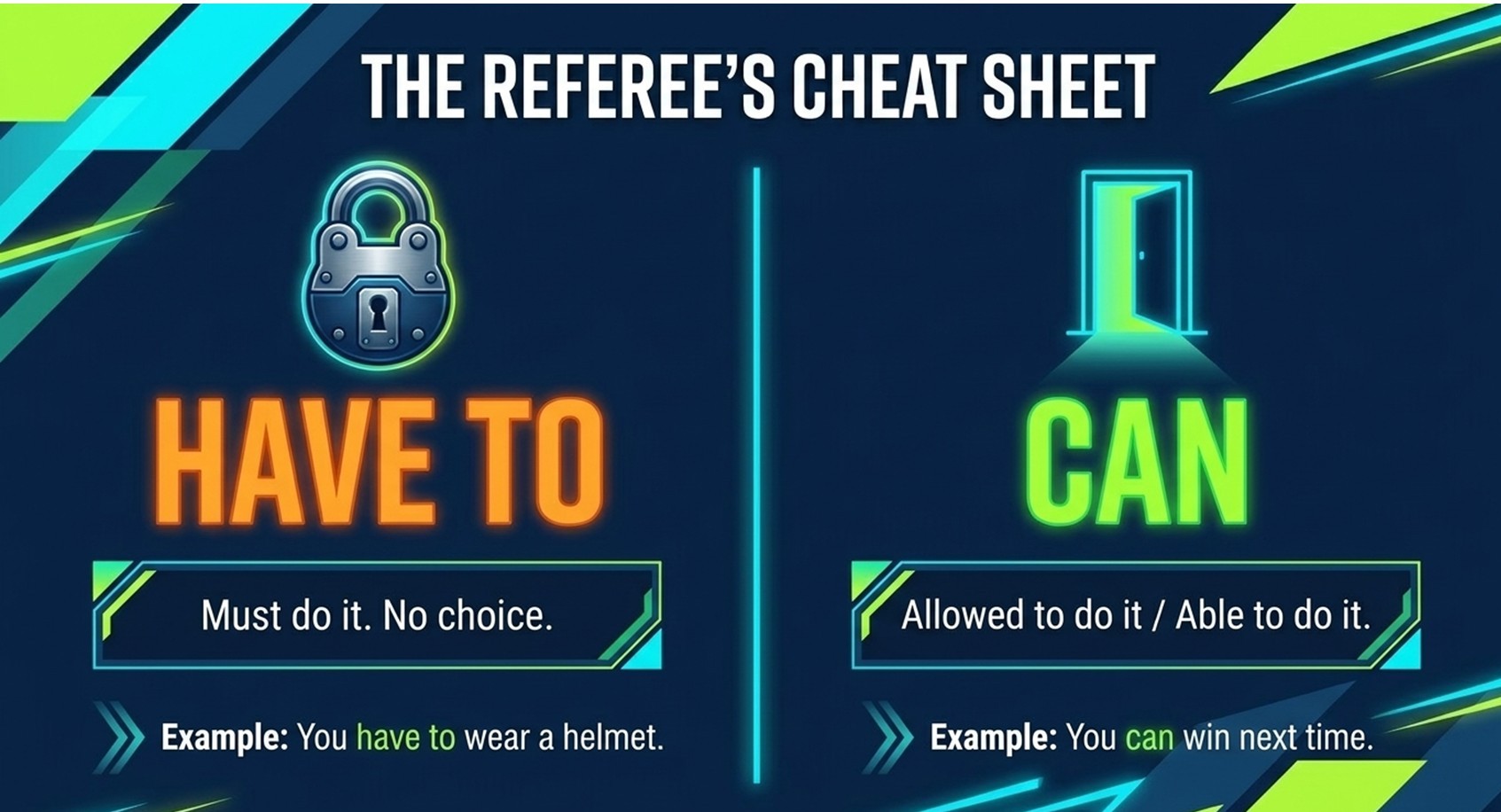
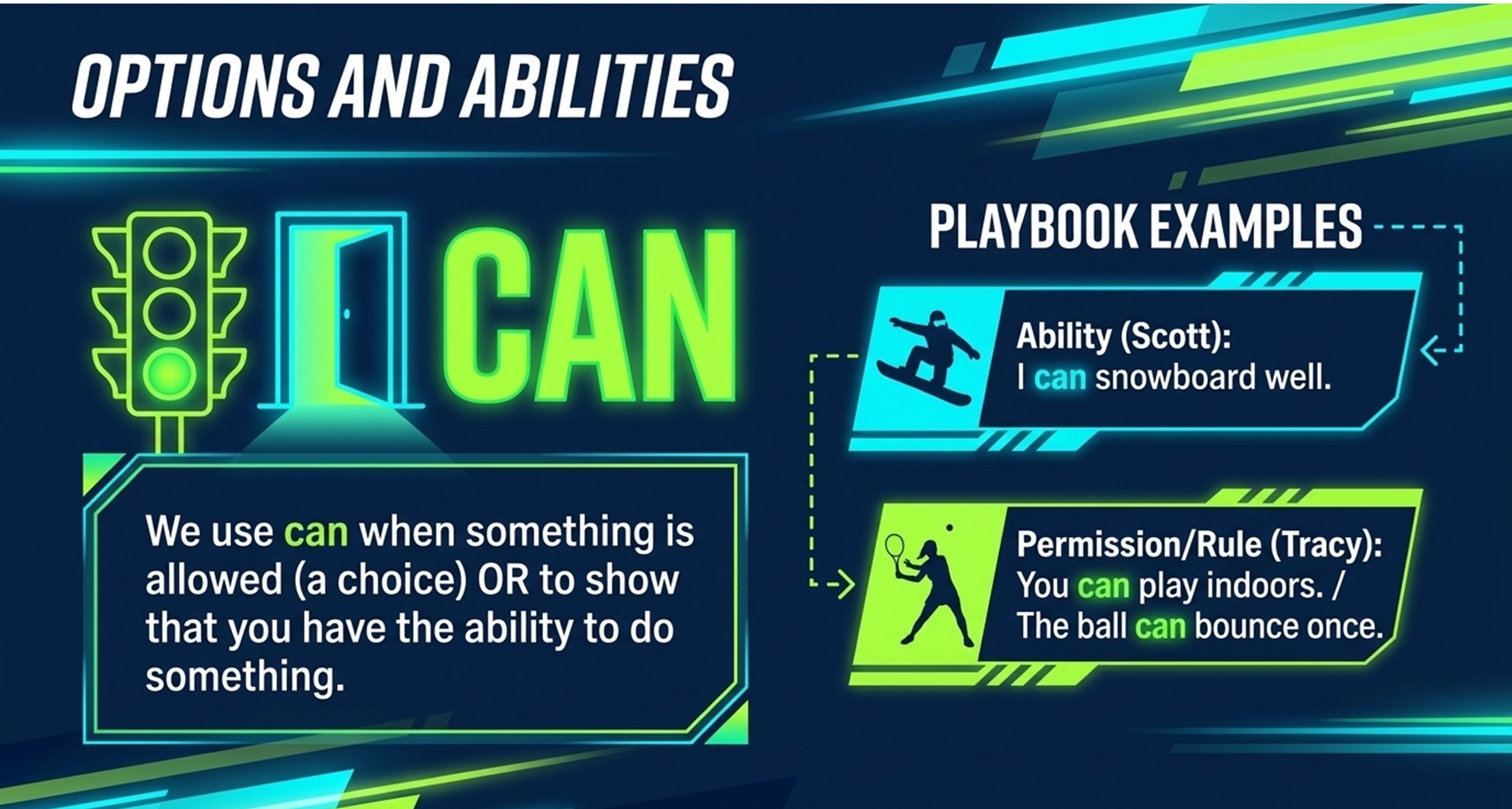
Klasa 5 – Use HAVE TO for Rules
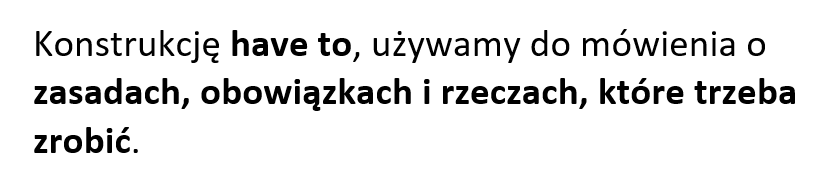
1. Użycie
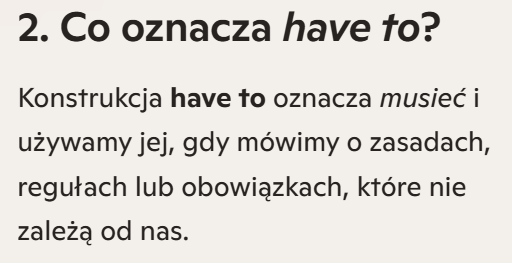
2. Co oznacza have to?
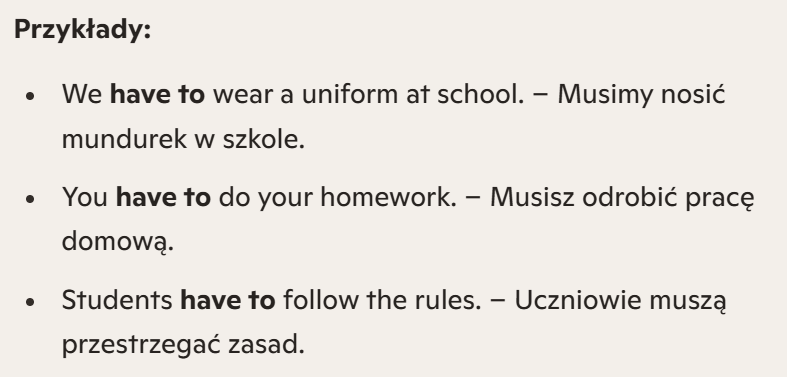
3. Budowa zdania
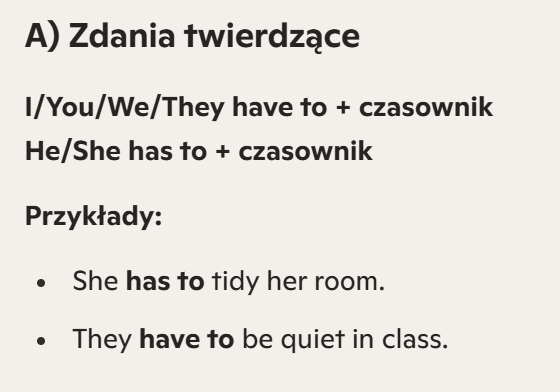
A) Zdania twierdzące
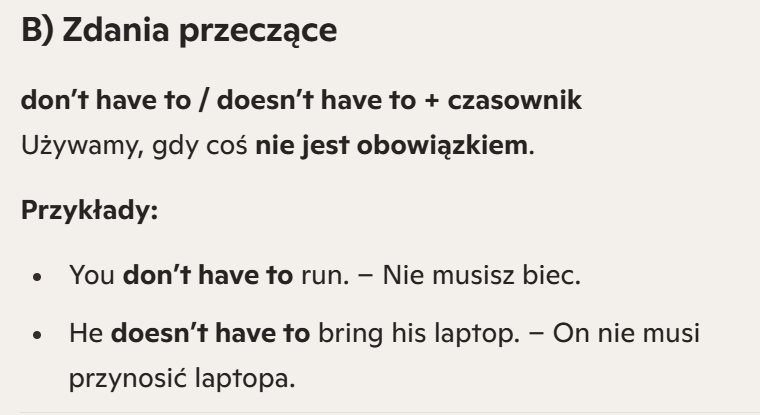
B) Zdania przeczące
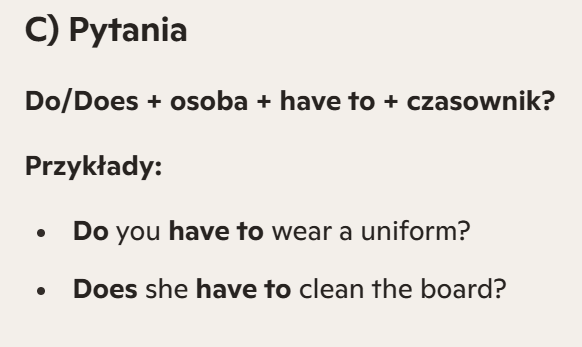
C) Pytania
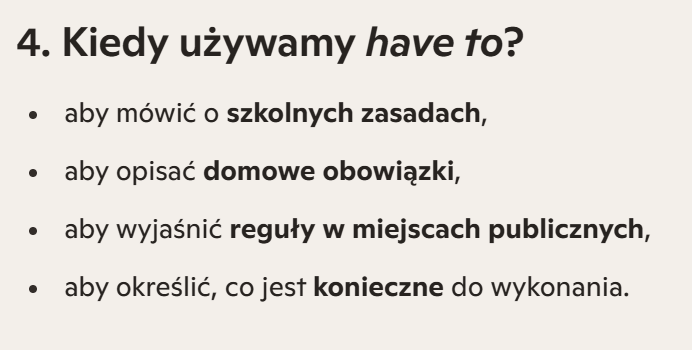
4. Kiedy używamy have to?
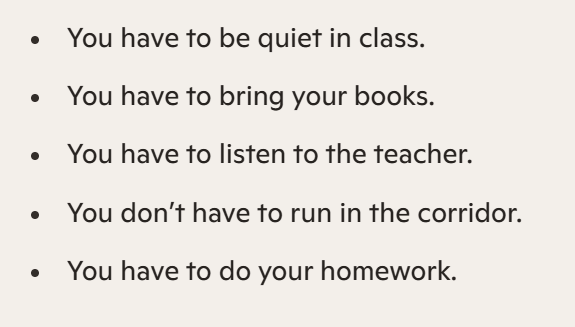
Przykłady
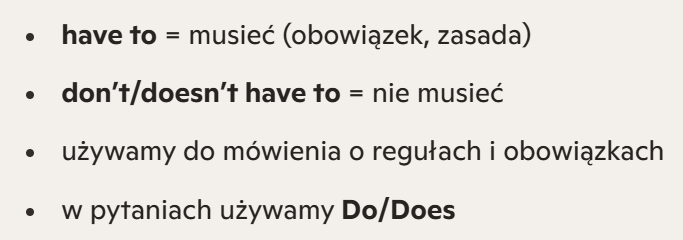
Podsumowanie
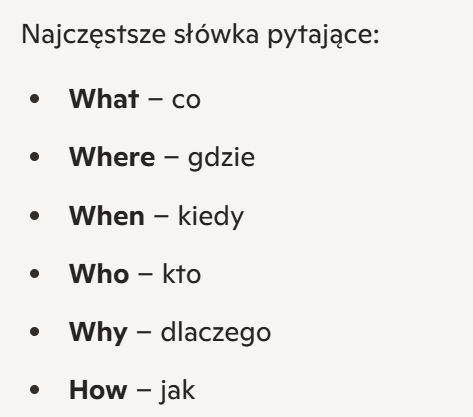
Wh‑ questions

Najczęstsze słówka pytające:
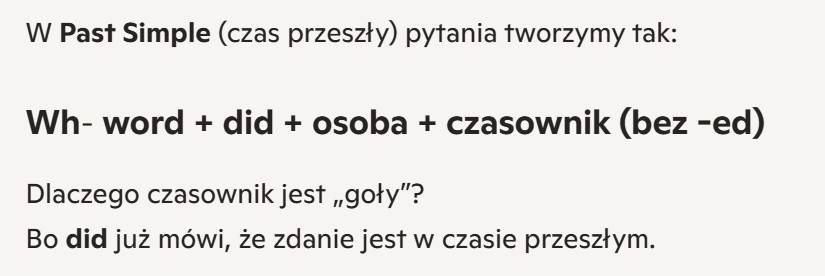
Tworzenie pytań
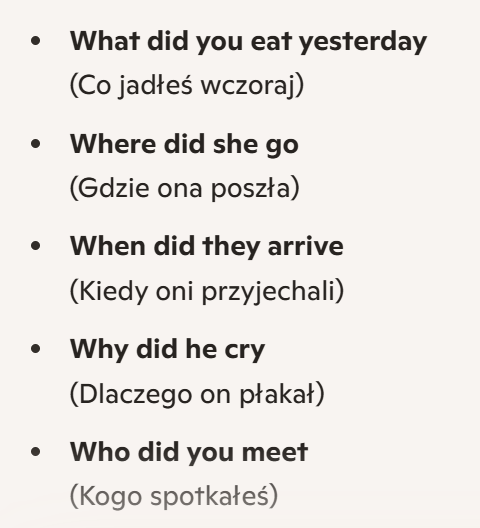
Przykłady
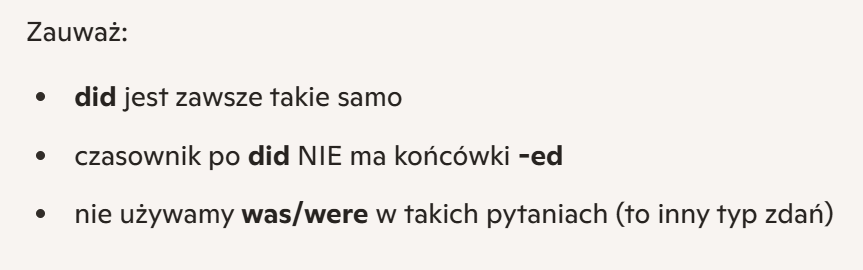
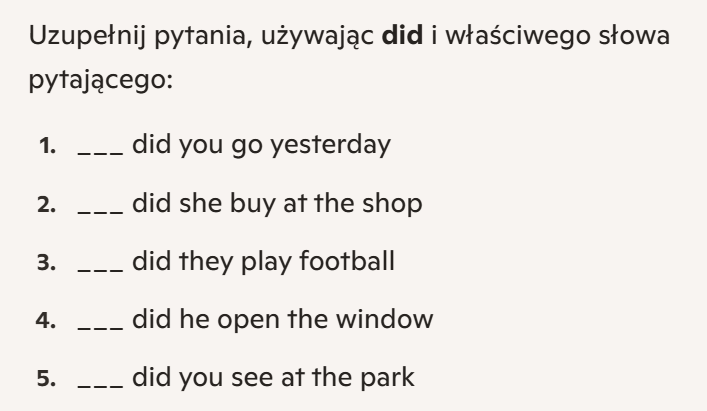
Mini‑ćwiczenie
Wprowadzenie
Najważniejsze zasady
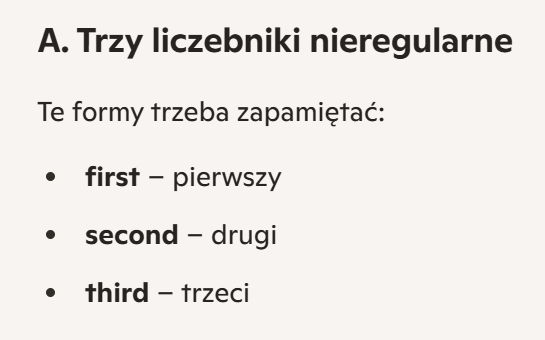
A. Trzy liczebniki nieregularne
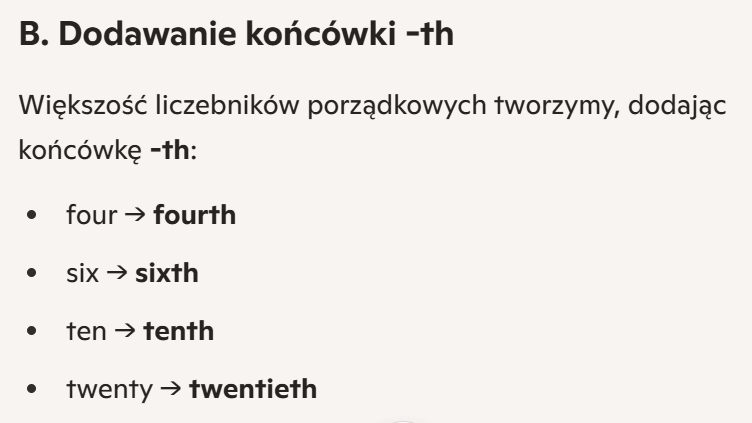
B. Dodawanie końcówki -th
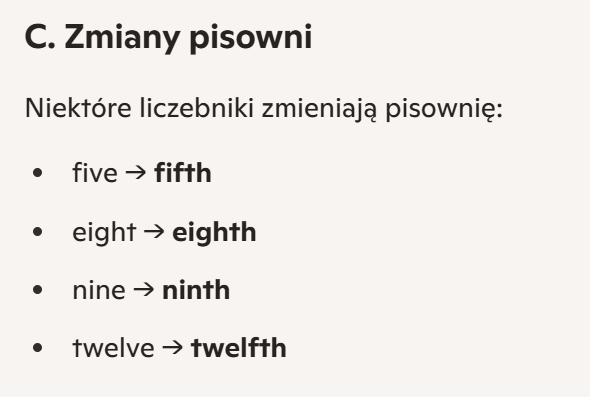
C. Zmiany pisowni
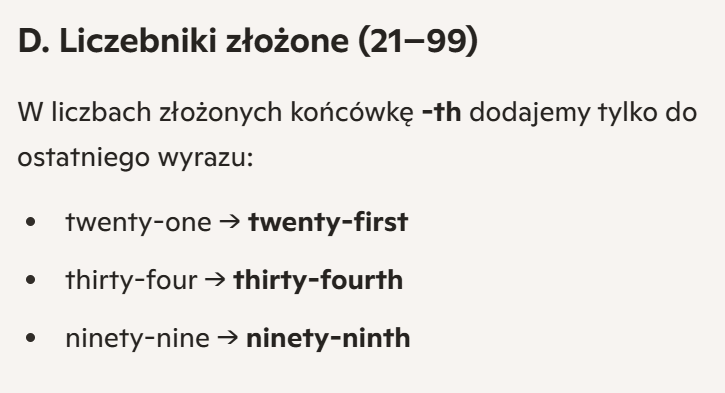
D. Liczebniki złożone (21–99)
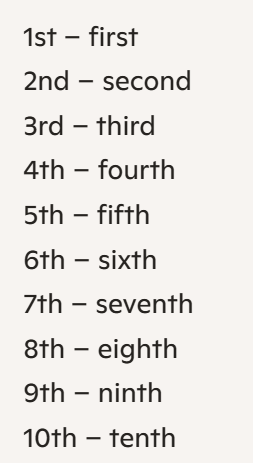
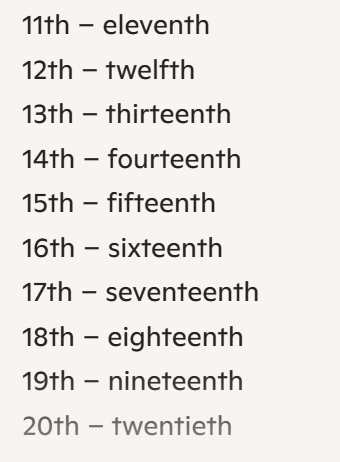
3. Liczebniki porządkowe 1–100 (zapis pełny)
1–20
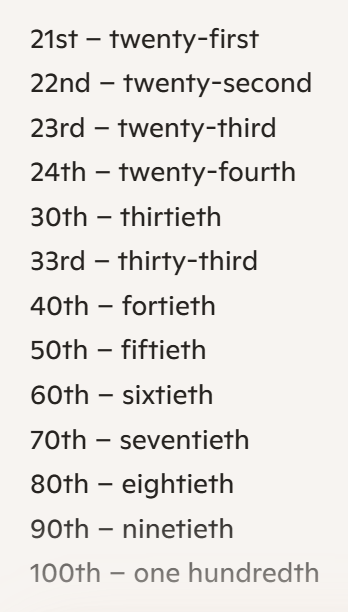
21–100 (wybrane przykłady)
4. Jak używamy liczebników porządkowych?
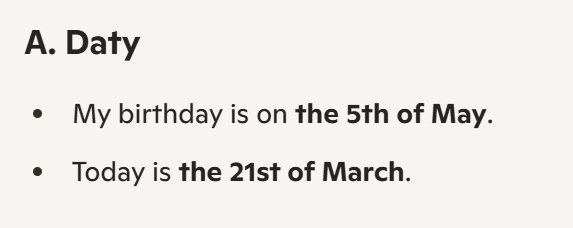
A. Daty
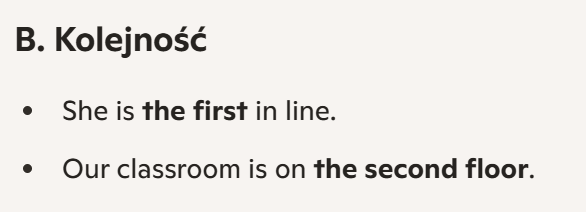
B. Kolejność
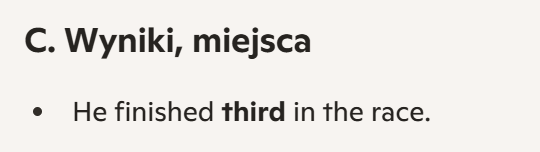
C. Wyniki, miejsca
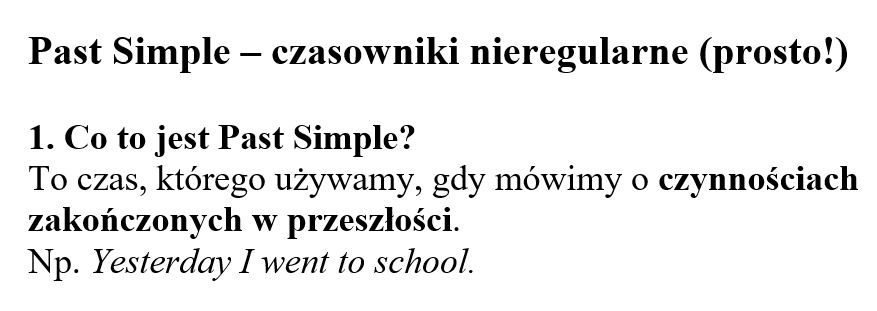
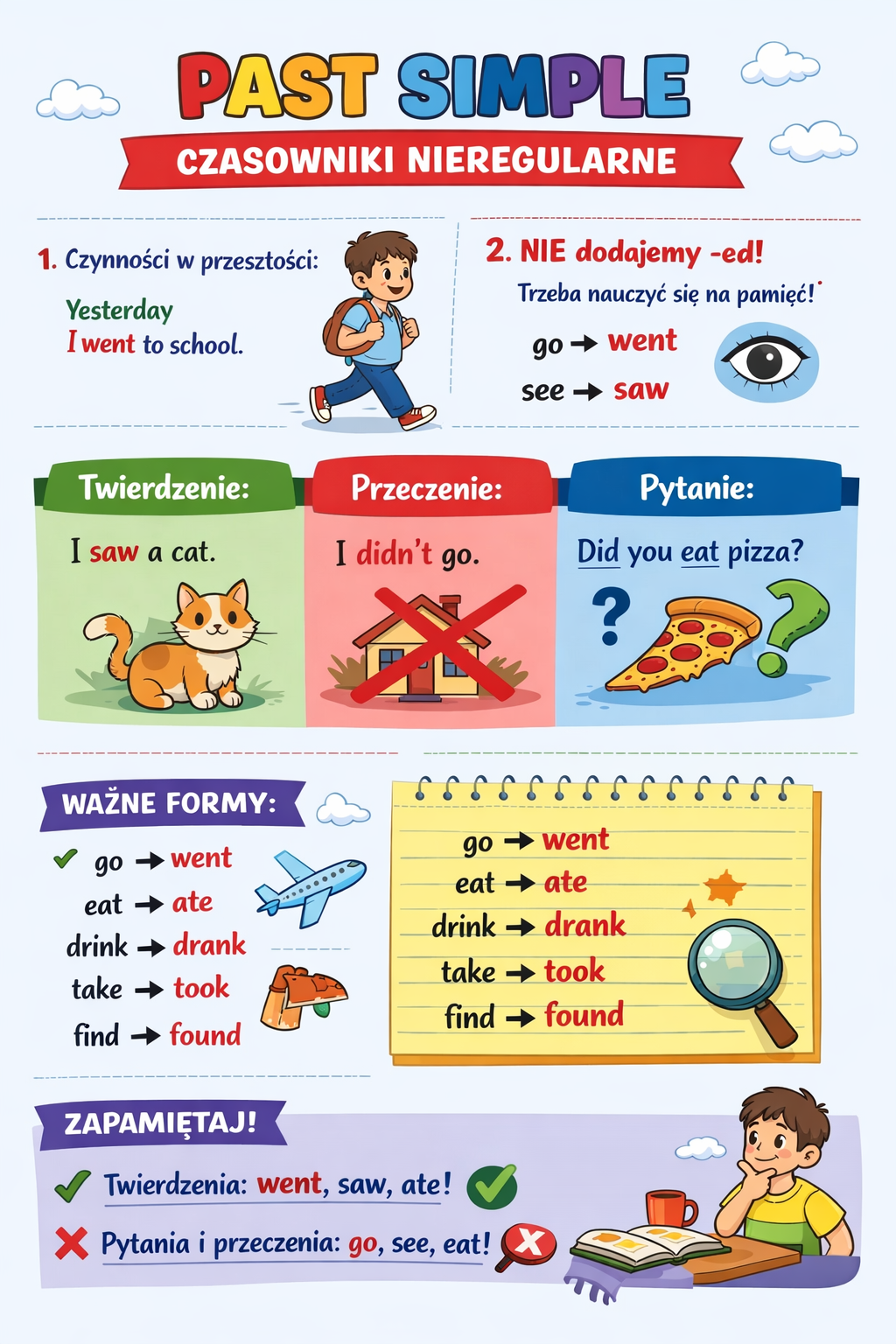
1. Co to jest Past Simple?
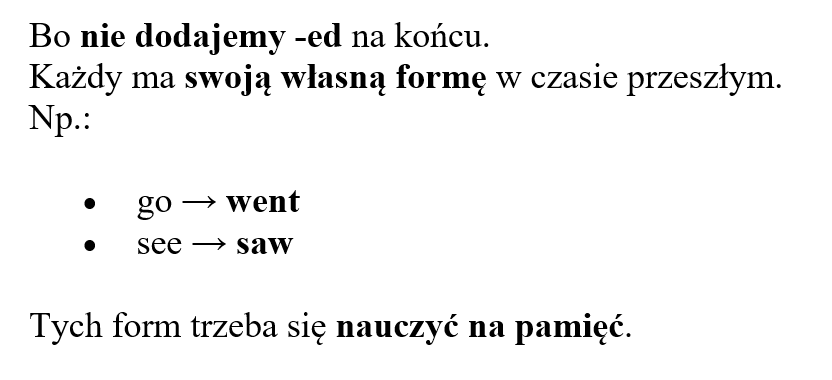
2. Dlaczego czasowniki nieregularne są trudne?
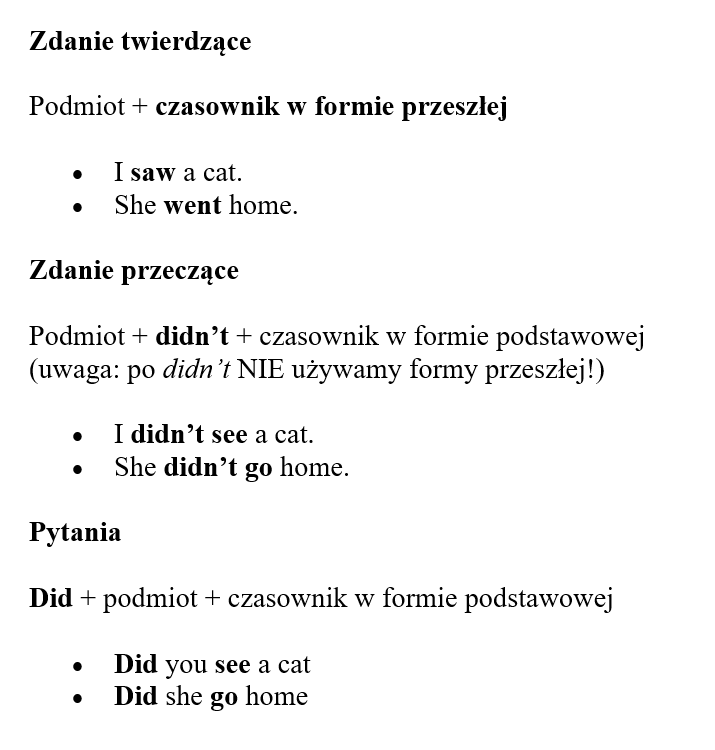
3. Jak budujemy zdania?
4. Najważniejsze czasowniki nieregularne dla klasy 5
| Czas teraźniejszy | Czas przeszły |
| go | went |
| see | saw |
| eat | ate |
| drink | drank |
| take | took |
| get | got |
| read | read |
| make | made |
| buy | bought |
| find | found |
| fly | flew |
| swim | swam |
| say | said |
| tell | told |
| think | thought |
| feel | felt |
| have | had |
| be | was/were |
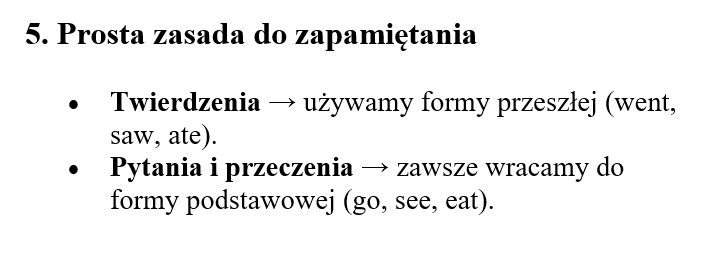
5. Prosta zasada do zapamiętania
Irregular verbs
be – być was/were – był/była
buy – kupować bought – kupił/kupiła
catch – łapać caught – złapał/złapała
do – robić did – zrobił/zrobiła
drink – pić drank – pił/piła
eat – jeść ate – zjadł/zjadła
fall – upadać fell – upadł/upadła
feel – czuć felt – czuł/czuła
find – znajdować found – znalazł/znalazła
fly – latać flew – leciał/leciała
get – dostawać got – dostał/dostała
get out of – wychodzić z got out of – wyszedł/wyszła z
go – iść went – poszedł/poszła
has/have – mieć had – miał/miała
hear – słyszeć heard – słyszał/słyszała
leave – opuszczać left – opuścił/opuściła
look – patrzeć looked – patrzył/patrzyła
make – robić/tworzyć made – zrobił/stworzyła
read – czytać read – czytał/czytała
say – mówić said – powiedział/powiedziała
see – widzieć saw – widział/widziała
sell – sprzedawać sold – sprzedał/sprzedała
sing – śpiewać sang – śpiewał/śpiewała
sit – siedzieć sat – siedział/siedziała
stand – stać stood – stał/stała
swim – pływać swam – pływał/pływała
take – brać took – wziął/wzięła
tell – mówić/opowiadać told – powiedział/opowiedziała
think – myśleć thought – myślał/myślała
write – pisać wrote – napisał/napisała
Categories
Klasa 5 Unit 7 Ordinal number
Categories
Klasa 5 WORD LIST 7
Sporty extremalne
Zwroty i wyrażenia związane ze sportem
Others words
Categories
Klasa 5 – Ice Age
Ice Age
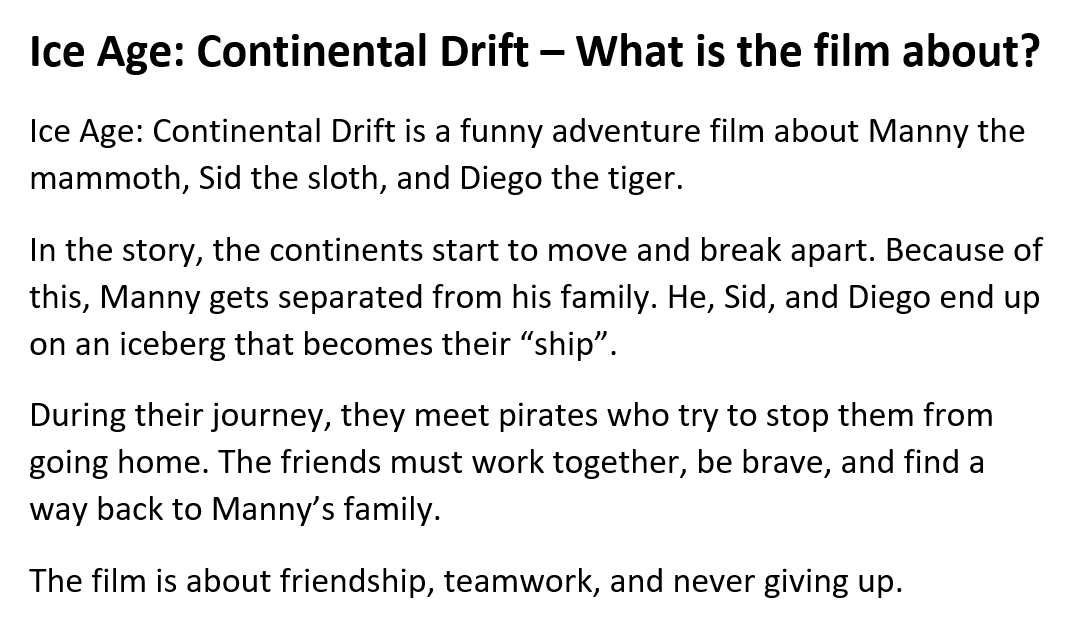
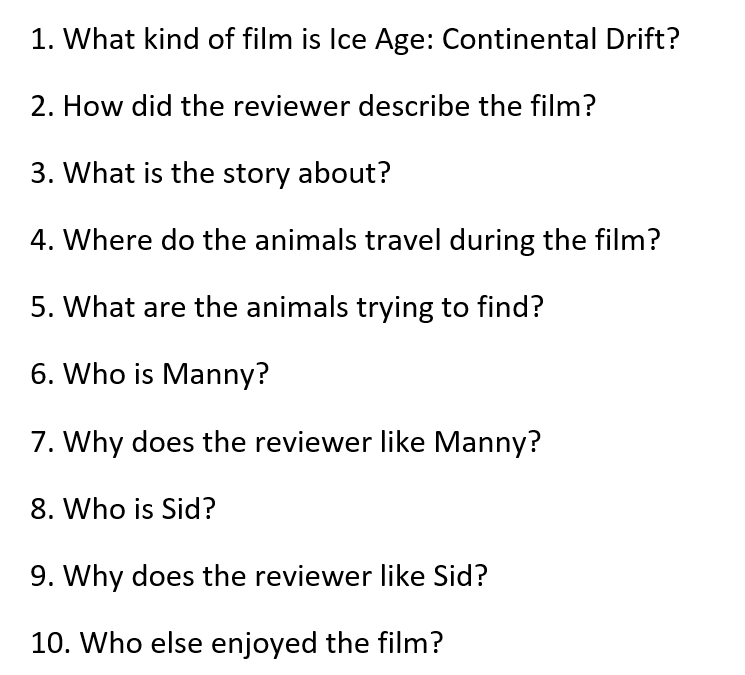
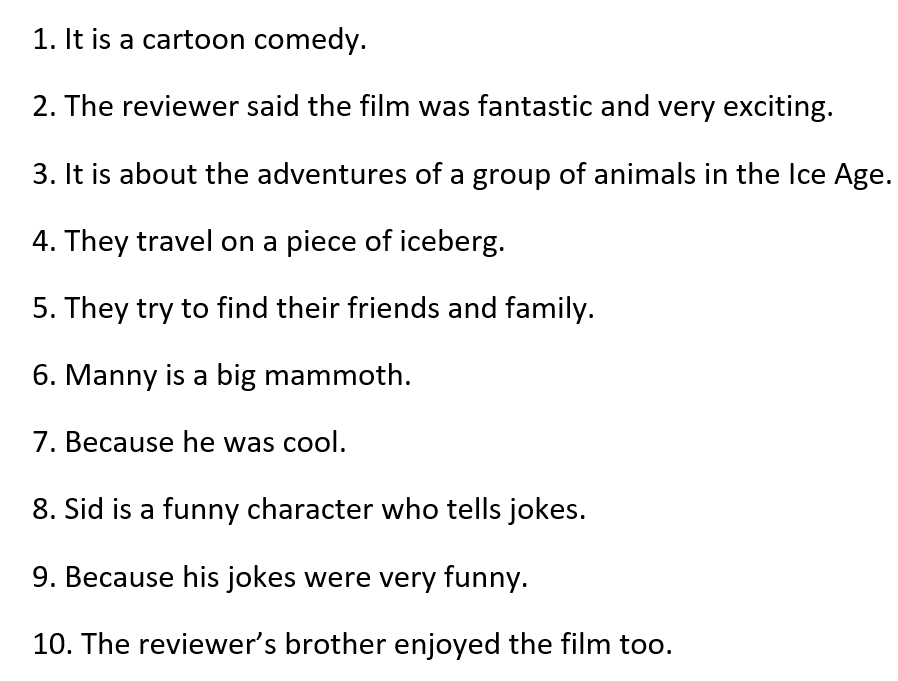
Ice Age: Continental Drift – What is the film about?
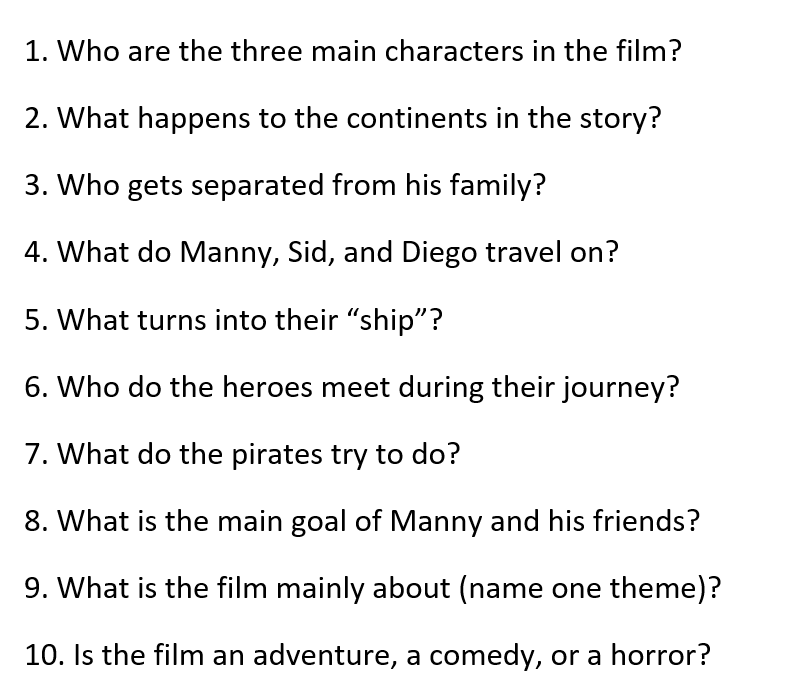
Questions
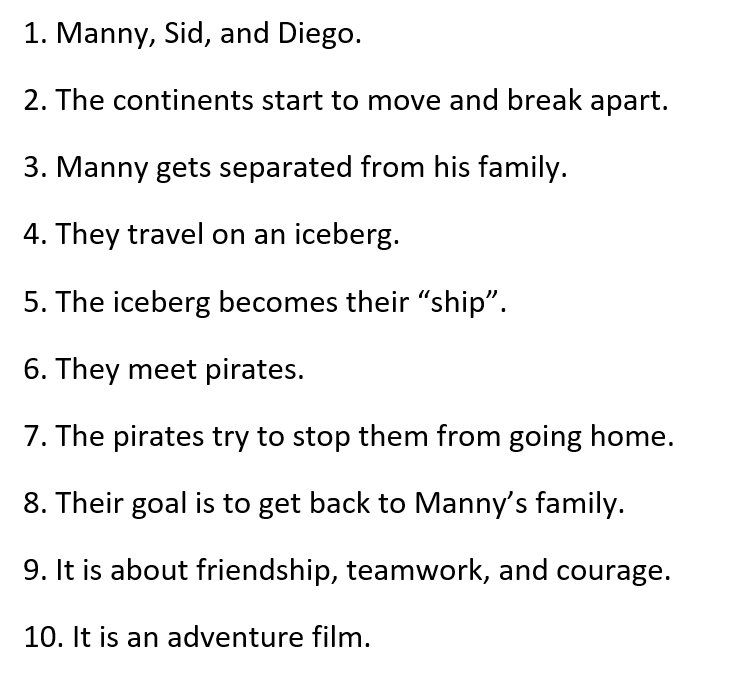
Answers
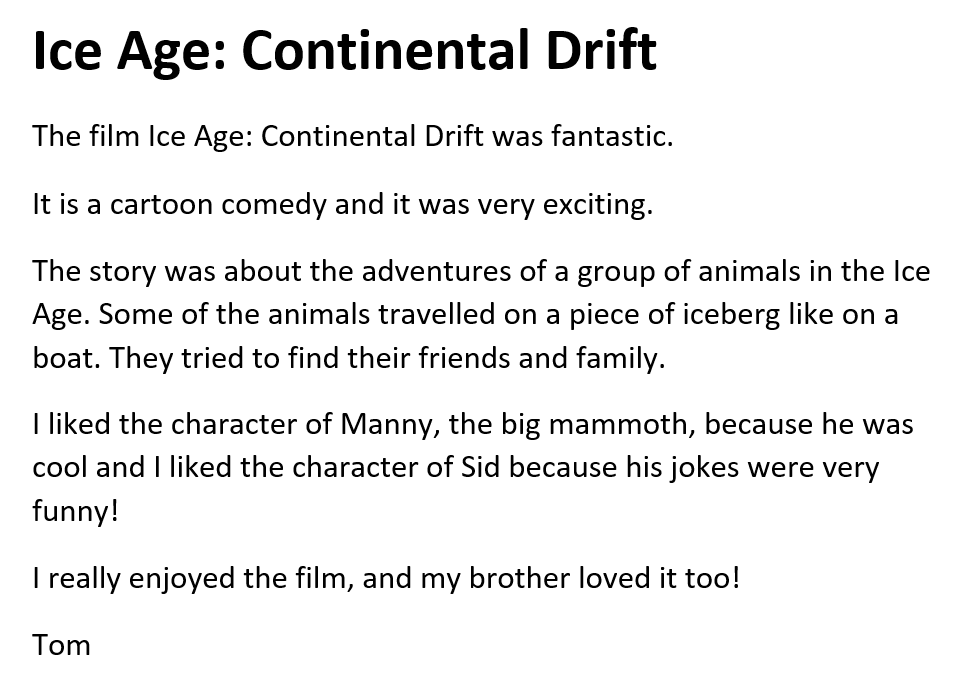
Ice Age: Continental Drift
Ice Age: Continental Drift
Questions
Answers
Categories
Klasa 5 Weekend TV Guide
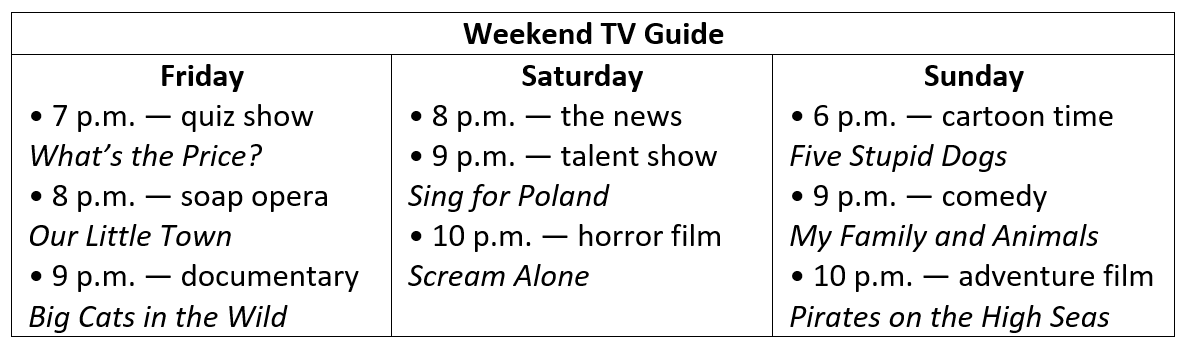
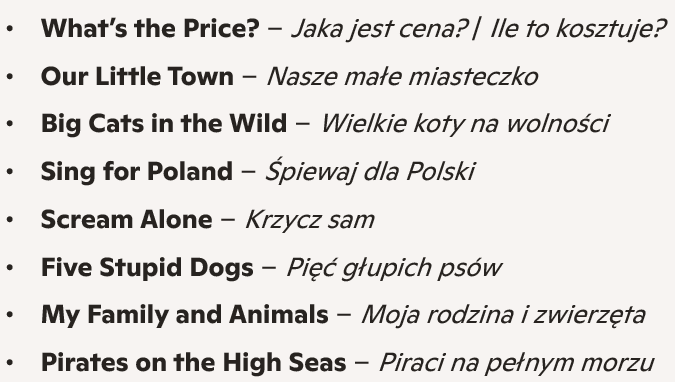
Tłumaczenia tytułów
…
Kliknij w kartę, aby zmienić widok (EN / PL / Obie)
Categories
Things I did yesterday evening
Three things I did yesterday evening
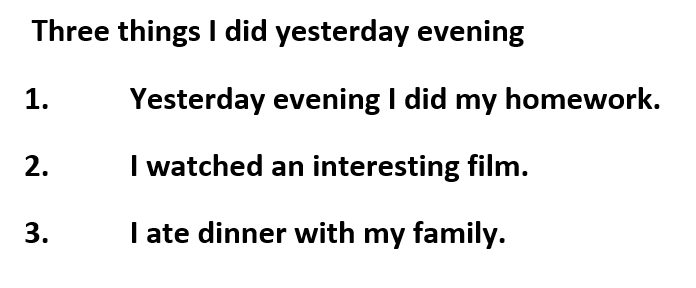
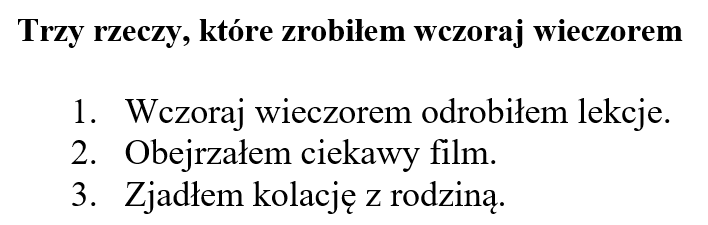
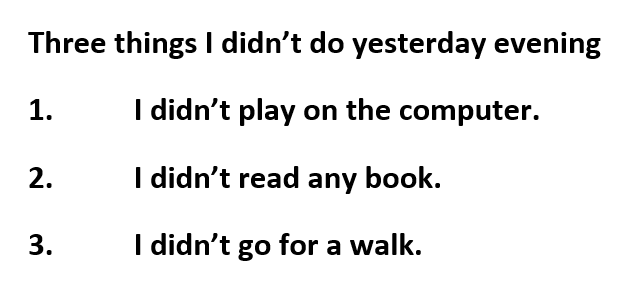
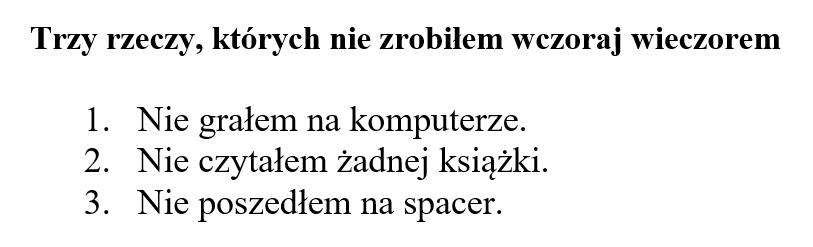
Three things I didn’t do yesterday evening
Categories
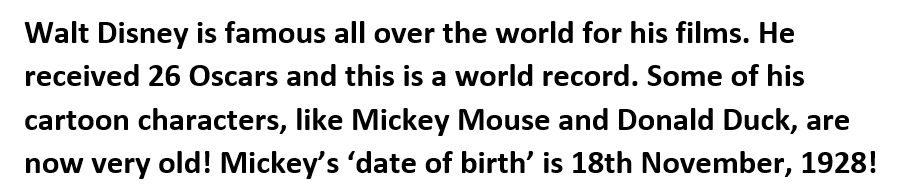
Walt Disney
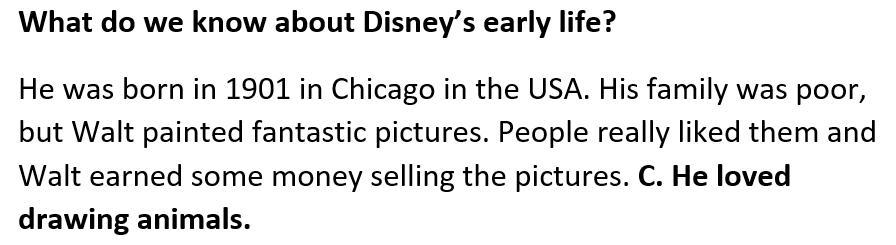
What do we know about Disney’s early life?
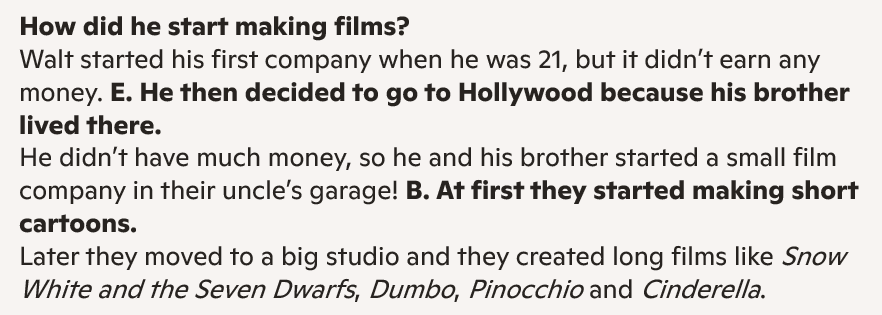
How did he start making films?
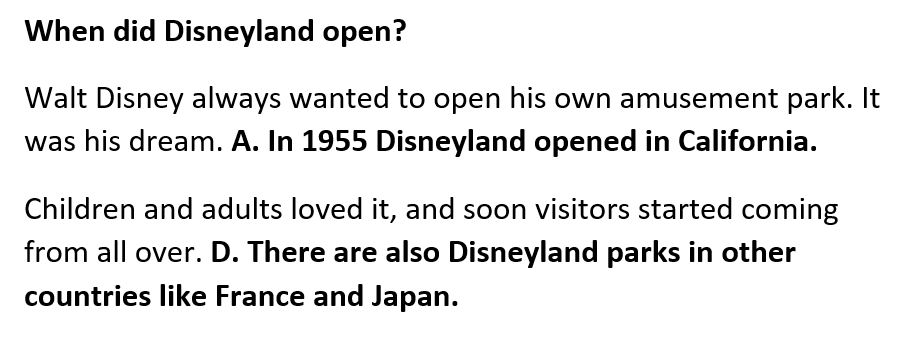
When did Disneyland open?
Categories
Klasa 5 Past Simple
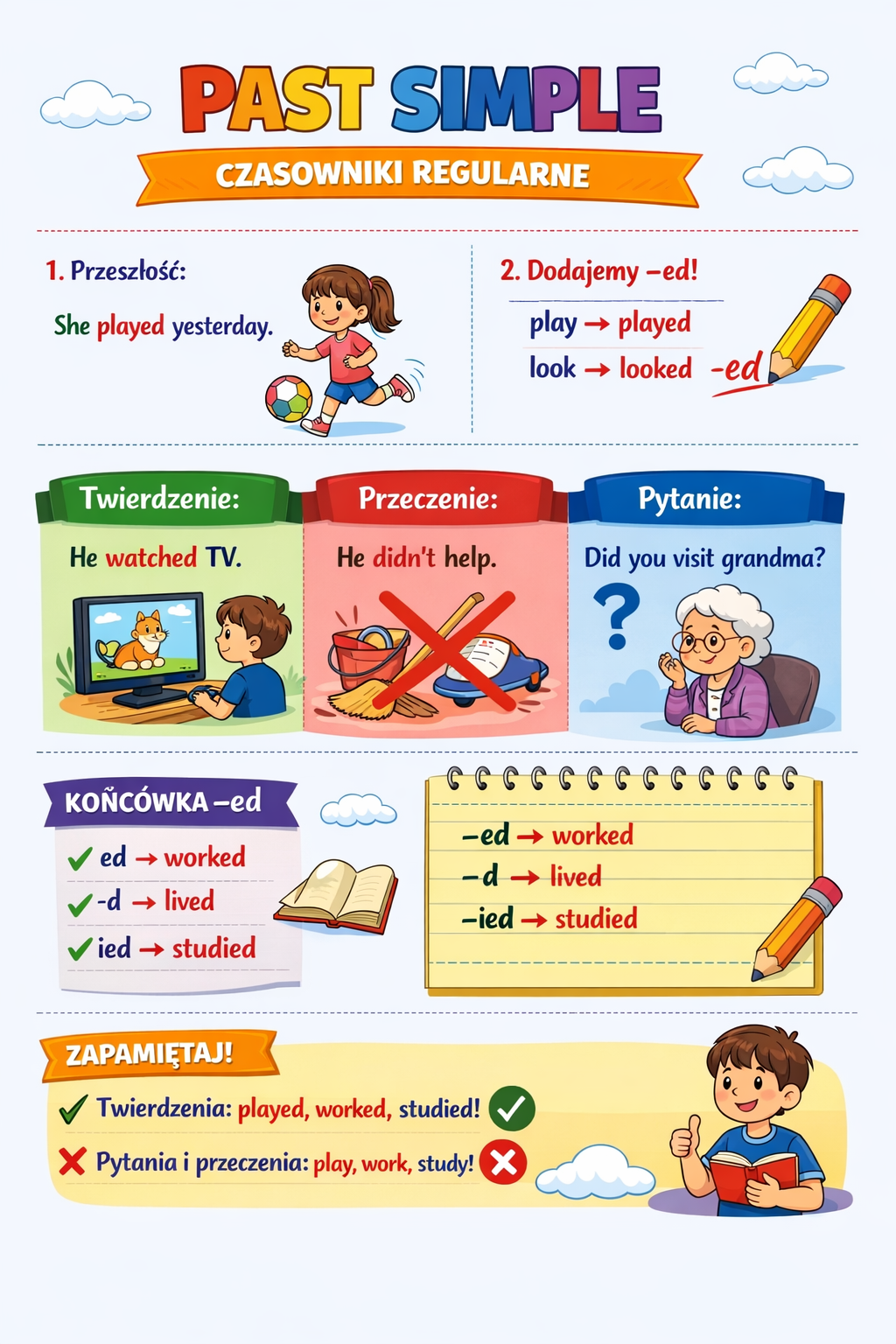
Czasowniki regularne
Klasa 5
Past Simple – czasowniki regularne
Cel lekcji
Uczeń potrafi tworzyć zdania twierdzące i przeczące w czasie przeszłym z użyciem czasowników regularnych.
Categories
Klasa 5 Past Simple
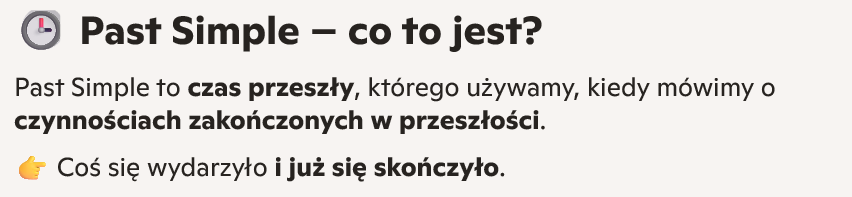
Past Simple – co to jest?
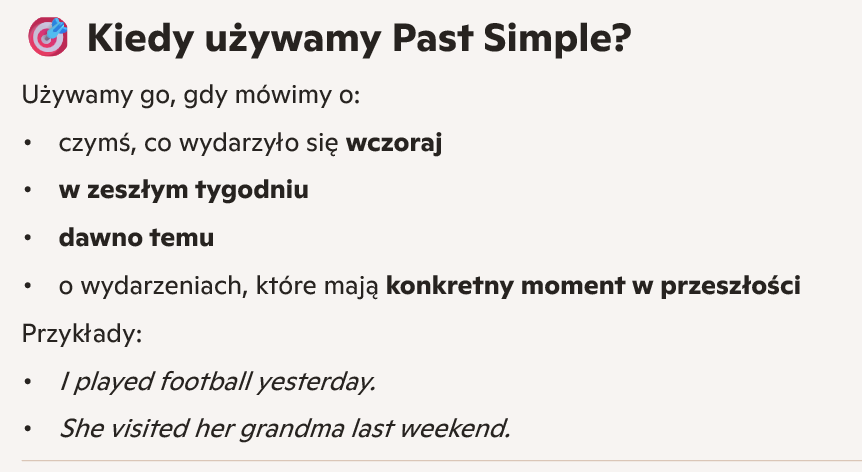
Kiedy używamy Past Simple?
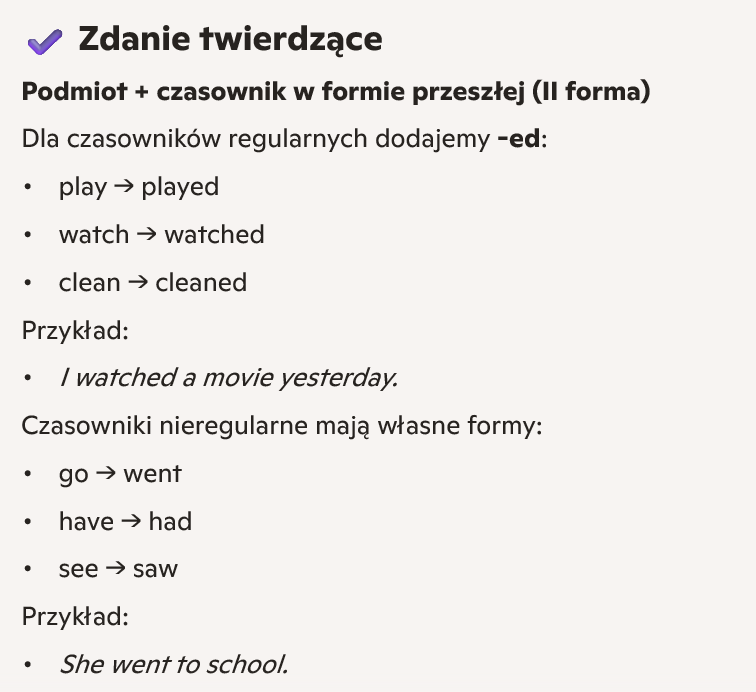
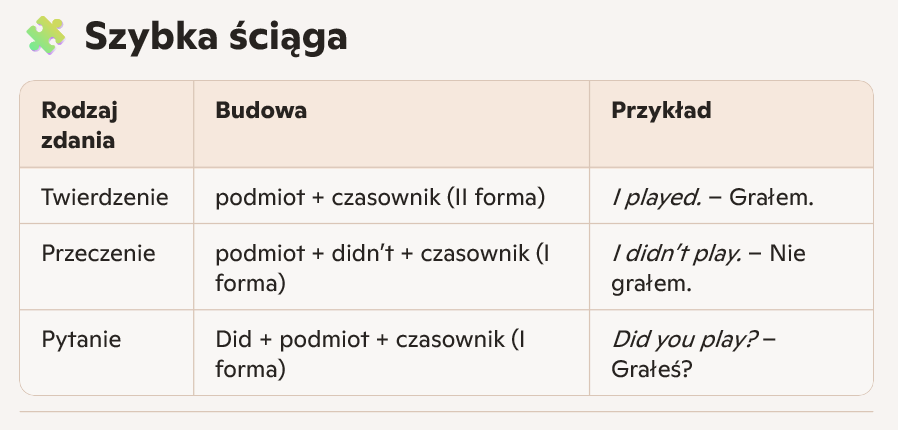
Jak budujemy zdania?
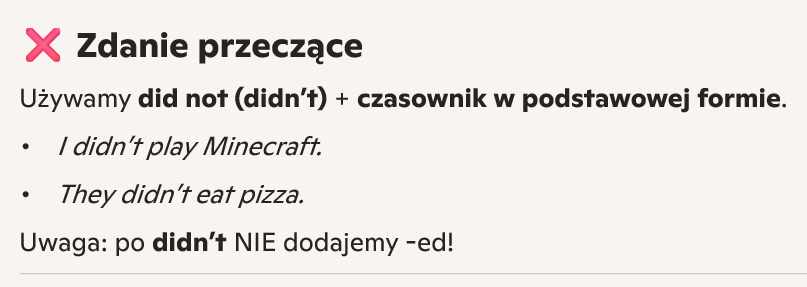
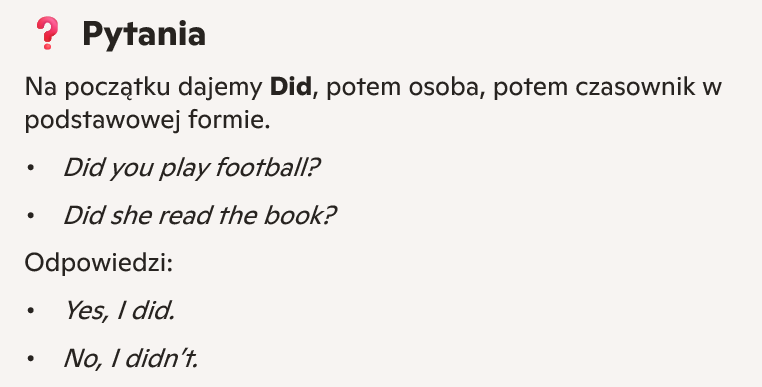
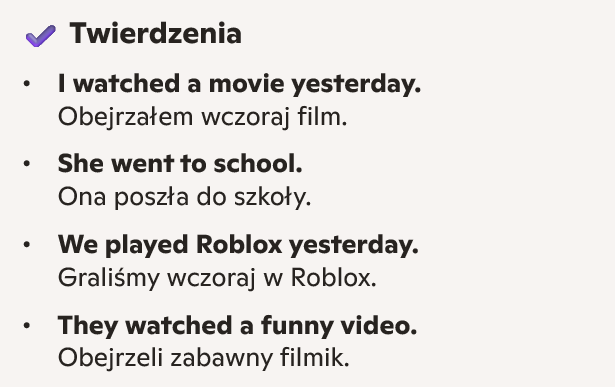
Zdania z Past Simple + tłumaczenie
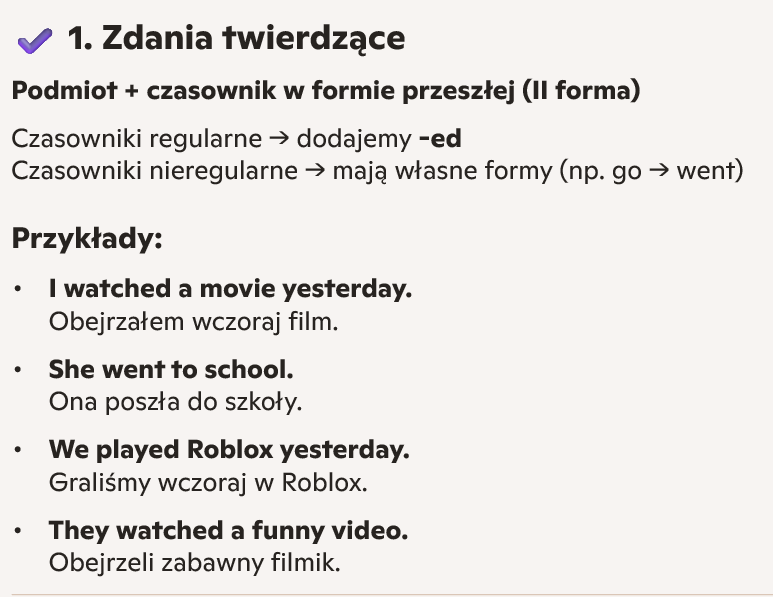
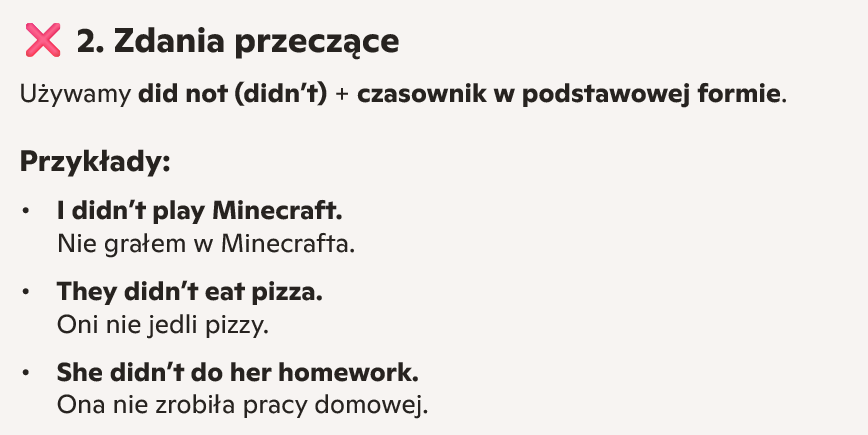
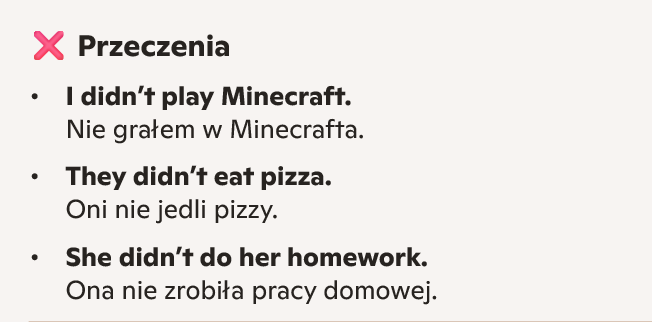
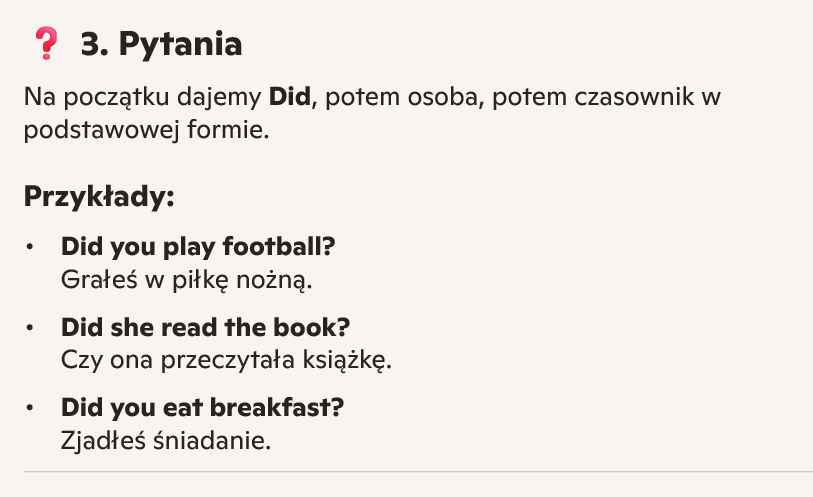
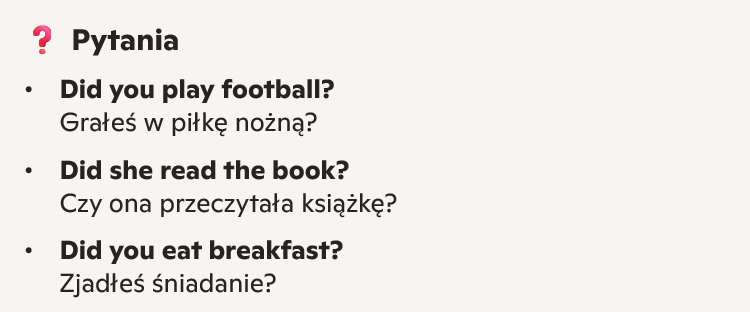
Szybka ściąg
Categories
Klasa 5 Unit 6
WORD LIST 6
Categories
Keeping healthy – zdania
Klasa 5
Zdania
Kliknij w kartę, aby zobaczyć tłumaczenie. Użyj przycisku głośnika, aby usłyszeć wymowę (US Slow).
Kliknij zdanie, aby zobaczyć tłumaczenie
I mustn’t go to school.
🔊
Nie mogę iść do szkoły.
My cheek really hurts.
🔊
Bardzo boli mnie policzek.
How about you?
🔊
A u ciebie?
I’ve got a terrible toothache.
🔊
Bardzo boli mnie ząb.
I must rest.
🔊
Muszę odpoczywać.
I’ve got the flu.
🔊
Mam grypę.
I fell while playing football.
🔊
Przewróciłem się podczas gry w piłkę.
I mustn’t use my phone.
🔊
Nie mogę używać telefonu.
I can’t eat anything hard.
🔊
Nie mogę jeść nic twardego.
My head hurts when I read.
🔊
Głowa boli mnie, kiedy czytam.
I must keep my arm in a bandage.
🔊
Muszę trzymać rękę w bandażu.
I’m also feeling ill.
🔊
Ja też czuję się chory/chora.
Have you got a sore throat?
🔊
Czy boli cię gardło?
I need to rest and be careful.
🔊
Muszę odpoczywać i uważać.
I’ve got earache and a headache.
🔊
Boli mnie ucho i głowa.
I mustn’t eat sweets for some time.
🔊
Przez jakiś czas nie mogę jeść słodyczy.
I also need to drink a lot of water.
🔊
Muszę też dużo pić.
Are you OK?
🔊
Czy u ciebie wszystko w porządku?
I must take medicine.
🔊
Muszę brać lekarstwa.
It’s swollen.
🔊
Jest spuchnięta.
What’s the matter?
🔊
Co ci dolega?
I want to tell you that I’m ill.
🔊
Chcę ci powiedzieć, że jestem chory/chora.
I’m not feeling well today.
🔊
Dzisiaj nie czuję się dobrze.
My head hurts when I look at the screen.
🔊
Głowa boli mnie, kiedy patrzę na ekran.
See you soon.
🔊
Do zobaczenia wkrótce.
I mustn’t use my computer.
🔊
Nie mogę używać komputera.
Get well soon.
🔊
Szybkiego powrotu do zdrowia.
Something bad happened yesterday.
🔊
Wczoraj stało się coś złego.
Have you got a temperature?
🔊
Czy masz temperaturę?
What’s new at school?
🔊
Co nowego w szkole?
Now my arm hurts a lot.
🔊
Teraz bardzo boli mnie ręka.
Write soon.
🔊
Napisz wkrótce.
I also need to visit the dentist.
🔊
Muszę też iść do dentysty.
I feel very tired.
🔊
Jestem bardzo zmęczony/zmęczona.
The doctor says.
🔊
Lekarz mówi.
I must stay in bed.
🔊
Muszę zostać w łóżku.
I need to be careful.
🔊
Muszę być ostrożny/ostrożna.
What do you think?
🔊
Co o tym sądzisz?
How are you?
🔊
Jak się masz?
I’m sorry you are feeling ill.
🔊
Przykro mi, że źle się czujesz.
I mustn’t play sports for two weeks.
🔊
Nie wolno mi uprawiać sportu przez dwa tygodnie.
I’ve got a bad headache.
🔊
Mam silny ból głowy.
Categories
Klasa 5 letters
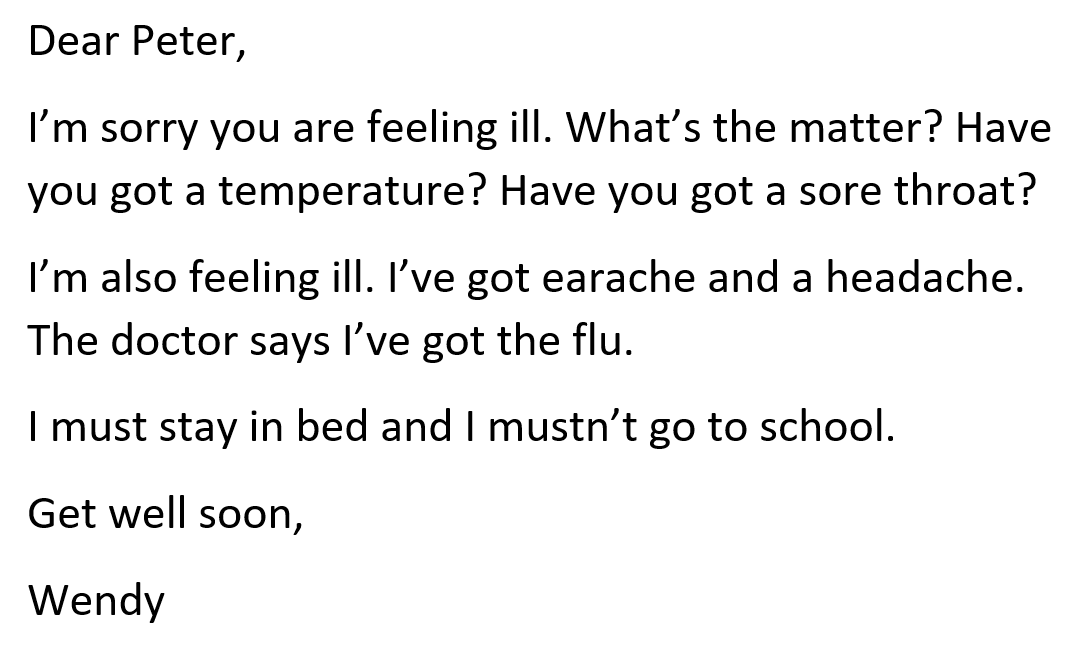
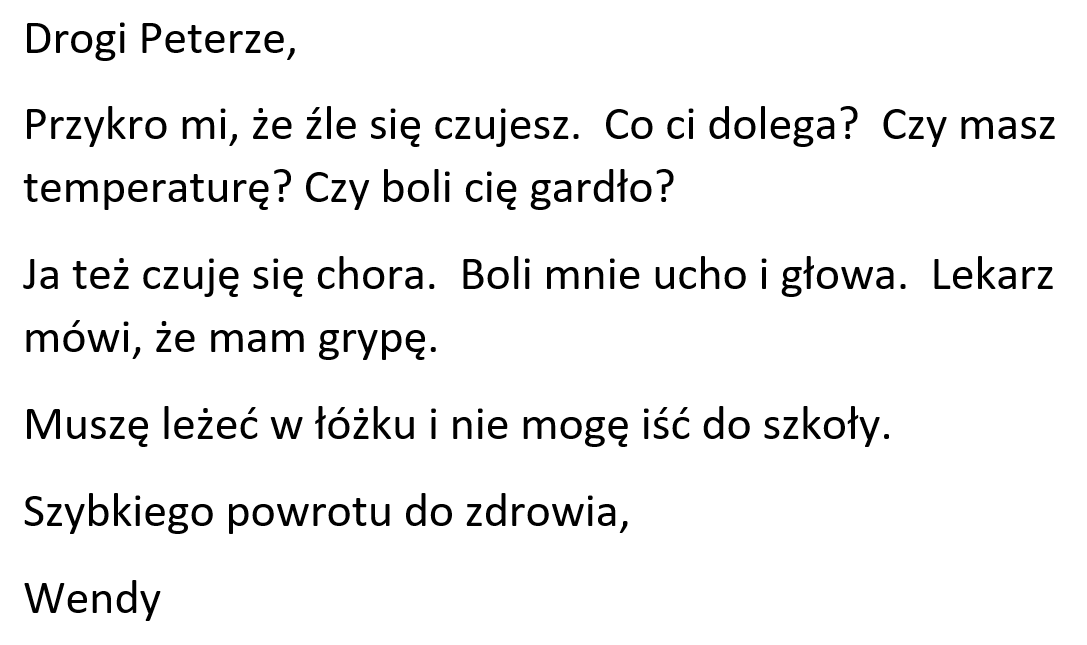
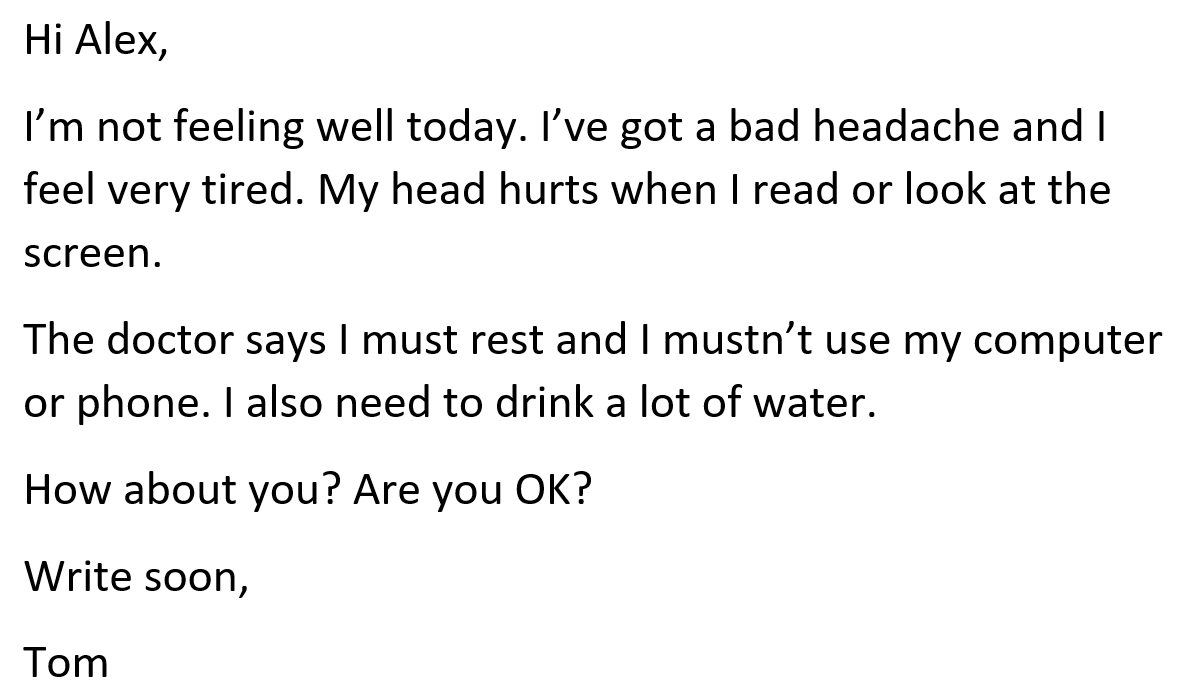
Keeping healthy – letters
Writing time
Tłumaczenie
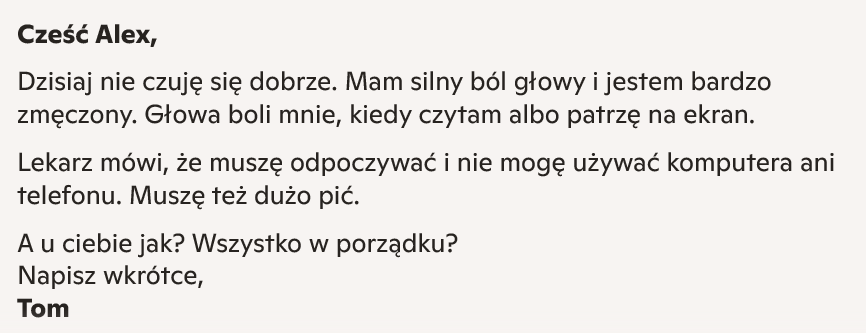
Headache (ból głowy)
Tłumaczenie
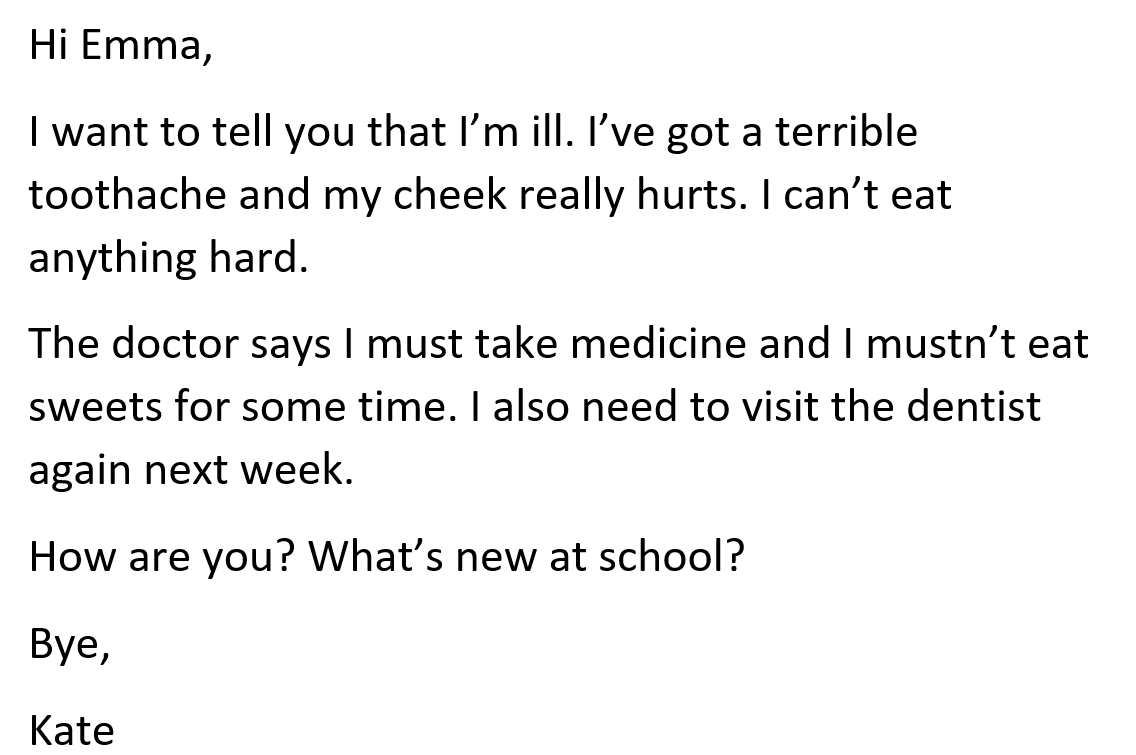
Toothache (ból zęba)
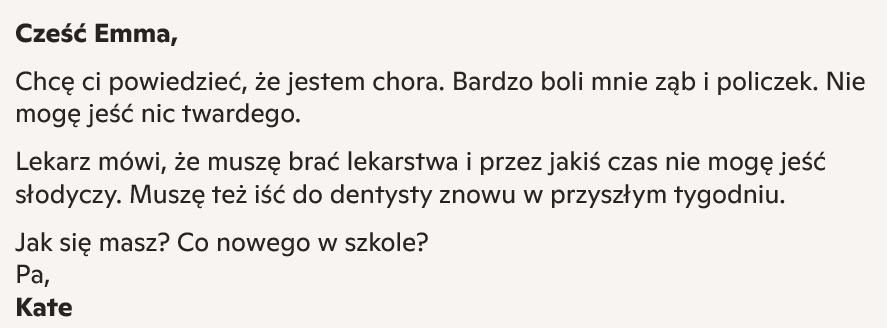
Tłumaczenie
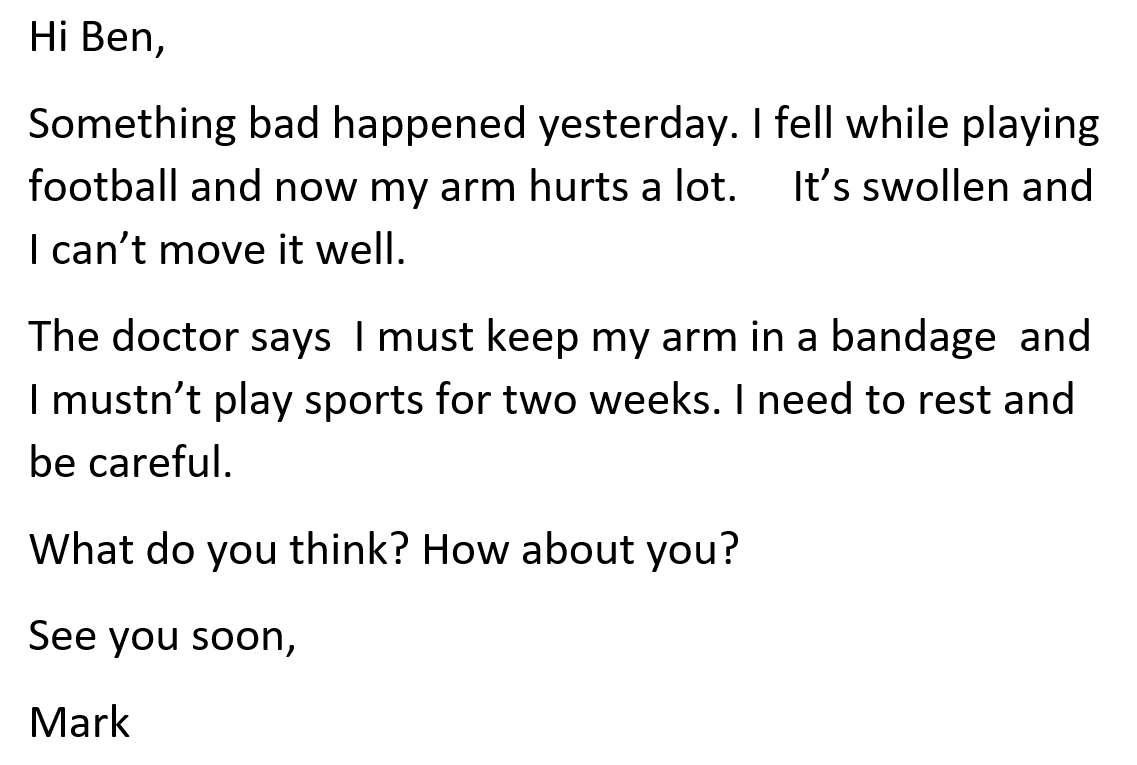
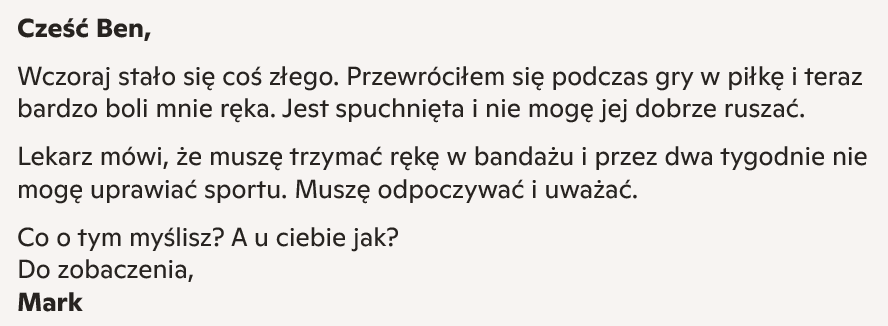
Injured arm (kontuzja ręki)
Tłumaczenie
Categories
At the doctor’s
Zdrowie – tłumaczenie zdań i zwrotów
Questions – Pytania
What’s the matter?
Co ci jest?
What’s wrong?
Co jest nie tak?
Are you OK?
Czy wszystko w porządku?
How do you feel?
Jak się czujesz?
Have you got a temperature?
Czy masz gorączkę?
Is it serious?
Czy to poważne?
Reactions – Reakcje i pomoc
Let me see.
Pokaż. / Daj zobaczyć.
Let me check.
Sprawdzę to.
Let me help you.
Pomogę ci.
Here you are.
Proszę bardzo – gdy coś komuś podajesz.
Don’t worry.
Nie martw się.
I’m calling the doctor.
Dzwonię po lekarza.
Health problems – Dolegliwości
I don’t feel well.
Nie czuję się dobrze.
I feel terrible.
Czuję się okropnie.
I’ve got back pain.
Bolą mnie plecy (dolegliwość).
My back hurts.
Bolą mnie plecy (teraz).
I’ve got a headache.
Boli mnie głowa.
I get lots of headaches.
Często boli mnie głowa.
I’ve got a terrible toothache.
Mam okropny ból zęba.
I’ve got a sore throat.
Boli mnie gardło (dolegliwość).
My throat hurts.
Boli mnie gardło (teraz).
I’ve got a bad cough.
Mam mocny kaszel.
I’ve got a runny nose.
Mam katar.
My head is hot.
Moja głowa jest gorąca.
Everyday actions – Czynności
Do you look at your computer screen for a long time?
Czy długo patrzysz w ekran komputera?
I spend many hours on the computer.
Spędzam wiele godzin przy komputerze.
I play computer games a lot.
Dużo gram w gry komputerowe.
Sitting too long can hurt your back.
Długie siedzenie może szkodzić twoim plecom.
It can hurt your eyes.
To może szkodzić oczom.
Advice – Rady
You must rest.
Musisz odpocząć.
You must do some exercise.
Musisz poćwiczyć.
You must open a window.
Musisz otworzyć okno.
You must go to the dentist.
Musisz iść do dentysty.
You must stay in bed.
Musisz zostać w łóżku.
You must drink warm tea.
Musisz pić ciepłą herbatę.
You mustn’t go outside.
Nie wolno ci wychodzić na dwór.
You mustn’t eat or drink anything too hot or too cold.
Nie wolno ci jeść ani pić niczego zbyt gorącego lub zimnego.
It can make the pain worse.
To może pogorszyć ból.
Vocabulary – Słownictwo
back pain
ból pleców
headache
ból głowy
toothache
ból zęba
sore throat
ból gardła
cough
kaszel
temperature
gorączka
runny nose
katar
painkiller
środek przeciwbólowy
prescription
recepta
medicine
lekarstwo
Categories
WORD LIST 5
Categories
Klasa 5 WORD LIST 5
Categories
was/ were
Categories
Klasa 5 WORD LISTS 4
Categories
Czas przyszły: BE GOING TO
Planujemy przyszłość!
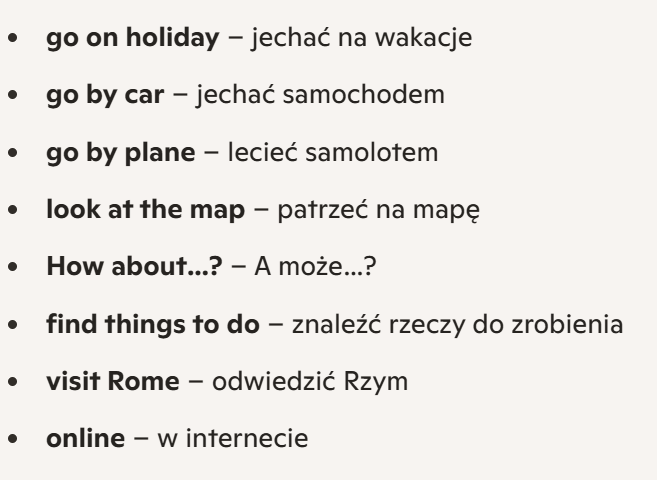
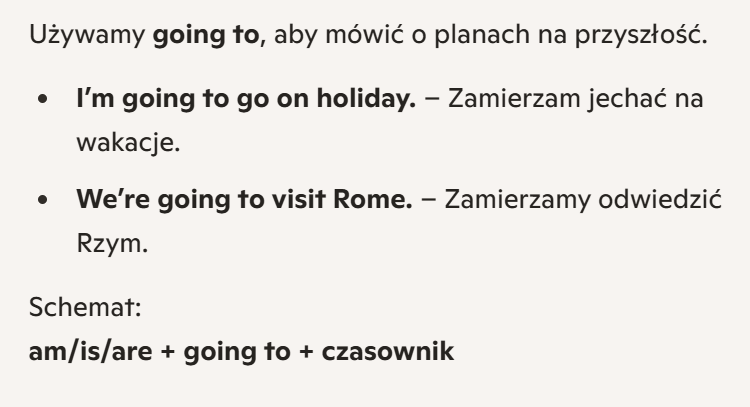
Dzisiaj będziemy mówić o przyszłości, czyli o tym, co planujemy zrobić albo co na pewno się wydarzy, bo widzimy na to dowody. Pomoże nam w tym magiczna konstrukcja: BE GOING TO.
Wyobraźcie sobie, że “be going to” to taki nasz “zamierzam” albo “mam zamiar”.
Kiedy używamy “BE GOING TO”?
Używamy jej, gdy:
Mówimy o swoich planach i zamiarach. To coś, co już sobie pomyśleliśmy, że zrobimy. To nasza decyzja!
Przykład: Dziś wieczorem zamierzam obejrzeć film. (To mój plan.)
Mówimy o czymś, co na pewno się wydarzy, bo widać to już teraz. Widzimy jakieś znaki!
Przykład: Patrzcie na te ciemne chmury! Będzie padać! (Widzimy chmury, więc na pewno będzie padać).
Jak tworzymy “BE GOING TO”?
Ta konstrukcja składa się z trzech części:
CZASOWNIK “TO BE” w odpowiedniej formie (czyli am, is albo are)
GOING TO (zawsze tak samo!)
CZASOWNIK GŁÓWNY (czyli to, co zamierzamy zrobić, np. play, eat, go) w formie podstawowej (bez żadnych końcówek!)
Spójrzmy na to, jak łączy się “to be” z różnymi osobami:
I + am + going to + czasownik
You + are + going to + czasownik
He / She / It + is + going to + czasownik
We + are + going to + czasownik
You + are + going to + czasownik
They + are + going to + czasownik
Skróty: Pamiętajcie, że możemy skracać:
I’m going to…
You’re going to…
He’s going to… / She’s going to… / It’s going to…
We’re going to…
They’re going to…
Jak tworzymy przeczenia?
Wystarczy dodać NOT po czasowniku TO BE:
I am NOT going to… (I’m not going to…)
You are NOT going to… (You aren’t going to…)
He / She / It is NOT going to… (He/She/It isn’t going to…)
Jak tworzymy pytania?
Wystarczy przestawić czasownik TO BE na początek zdania:
Am I going to…?
Are you going to…?
Is he / she / it going to…?
Are we going to…?
Are they going to…?
Przykładowe zdania
Zdania twierdzące (Plany i zamiary):
Jutro będzie słonecznie.
It is going to be sunny tomorrow.
Oni zamierzają zjeść pizzę na obiad.
They are going to eat pizza for dinner.
My zamierzamy zagrać w piłkę nożną jutro.
We are going to play football tomorrow.
Ja zamierzam przeczytać książkę dziś wieczorem.
I am going to read a book tonight.
Ona zamierza odwiedzić swoją babcię w przyszłym tygodniu.
She is going to visit her grandma next week.
Ja zamierzam uczyć się angielskich słówek każdego dnia.
I am going to learn English words every day.
Ty zamierzasz pomóc swojej mamie.
You are going to help your mom.
On zamierza kupić nową zabawkę.
He is going to buy a new toy.
Moja siostra zamierza zacząć szkołę we wrześniu.
My sister is going to start school in September.
Nasza klasa zamierza niedługo mieć przyjęcie.
Our class is going to have a party soon.
Zdania przeczące (Brak planów, coś się nie wydarzy):
Mój pies nie zamierza spać na zewnątrz.
My dog is not going to sleep outside.
Ty nie zamierzasz zapomnieć swojej pracy domowej.
You are not going to forget your homework.
Ona nie zamierza biegać w parku.
She is not going to run in the park.
Ja nie zamierzam przegrać gry.
I am not going to lose the game.
On nie zamierza zaśpiewać piosenki.
He is not going to sing a song.
Nie będzie padać dziś po południu.
It is not going to rain this afternoon.
Ja nie zamierzam oglądać telewizji dzisiaj.
I am not going to watch TV today.
My nie zamierzamy podróżować tego lata.
We are not going to travel this summer.
Kot nie zamierza złapać myszy.
The cat is not going to catch the mouse.
Oni nie zamierzają malować ściany.
They are not going to paint the wall.
Zdania pytające (Pytania o plany lub o to, co się wydarzy):
Czy ona zamierza założyć niebieską sukienkę?
Is she going to wear a blue dress?
Czy zamierzasz uczyć się do testu?
Are you going to study for the test?
Czy będzie padać śnieg jutro rano?
Is it going to snow tomorrow morning?
Czy oni zamierzają zbudować zamek z piasku?
Are they going to build a sandcastle?
Czy zamierzasz zostać lekarzem w przyszłości?
Are you going to be a doctor in the future?
Czy ja zamierzam wygrać ten konkurs?
Am I going to win this competition?
Czy on zamierza nas odwiedzić w przyszłą niedzielę?
Is he going to visit us next Sunday?
Czy będziemy się dobrze bawić na przyjęciu?
Are we going to have fun at the party?
Czy nauczyciel zamierza dać nam pracę domową?
Is the teacher going to give us homework?
Czy twoi przyjaciele zamierzają przyjść na twoje urodziny?
Are your friends going to come to your birthday?
Mam nadzieję, że teraz konstrukcja “be going to” jest dla Was jasna! Pamiętajcie o “am/is/are” i zawsze “going to” przed czasownikiem. Powodzenia!