Categories
Lekcje klasa 8

Quick check (3)

Klasa 8

Future forms & relative clauses

1. Future Simple (will)

Używamy, gdy nie mamy planu, decydujemy w chwili mówienia, przewidujemy przyszłość lub obiecujemy.

Budowa:

will + czasownik (bez zmian)

Przykłady:

  • I think it will rain tomorrow.
  • I will help you with your homework.
  • She will be late.

Kiedy używać:

  • przewidywania: It will be cold.
  • decyzje podjęte teraz: I’ll take a taxi.
  • obietnice: I’ll call you.

2. Present Continuous z znaczeniem przyszłym

Używamy, gdy mówimy o konkretnych, ustalonych planach — często z datą lub godziną.

Budowa:

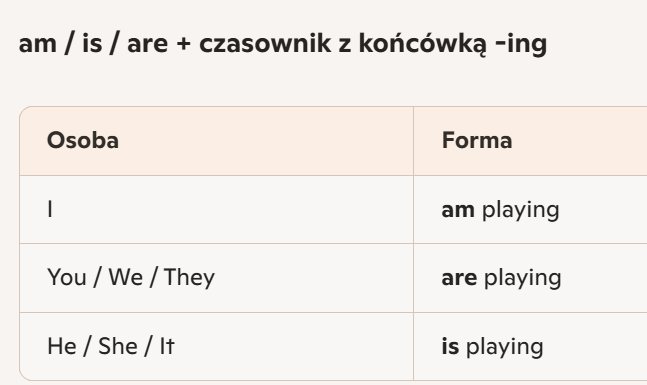
am/is/are + czasownik -ing

Przykłady:

  • We are meeting at 6 p.m.
  • She is flying to London next week.
  • I am having dinner with my cousins tomorrow.

Kiedy używać:

  • ustalone plany
  • spotkania, wyjazdy, wydarzenia z kalendarza

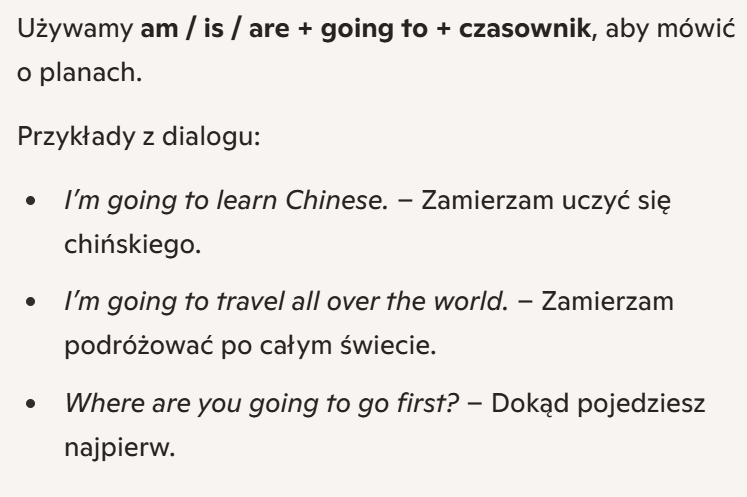
3. Be going to

Używamy, gdy mówimy o intencjach (co planujemy zrobić) lub o przyszłości widocznej teraz.

Budowa:

am/is/are + going to + czasownik

Przykłady:

  • I’m going to study medicine. (mam taki plan)
  • Look at the clouds! It’s going to rain. (widać oznaki)
  • They’re going to buy a new car.

Kiedy używać:

  • plany i zamiary
  • przewidywania oparte na tym, co widzimy

4. Relative Clause (zdanie względne)

Dodaje dodatkową informację o osobie, rzeczy lub miejscu. Najczęściej używamy: who, which, where.

who – do ludzi

  • The girl who lives next door is my friend.

which – do rzeczy

  • This is the book which I bought yesterday.

where – do miejsc

  • That’s the café where we met.

Po co używamy?

  • aby połączyć zdania
  • aby uniknąć powtarzania
  • aby dodać opis lub szczegół

Podsumowanie dla uczniów

  • will → szybkie decyzje, przewidywania, obietnice
  • present continuous (future) → ustalone plany
  • going to → zamiary i przyszłość „widoczna teraz”
  • relative clause → zdania dodające opis (who/which/where)
Categories
Lekcje klasa 1

Nice to meet you, Sam.

Klasa 1

Categories
Lekcje klasa 3

I ride a horse

Klasa 3

Categories
Lekcje klasa 7

Past Simple

Klasa 7

🧠 PAST SIMPLE — wyjaśnienie

📌 1. Do czego używamy Past Simple?

Używamy go, gdy mówimy o:

✔️ czynnościach zakończonych w przeszłości

  • I watched a film yesterday.
  • She visited her grandma last week.

✔️ wydarzeniach w konkretnym momencie przeszłości

  • They arrived at 6 p.m.
  • We played football on Saturday.

✔️ sekwencji wydarzeń (co było po kolei)

  • He got up, ate breakfast and went to school.

📌 2. Jak budujemy Past Simple?

✔️ Regular verbs (czasowniki regularne)

Dodajemy -ed:

  • watch → watched
  • play → played
  • open → opened

Uwaga na pisownię:

  • stop → stopped
  • study → studied

✔️ Irregular verbs (czasowniki nieregularne)

Trzeba je zapamiętać:

  • go → went
  • have → had
  • see → saw
  • make → made
  • eat → ate

📌 3. Zdania twierdzące

Podmiot + czasownik w Past Simple

  • I watched a documentary.
  • She went to the cinema.
  • They played a quiz show game.

📌 4. Zdania przeczące

Używamy didn’t + czasownik w formie podstawowej (bez -ed!)

  • I didn’t watch the news.
  • She didn’t see the horror film.
  • They didn’t like the comedy.

👉 Uczniowie często robią błąd: ❌ I didn’t watched ✔️ I didn’t watch

📌 5. Pytania

Używamy Did + podmiot + czasownik w formie podstawowej

  • Did you watch the talent show
  • Did she see the adventure film
  • Did they like the musical

Odpowiedzi:

  • Yes, I did.
  • No, I didn’t.

📌 6. Typowe określenia czasu w Past Simple

  • yesterday
  • last week / last month / last year
  • two days ago
  • in 2020
  • when I was a child
Categories
Lekcje klasa 6

TV and film

Klasa 6

Categories
Lekcje klasa 5

A / AN / SOME / ANY

Klasa 5

🍎 1. A / AN – używamy z rzeczownikami policzalnymi w liczbie pojedynczej

A – przed wyrazami zaczynającymi się od spółgłoski

  • a banana
  • a sandwich
  • a chocolate bar
  • a bottle of water

AN – przed wyrazami zaczynającymi się od samogłoski (a, e, i, o, u)

  • an apple
  • an orange
  • an egg

👉 Używamy, gdy mówimy o jednej rzeczy.

Przykłady:

  • I have a banana.
  • She wants an apple.
  • He bought a bottle of water.

🥛 2. SOME – używamy w zdaniach twierdzących

Do rzeczy niepoliczalnych i policzalnych w liczbie mnogiej.

✔️ SOME + uncountable (niepoliczalne)

  • some milk
  • some water
  • some juice
  • some rice
  • some pasta

✔️ SOME + countable plural (policzalne, liczba mnoga)

  • some apples
  • some bananas
  • some biscuits

👉 Używamy, gdy mówimy, że czegoś jest trochę / jakieś.

Przykłady:

  • There is some milk in the fridge.
  • I have some apples in my bag.
  • She bought some biscuits.

❓ 3. ANY – używamy w pytaniach i przeczeniach

✔️ ANY w pytaniach

  • Do you have any apples?
  • Is there any milk
  • Are there any bananas

✔️ ANY w przeczeniach

  • I don’t have any apples.
  • There isn’t any milk.
  • They don’t have any water.

👉 ANY = czy są jakieś / nie ma żadnych

🗣️ 4. Proste porównanie dla klasy 5

SłowoKiedy używamy?Przykład
a / anjedna policzalna rzecza banana, an apple
sometwierdzenia: trochę, jakieśsome milk, some apples
anypytania i przeczeniaany milk, any apples
Categories
Lekcje klasa 5

Countable and uncountable nouns

Klasa 5

🍎 1. Countable nouns (rzeczowniki policzalne)

To rzeczy, które możemy policzyć: 1, 2, 3…

  • mają liczbę pojedynczą (one apple)
  • mają liczbę mnogą (two apples)
  • możemy używać a / an (a banana, an apple)

✔️ Przykłady z koszyka (policzalne):

  • apple / apples
  • banana / bananas
  • carrot / carrots
  • sandwich / sandwiches
  • chocolate bar / chocolate bars
  • bottle of water / bottles of water
  • egg / eggs
  • roll / rolls

👉 Możemy powiedzieć: three apples, a banana, two sandwiches, five eggs

🥛 2. Uncountable nouns (rzeczowniki niepoliczalne)

To rzeczy, których nie możemy policzyć pojedynczo. Nie mają liczby mnogiej. Nie używamy a / an.

✔️ Przykłady z koszyka (niepoliczalne):

  • milk
  • water
  • juice
  • rice
  • pasta
  • sugar
  • flour
  • honey
  • jam
  • ketchup
  • mustard
  • chocolate (jako masa, nie baton!)

👉 Nie mówimy: ❌ two milks ❌ a sugar

Mówimy: ✔️ some milk ✔️ some rice ✔️ a bottle of water (bo liczymy butelkę, nie wodę!) ✔️ a bar of chocolate (bo liczymy baton, nie czekoladę jako masę)

🧺 3. Jak łatwo rozpoznać?

Policzalne → to, co widzisz jako pojedyncze sztuki

🍎 apple, 🥚 egg, 🥖 roll, 🍌 banana

Niepoliczalne → to, co jest „masą”, „płynem”, „proszkiem”

🥛 milk, 💧 water, 🍚 rice, 🍝 pasta, 🍫 chocolate (masa)

Categories
Lekcje klasa 8

Quick check (2) OPEN TASKS

Klasa 8

Przekształcenia zdań — Past Simple / Past Continuous

Key word transformation

Uzupełnij zdania — Past Simple i Past Continuous

Uzupełnij każde zdanie z luką tak, aby zachowało znaczenie zdania wyjściowego. Użyj podanego wyrazu, nie zmieniając jego formy — maksymalnie cztery wyrazy w luce.

Wskazówka: te zdania ćwiczą used to (dawne przyzwyczajenia), Past Continuous (czynność w tle przerwana przez inną), przeczenia z any-, konstrukcję by + sposób, oraz there was / there were.

Categories
Lekcje klasa 8

Quick check (2) – gramatyka, dialog

Klasa 8

Past Simple – czynność zakończona w przeszłości, w konkretnym momencie.
I watched a film yesterday. (obejrzałem – skończone)

Past Continuous – czynność trwająca w danym momencie w przeszłości (tło wydarzeń), często przerywana przez inną czynność.
I was watching a film when he called. (byłem w trakcie oglądania)

Past Habit (used to) – coś, co robiliśmy regularnie w przeszłości, ale już tego nie robimy.
I used to watch cartoons every day. (kiedyś robiłem to często, teraz już nie)

Skrót:

  • Past Simple → jedno wydarzenie, skończone
  • Past Continuous → coś się działo (tło, przerwana czynność) – was/were + -ing
  • Past Habit → kiedyś, a teraz już nie (zwyczaj) – used to + bezokolicznik
Categories
Lekcje klasa 3

OPENER

Klasa 3

Categories
Lekcje klasa 7

Modal Verbs (czasowniki modalne)

Klasa 7

Co to są modal verbs?

Modal verbs to specjalne czasowniki, które dodajemy przed czasownikiem głównym, żeby wyrazić m.in.: umiejętność, możliwość, przypuszczenie, obowiązek, pozwolenie lub radę.

Najważniejsza zasada: po modal verb czasownik główny jest zawsze w formie podstawowej (bez “to”).

✅ She can swim.
❌ She can to swim. / She cans swim.

Podstawowe modal verbs dla klasy 7

CAN / CAN’T – umiejętność i możliwość

  • I can ride a bike. (Umiem jeździć na rowerze.)
  • He can’t speak French. (On nie umie mówić po francusku.)

MUST / MUSTN’T – obowiązek i zakaz

  • You must do your homework. (Musisz odrobić pracę domową.)
  • You mustn’t talk during the test. (Nie wolno ci rozmawiać podczas testu.) – to jest zakaz, nie brak obowiązku!

SHOULD / SHOULDN’T – rada

  • You should eat vegetables. (Powinieneś jeść warzywa.)
  • You shouldn’t eat too much sugar. (Nie powinieneś jeść za dużo cukru.)

MAY / MIGHT – przypuszczenie, pozwolenie

  • It may rain tomorrow. (Może jutro padać.)
  • May I open the window? (Czy mogę otworzyć okno? – grzeczna prośba)

HAVE TO – obowiązek (z zewnątrz)

  • I have to wear a uniform at school. (Muszę nosić mundurek – to zasada szkoły, nie moja decyzja.)

MUST vs. MUSTN’T vs. DON’T HAVE TO

FormaZnaczenie
You must go.Musisz iść (obowiązek)
You mustn’t go.Nie wolno ci iść (zakaz!)
You don’t have to go.Nie musisz iść (masz wybór)

Charakterystyczne cechy modal verbs

  1. Nie dodajemy -s w 3. osobie liczby pojedynczej: She cans → She can
  2. Pytania tworzymy przez inwersję (bez “do/does”): Can you help me?
  3. Przeczenia: can’t, mustn’t, shouldn’t itd.
Categories
Lekcje klasa 8

Quick check 2

Klasa 8

Wynik: 0 / 14
Categories
Lekcje klasa 6

Transport

Klasa 6

Categories
Lekcje klasa 2

NEIGHBOURS (2) – słówka

Klasa 2

Categories
Lekcje klasa 4

Dni tygodnia

Klasa 4

Categories
Lekcje klasa 4

WELCOME Numbers 1-20

Klasa 4

Categories
Lekcje klasa 4

WELCOME – Plural Nouns

Klasa 4

1. Regular Plural (liczba mnoga regularna)

Większość rzeczowników w liczbie mnogiej tworzymy przez dodanie końcówki -s.

Liczba pojedynczaLiczba mnoga
a catcats
a bookbooks
a dogdogs
a penpens

Zasady dodawania końcówki

a) Dodajemy -s (większość rzeczowników):

  • cat → cats
  • car → cars
  • toy → toys

b) Dodajemy -es, gdy rzeczownik kończy się na: -s, -ss, -sh, -ch, -x, -z

  • bus → buses
  • class → classes
  • brush → brushes
  • watch → watches
  • box → boxes

c) Gdy rzeczownik kończy się na spółgłoskę + y → zamieniamy y na i i dodajemy -es

  • baby → babies
  • city → cities
  • family → families

(Ale jeśli przed „y” jest samogłoska, dodajemy tylko -s: boy → boys, day → days)

d) Niektóre rzeczowniki kończące się na -f lub -fe → zamieniamy na -ves

  • leaf → leaves
  • knife → knives

2. Irregular Plural (liczba mnoga nieregularna)

Niektóre rzeczowniki mają zupełnie inną formę w liczbie mnogiej – trzeba je zapamiętać na pamięć!

Liczba pojedynczaLiczba mnoga
a manmen
a womanwomen
a childchildren
a footfeet
a toothteeth
a mousemice
a personpeople
a fishfish (bez zmiany!)
a sheepsheep (bez zmiany!)

Przykłady zdań

  1. I have two cats and one dog. (regular)
  2. There are five children in the park. (irregular)
  3. She has white teeth. (irregular)
  4. Look at those boxes! (regular)
  5. Three mice are in the kitchen. (irregular)

1 cat – 2 cats

1 toy – 2 toys

1 bus – 2 buses

1 class – 2 classes

1 brush – 2 brushes

1 watch – 2 watches

1 box – 2 boxes

1 baby – 2 babies

1 city – 2 cities

1 family – 2 families

1 boy – 2 boys

1 day – 2 days

1 leaf – 2 leaves

1 knife – 2 knives

1 man – 2 men

1 woman – 2 women

1 child – 2 children

1 foot – 2 feet

1 tooth – 2 teeth

1 mouse – 2 mice

1 person – 2 people

1 fish – 2 fish

1 sheep – 2 sheep

Categories
Lekcje klasa 4

WELCOME – colours

Klasa 4

Categories
Lekcje klasa 5

Possessive adjectives

Klasa 5

Possessive Adjectives (przymiotniki dzierżawcze)

Possessive adjectives to słowa, które mówią, do kogo coś należy (czyj to przedmiot). W języku polskim odpowiadają np. “mój”, “twój”, “jego”, “jej”, “nasz”, “wasz”, “ich”.

Tabelka – zaimki osobowe i przymiotniki dzierżawcze

Imymój / moja / moje
youyourtwój / twoja / twoje
hehisjego
sheherjej
ititsjego / jej (o rzeczach / zwierzętach)
weournasz / nasza / nasze
you (l.mn.)yourwasz / wasza / wasze
theytheirich

Ważna zasada

Possessive adjective zawsze stoi przed rzeczownikiem – tak jak w polskim mówimy “mój pies”, tak po angielsku mówimy “my dog”.

⚠️ Uwaga: forma nie zmienia się w zależności od tego, czy rzeczownik jest w liczbie pojedynczej czy mnogiej:

  • my dog (mój pies)
  • my dogs (moje psy)

Przykłady zdań

  1. This is my book. – To jest moja książka.
  2. Is this your pencil? – Czy to jest twój ołówek?
  3. He loves his cat. – On kocha swojego kota.
  4. She is talking to her friend. – Ona rozmawia ze swoją przyjaciółką.
  5. The dog is wagging its tail. – Pies macha ogonem.
  6. We live in our house. – Mieszkamy w naszym domu.
  7. Is this your car? (do grupy) – Czy to jest wasz samochód?
  8. They are playing with their toys. – Oni bawią się swoimi zabawkami.

Częsty błąd uczniów

Dzieci często mylą:

  • it’s (skrót od “it is”) ❌
  • its (possessive – “jego/jej”) ✅

Przykład: The cat licks its paw. (Kot liże swoją łapę.) – bez apostrofu!

Categories
Lekcje klasa 5

Preposition of place

Klasa 5

Categories
Lekcje klasa 5

Question words

Klasa 5

Categories
Lekcje klasa 5

People

Klasa 5

Categories
Lekcje klasa 5

Countries and nationalities

Categories
Lekcje klasa 5

Sport

Klasa 5

🟦 PLAY – używamy z grami zespołowymi i sportami z piłką

PLAY = gdy jest piłka, drużyna, mecz, boisko.

✔️

  • basketball → play basketball
  • volleyball → play volleyball
  • football → play football
  • baseball → play baseball
  • tennis → play tennis (bo to gra, ma zasady, punkty, mecz)

👉

Jeśli możesz mieć drużynę albo mecz → PLAY.

🟩 GO – używamy z sportami zakończonymi na -ing

GO = gdy sport jest czynnością, ruchem, aktywnością fizyczną, zwykle kończy się na -ing.

✔️

  • skiing → go skiing
  • ice skating → go ice skating
  • sailing → go sailing
  • running → go running
  • swimming → go swimming
  • cycling → go cycling
  • horse riding → go horse riding

👉

Jeśli kończy się na -ing → GO.

🟧 Super‑prosto

PLAY = gry z piłką i drużynowe

basketball, volleyball, football, baseball, tennis

GO = sporty z -ing

skiing, ice skating, sailing, running, swimming, cycling, horse riding

Categories
Lekcje klasa 6

Keeping healthy

Klasa 6

Categories
Lekcje klasa 6

Dangerous sports

Klasa 6

Categories
Lekcje klasa 6

Jobs

Klasa 6

Would to słowo, które nie ma jednego stałego tłumaczenia — zależy od kontekstu. Najczęściej pomaga tworzyć grzeczne prośby, mówić o przyszłości w przeszłości oraz w zdaniach warunkowych (o czym uczniowie dowiedzą się później). Na razie w klasie 6 najważniejsze są dwa użycia:

1. Grzeczne prośby i pytania — “Would you like…?”

Używamy, gdy grzecznie coś proponujemy lub pytamy, czy ktoś czegoś chce.

AngielskiPolski
Would you like some tea?Czy chciałbyś/chciałabyś herbaty?
Would you like to play football?Czy chciałbyś zagrać w piłkę?
I would like a sandwich, please.Poproszę kanapkę. (dosłownie: Chciałbym kanapkę)

👉 Would like = chciałbym / chciałabyś — to grzeczniejsza wersja słowa “want” (chcieć).

2. Skrót ‘d

W mowie i piśmie często skracamy would do ‘d:

  • I would like → I’d like
  • She would like → She’d like

Prosta zasada do zapamiętania

👉 would like = grzeczne “chciałbym”
👉 działa jak “chciałbym” + rzeczownik LUB “chciałbym” + to + czasownik

Przykłady:

  • I’d like a pizza. → Chciałbym pizzę.
  • I’d like to go home. → Chciałbym pójść do domu.
  • Would you like to dance? → Czy chciałbyś zatańczyć?

Ważne: would ≠ want

  • want = chcę (bardziej bezpośrednio, mniej grzecznie): I want a pizza.
  • would like = chciałbym (grzeczniej, bardziej uprzejmie): I would like a pizza, please.

Categories
Lekcje klasa 7

Present Simple, Present Continuous

Klasa 7

🧠 Present Simple vs Present Continuous — wyjaśnienie

📌 1. Present Simple — czas teraźniejszy prosty

Używamy go, gdy mówimy o:

✔️ czynnościach regularnych

  • I get up at 7.
  • She watches the news every evening.

✔️ nawykach, rutynie

  • They play football on Saturdays.

✔️ faktach, prawdach ogólnych

  • Water boils at 100°C.
  • Documentaries show real events.

✔️ upodobaniach

  • I like comedies.
  • He doesn’t enjoy horror films.

🔧 Budowa

I/you/we/they + verb he/she/it + verb + -s

❗ Przeczenia i pytania

  • I don’t watch musicals.
  • Does she like adventure films

📌 2. Present Continuous — czas teraźniejszy ciągły

Używamy go, gdy mówimy o:

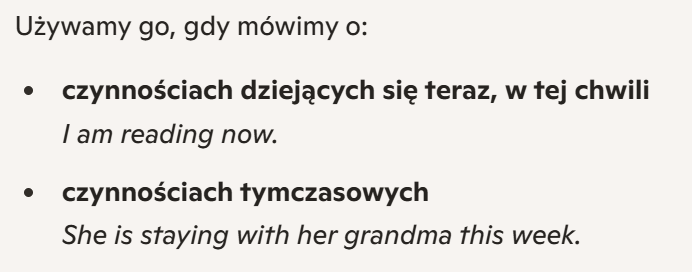
✔️ czynnościach dziejących się teraz, w tej chwili

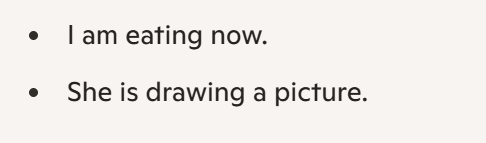
  • I am watching a cartoon now.
  • She is doing her homework at the moment.

✔️ tymczasowych sytuacjach

  • We are staying with our grandparents this week.

✔️ planach na najbliższą przyszłość

  • They are meeting after school.
  • I am going to the cinema tomorrow.

🔧 Budowa

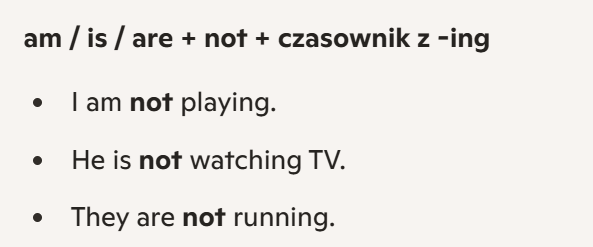
am/is/are + verb + -ing

❗ Przeczenia i pytania

  • I’m not watching the news now.
  • Is he reading a book

🎬 3. Przykłady z tematów: TV & films

Present Simple

  • I often watch documentaries.
  • She likes science fiction films.
  • They don’t enjoy soap operas.
  • My brother usually watches quiz shows.

Present Continuous

  • We are watching a comedy right now.
  • She is reading about horror films at the moment.
  • They are making a talent show this week.
  • I’m not watching the news now.

🔍 4. Jak rozpoznać, którego czasu użyć?

Present Simple → zawsze, często, zwykle, co tydzień

  • always
  • often
  • usually
  • every day/week
  • sometimes

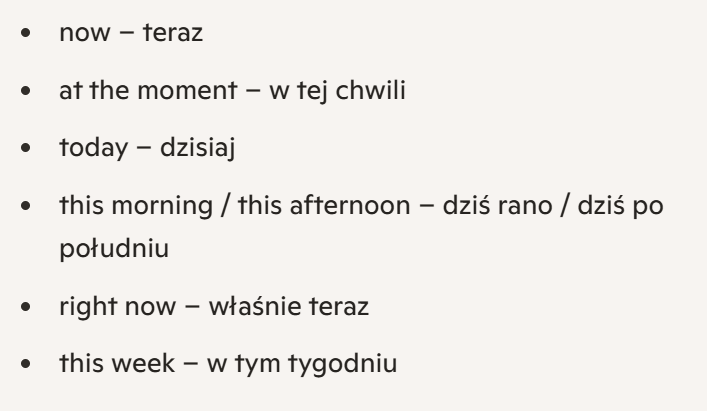
Present Continuous → teraz, w tej chwili, dziś, w tym tygodniu

  • now
  • at the moment
  • today
  • this week

🆚 5. Szybkie porównanie

Present SimplePresent Continuous
rutynaczynność w toku
faktysytuacje tymczasowe
upodobaniaplany na najbliższą przyszłość
he/she/it + -sam/is/are + -ing

Categories
Lekcje klasa 7

Jobs

Klasa 7

Categories
Lekcje klasa 7

Saxon genitive (dopełniacz saksoński)

Klasa 7

Saxon genitive (nazywany też “‘s genitive”) to sposób pokazywania przynależności (czyj to jest?) w języku angielskim. Używamy go głównie, gdy mówimy o ludziach, zwierzętach (rzadziej o rzeczach).

Budowa (forma)

1. Liczba pojedyncza → rzeczownik + ‘s

  • Tom’s book → książka Toma

2. Liczba mnoga zakończona na -s → tylko apostrof ‘

  • the students’ books → książki uczniów

3. Liczba mnoga nieregularna (bez -s) → ‘s

  • the children’s toys → zabawki dzieci

4. Imiona kończące się na -s → można dodać samo ‘ albo ‘s

  • Chris’ car / Chris’s car → samochód Chrisa

Przykłady zdań

AngielskiPolski
This is Anna’s cat.To jest kot Anny.
My sister’s room is blue.Pokój mojej siostry jest niebieski.
The dog’s tail is long.Ogon psa jest długi.
My parents’ house is big.Dom moich rodziców jest duży.
Mr. Smith’s car is new.Samochód pana Smitha jest nowy.

Ważna różnica: ‘s (‘s) vs of

  • Saxon genitive → dla ludzi i zwierząt: the boy’s bike (rower chłopca)
  • of → dla rzeczy: the color of the car (kolor samochodu), a nie the car’s color

Prosta zasada

👉 Właściciel + ‘s + rzecz posiadana
np. Mark’s phone = telefon Marka

Saxon Genitive — Koło Fortuny

Kliknij „Losuj imię” i „Losuj przedmiot”, a potem wpisz zdanie w formie dopełniacza saksońskiego (np. Jenny’s brush) i jego polskie tłumaczenie.

?
?
Wynik: 0 / 0
Categories
Lekcje klasa 8

My favourite photo

Klasa 8

Categories
Lekcje klasa 1

Are you curious? Colors

Klasa 1

Categories
Lekcje klasa 1

Are you curious? Color things

Klasa 1

Categories
Lekcje klasa 3

Wearing – Questions

Klasa 3

Categories
Lekcje klasa 7

Possessive adjectives and pronouns

Klasa 7

Possessive adjectives (przymiotniki dzierżawcze)

Mówią, do kogo coś należy i zawsze stoją przed rzeczownikiem.

ImyThis is my dog.
youyourIs this your book?
hehisHis name is Tom.
sheherHer cat is black.
ititsThe dog wags its tail.
weourOur school is big.
theytheirTheir house is new.

Possessive pronouns (zaimki dzierżawcze)

Zastępują całą frazę “przymiotnik + rzeczownik” – używamy ich, żeby nie powtarzać rzeczownika.

Zaimek osobowyPossessive Przykład
ImineThis book is mine.
youyoursIs this pen yours?
hehisThis bag is his.
shehersThe red coat is hers.
weoursThis house is ours.
theytheirsThese toys are theirs.
Categories
Lekcje klasa 8

OPEN TASKS

Klasa 8

Categories
Lekcje klasa 5

FOOD

Klasa 5

Categories
Lekcje klasa 5

Free time

Klasa 5

Categories
Lekcje klasa 2

Family

Klasa 2

Categories
Lekcje klasa 6

Looks and personality

Klasa 6

Ta osoba ma długie, jasne włosy i niebieskie oczy. Ta osoba jest miła i cierpliwa. Kto to jest?

This person has got long fair hair and blue eyes. This person is nice and patient. Who is it?

Ta osoba jest wysoka i ma zielone oczy oraz krótkie, ciemne, kręcone włosy. Ta osoba jest zawsze punktualna. Kto to jest?

This person is tall and has got green eyes and short dark curly hair. This person is always punctual. Who is it?

Categories
Lekcje klasa 4

Alphabet

Klasa 4

Categories
Lekcje klasa 3

Hello

Klasa 3

Jim

Categories
Domyślna kategoria

They’re my grandparents

Klasa 2

Categories
Lekcje klasa 5

At school, at home, my house, przyimki

Klasa 5

My house

There are six rooms in my house: a kitchen, a living room, a bathroom and three bedrooms.

In the kitchen there is a big table in the middle of the room. The fridge is next to the cooker and there are some cups on the shelf above the sink.

The living room is my favourite room. There is a sofa opposite the TV and a small table in front of the sofa. My cat often sleeps under the table. There are two pictures on the wall, between the window and the door.

My bedroom is small. There is a bed near the window and a desk behind the door. My schoolbag is on the floor beside the bed and my posters are on the wall.

The bathroom is at the end of the corridor.

Categories
Lekcje klasa 8

Choose the odd one out

Klasa 8

Categories
Lekcje klasa 8

Choose correct answers

Klasa 8

Choose the correct answers.

Kliknij formę, która Twoim zdaniem jest poprawna.

Poprawne odpowiedzi: 0 / 7

  1. I think CJ / shave his beard.

    Poprawnie: I think CJ should shave his beard.

    Dlaczego: should = rada, moja opinia („uważam, że powinien”). has to oznaczałoby przymus z zewnątrz (nakaz, przepis), co nie pasuje do wstępu I think.

    Tłumaczenie: Myślę, że CJ powinien zgolić brodę.

  2. Maddox / for his exams now.

    Poprawnie: Maddox is studying for his exams now.

    Dlaczego: słowo now to sygnał Present Continuous – czynność dzieje się w tej chwili.

    Tłumaczenie: Maddox uczy się teraz do egzaminów.

  3. All of us are into / videos.

    Poprawnie: All of us are into making videos.

    Dlaczego: be into something kończy się przyimkiem into, a po przyimku zawsze stoi forma z -ing.

    Tłumaczenie: Wszyscy kręcimy filmiki / bardzo lubimy kręcić filmiki.

  4. / any of your friends collect anything?

    Poprawnie: Do any of your friends collect anything?

    Dlaczego: podmiotem jest your friends – rzeczownik w liczbie mnogiej, więc operator to do, a czasownik nie ma końcówki -s.

    Tłumaczenie: Czy któryś z twoich znajomych coś kolekcjonuje?

  5. Only Jen and Steve / to hip-hop.

    Poprawnie: Only Jen and Steve don’t usually listen to hip-hop.

    Dlaczego: usually opisuje zwyczaj, a nie chwilę obecną – potrzebny jest Present Simple.

    Tłumaczenie: Tylko Jen i Steve zwykle nie słuchają hip-hopu.

  6. We really enjoy / time together.

    Poprawnie: We really enjoy spending time together.

    Dlaczego: po czasowniku enjoy zawsze stoi forma z -ing (podobnie: like, love, hate, mind).

    Tłumaczenie: Naprawdę lubimy spędzać razem czas.

  7. / you got such close friends in your class?

    Poprawnie: Have you got such close friends in your class?

    Dlaczego: w konstrukcji have got pytanie tworzymy przez inwersję (Have you got…?), bez operatora do.

    Tłumaczenie: Czy masz w swojej klasie takich bliskich przyjaciół?

Categories
Lekcje klasa 8

New Message

Klasa 8

Kliknij dowolne zdanie, aby zobaczyć tłumaczenie.

Hi Karren,
Just a quick email to let you know that I’m staying with the Johnsons in Leeds now.
They are visiting Emily’s grandmother and I’m here as a guest.
Emily’s grandma has got a big house so we play in the garden every day.
We also go for walks in the city.
Emily has got a really handsome cousin.
He’s 17, he’s tall and he’s very kind.
I really like him, Karren!
I’d like to have a boyfriend like him.
But it’s a secret and you have to keep it!
You mustn’t tell anyone, even your sister!
I can tell you more when I get back.
Anyway, I’d like to buy you something.
What would you like – a hoodie with the British flag or a badge?
Or maybe some earrings?
Let me know.
See you!
Sally
Categories
Lekcje klasa 1

Are you curious? – Comunication

Klasa 1

Categories
Lekcje klasa 1

Are you curious?

Klasa 1

Categories
Lekcje klasa 7

Numbers

Klasa 7

Cardinal numbers

Ordinal numbers

Plural nouns

Categories
Lekcje klasa 8

Quick Check

Klasa 8

1. My parents usually wake up half an hour earlier than me.
Moi rodzice zwykle budzą się pół godziny wcześniej niż ja.
2. My friends aren’t really keen on collecting things.
Moi przyjaciele tak naprawdę nie przepadają za kolekcjonowaniem rzeczy.
3. My older sister doesn’t want to get married or have children.
Moja starsza siostra nie chce wyjść za mąż ani mieć dzieci.
4. Please be punctual this time. We mustn’t be late!
Proszę, bądź punktualny tym razem. Nie możemy się spóźnić!
5. Be quiet, Tom. Lucy is sleeping.
Bądź cicho, Tom. Lucy śpi.
6. On weekdays after school we don’t play computer games.
W dni powszednie po szkole nie gramy w gry komputerowe.
7. We should go to bed early because we have to get up at 5.
Powinniśmy iść wcześnie spać, ponieważ musimy wstać o 5.
8. There are five people in my family.
W mojej rodzinie jest pięć osób.
9. You can come – we aren’t doing anything important at the moment.
Możesz przyjść – nie robimy teraz nic ważnego.
10. My brother and I are planning a surprise for our parents’ anniversary.
Mój brat i ja planujemy niespodziankę na rocznicę naszych rodziców.
11. Claire always knows everything – she is very clever.
Claire zawsze wszystko wie – jest bardzo mądra.
12. Fortunately, I don’t have to wear a white shirt for the ceremony.
Na szczęście nie muszę nosić białej koszuli na uroczystość.
13. My uncle hasn’t got a car.
Mój wujek nie ma samochodu.
14. What do Mike’s sisters study?
Co studiują siostry Mike’a?
Categories
Lekcje klasa 4

Welcome

Klasa 4

Buzz Lightyear – kosmiczny ranger-zabawka z filmów “Toy Story” (Pixar)

Kapitan Jack Sparrow – ekscentryczny pirat z serii “Piraci z Karaibów”, grany przez Johnny’ego Deppa

Hermiona Granger – jedna z głównych bohaterek serii “Harry Potter”, najzdolniejsza uczennica swojego rocznika

Luke Skywalker – główny bohater oryginalnej trylogii “Gwiezdnych wojen”, młody Jedi

Categories
Lekcje klasa 7

Who lives with you?

Klasa 7

I live with my parents and my younger sister.
She is twelve and I often help her with homework.
My mum is very kind and I talk to her every day.
My dad likes animals and we have a dog.
We love him very much and he always plays with us.
I take him for a walk after school.

Categories
Lekcje klasa 6

Family

Klasa 6

Tekst:
My family is small. I’ve got one brother. I haven’t got any cousins. I’ve got one grandma and two grandads.

Wersja 1:
My family is big. I’ve got two sisters. I’ve got a lot of cousins. I’ve got two grandmas and one grandad.

Wersja 2:
My family is small. I haven’t got any brothers or sisters. I’ve got one cousin. I’ve got one grandma and one grandad.

Wersja 3:
My family is big. I’ve got one brother and one sister. I’ve got three cousins. I’ve got two grandmas and two grandads.

Categories
Lekcje klasa 6

Meeting people

Kangaroos live in Australia. They are the only big animals in the world that hop to move from place to place. They have big hind legs and feet and a long strong tail that helps them keep their balance.

Kangury żyją w Australii. Są jedynymi dużymi zwierzętami na świecie, które przemieszczają się skacząc. Mają duże tylne nogi i stopy oraz długi, silny ogon, który pomaga im utrzymać równowagę.

Categories
Lekcje klasa 7

Zaimki osobowe: Subject vs Object pronouns

Subject pronouns (zaimki w funkcji podmiotu)

To zaimki, które wykonują czynność w zdaniu – stoją zazwyczaj przed czasownikiem.

ZaimekZnaczenie
Ija
youty/wy
heon
sheona
itono
wemy
theyoni/one

Przykład:

  • She likes pizza. (Ona wykonuje czynność – lubi)

Object pronouns (zaimki w funkcji dopełnienia)

To zaimki, na które czynność jest skierowana – stoją zazwyczaj po czasowniku lub po przyimku (to, for, with, at…).

ZaimekZnaczenie
memnie/mi
youciebie/tobie/was
himjego/jemu
herją/jej
itto
usnas/nam
themich/im

Przykład:

  • I like her. (Czynność “lubię” jest skierowana NA nią)

Porównanie w jednym zdaniu

🔹 She likes him.
→ She (ona) = podmiot, wykonuje czynność (subject)
→ him (jego) = dopełnienie, na kogo skierowana jest czynność (object)

Dosłownie: “Ona lubi jego” = “Ona go lubi”

Więcej przykładów

Subject (podmiot)Object (dopełnienie)
I love music.Music makes me happy.
We know them.They know us.
He gave a book to her.

Jak łatwo zapamiętać? 💡

Subject = “KTO/CO wykonuje czynność?” → na początku zdania
Object = “KOGO/CO dotyczy czynność?” → zwykle na końcu, po czasowniku

Prosta zasada: jeśli zaimek jest przed czasownikiem głównym → subject
Jeśli zaimek jest po czasowniku lub przyimku → object

1. To ja. Jestem Katie. Mam 14 lat.
This is me. I’m Katie. I am 14.
2. To mój brat. Ma 17 lat. Moja siostra jest obok niego. Ona ma 16 lat. Dzielę sypialnię z nią. Mieszkamy w Irlandii.
This is my brother. He is 17. My sister is next to him. She is 16. I share a bedroom with her. We live in Ireland.
3. To moja babcia. Ona mieszka z nami.
This is my grandmother. She lives with us.
4. To wąż mojego brata. Mieszka w jego pokoju. Nie lubię go zbytnio.
This is my brother’s pet snake. It lives in his room. I don’t like it very much.
5. To nasze rybki. Nie robią zbyt wiele, ale moja siostra je kocha.
These are our pet fish. They don’t do very much, but my sister loves them.

Categories
Lekcje klasa 7

Personal i impersonal pronouns – wyjaśnienie

Personal pronouns (zaimki osobowe)

To zaimki, które zastępują konkretną osobę, rzecz lub grupę – wiemy dokładnie, o kim lub o czym mówimy.

Liczba pojedyncza:

  • I – ja
  • you – ty
  • he – on
  • she – ona
  • it – ono (dla rzeczy/zwierząt)
  • Liczba mnoga:
  • we – my
  • you – wy
  • they – oni/one

Przykłady:

  • Tom is my friend. He plays football. (He = Tom)
  • My sister is smart. She likes math. (She = moja siostra)
  • I have a dog. It is brown. (It = pies)

W każdym zdaniu zaimek zastępuje konkretną osobę lub rzecz, którą wcześniej wymieniliśmy.

Impersonal pronoun (zaimek nieosobowy)

To specjalne użycie słowa it, które NIE zastępuje żadnej konkretnej osoby ani rzeczy. Używamy go, gdy mówimy ogólnie o:

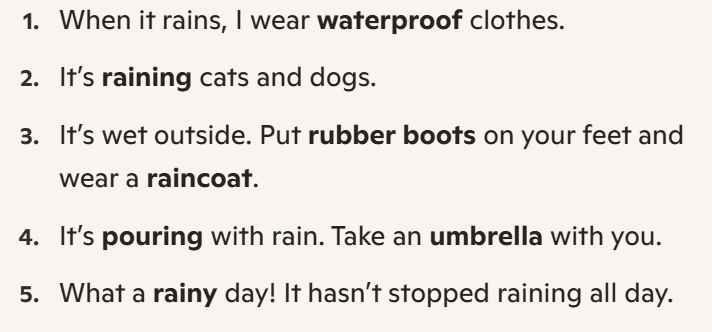
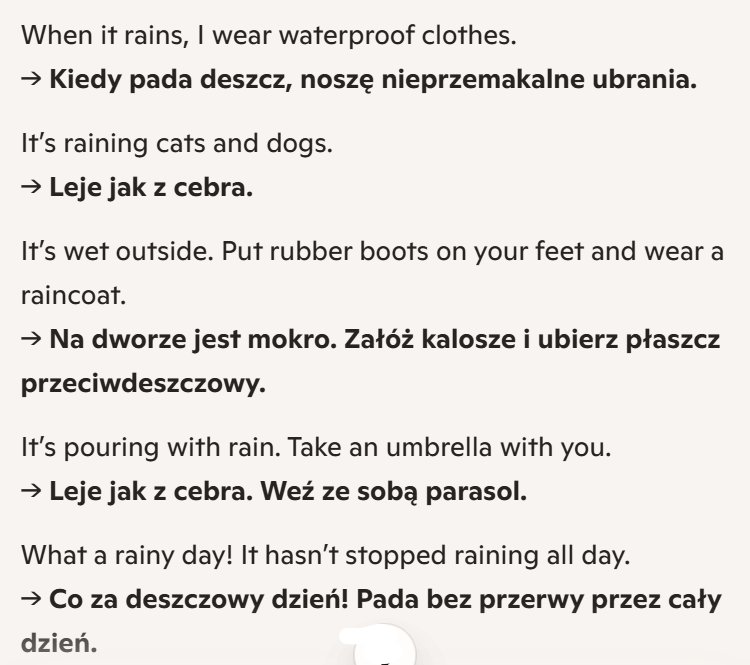
1. Pogodzie:

  • It is raining. (Pada.)
  • It’s cold today. (Dziś jest zimno.)

2. Czasie:

  • It is 5 o’clock. (Jest piąta.)
  • It’s Monday. (Jest poniedziałek.)

3. Odległości:

  • It is 10 kilometers to school. (Do szkoły jest 10 km.)

4. Ogólnych stwierdzeniach:

  • It is important to study. (Ważne jest, żeby się uczyć.)

Kluczowa różnica

Personal “it”Impersonal “it”
Zastępuje konkretną rzeczNic konkretnego nie zastępuje
I have a cat. It is black. (it = kot)It is snowing. (it = nic, tylko gramatyka wymaga podmiotu)

Zapamiętaj 💡

W angielskim zdaniu zawsze musi być podmiot – dlatego przy pogodzie, czasie czy odległości “sztucznie” wstawiamy it, mimo że nie ma ono żadnego znaczenia – pełni tylko funkcję gramatyczną.

Categories
Lekcje klasa 7

Famous places in New York

Klasa 7

Statue of Liberty

The Statue of Liberty is a famous statue on an island in New York. It is a symbol of freedom and one of the most well‑known sights in the USA. You can take a ferry to see it up close.

Times Square

Times Square is a very bright and busy place in the centre of New York. There are big advertisements, lights, and many tourists. It is very crowded, especially at night.

Central Park

Central Park is a huge park in the middle of New York City. There are trees, lakes, and paths where people walk, relax, or ride bikes. It is a quiet place in a very busy city.

Empire State Building

The Empire State Building is a tall skyscraper and one of the most famous buildings in New York. There is an observation deck at the top, and you can see a beautiful view of the whole city. It is a popular tourist attraction.

Brooklyn Bridge

The Brooklyn Bridge is a famous bridge that connects Manhattan and Brooklyn. Many people walk or bike across it to see the beautiful view of the city. It is one of the most iconic landmarks in New York.

Broadway

Broadway is a famous street in New York known for its theatres and musicals. You can watch many popular shows there. It is one of the most exciting places for entertainment in the city.

The Big Apple

“The Big Apple” is a nickname for New York City. People use it to show that the city is important, exciting, and full of life. It is one of the most well‑known nicknames in the world.

Categories
Lekcje klasa 6

Białowieża Forest

Klasa 6

Białowieska Puszcza

Białowieska Puszcza to bardzo duży i stary las, który leży na terenie Polski i Białorusi. Jest jednym z największych i najcenniejszych lasów w Europie. Część puszczy znajduje się w Polsce i nazywa się Białowieski Park Narodowy. Można tam wejść tylko z przewodnikiem, aby chronić przyrodę.

Las jest wyjątkowy, ponieważ rośnie tu od czasów końca epoki lodowcowej. Oznacza to, że wiele roślin i zwierząt żyje tu w naturalnych warunkach, prawie bez wpływu człowieka.

Najbardziej znanym zwierzęciem puszczy jest żubr – największy ssak lądowy w Europie. Żubry są pod ochroną, ponieważ kiedyś było ich bardzo mało. Podczas II wojny światowej wojska niemieckie zabiły wiele żubrów, dlatego później trzeba było je ponownie sprowadzić i chronić.

W puszczy żyją także inne zwierzęta, takie jak wilki, rysie, jelenie, łosie oraz wiele gatunków ptaków. To świetne miejsce dla osób, które lubią obserwować przyrodę. Organizowane są tu specjalne wycieczki, na których można zobaczyć rzadkie ptaki i zwierzęta.

Białowieża Forest

Białowieża Forest is a very big and old forest in Poland and Belarus. It is one of the most famous forests in Europe. The Polish part of the forest is called Białowieża National Park. People can enter this part only with a guide, because the forest is protected.

The forest is special because it has existed since the end of the Ice Age. Many plants and animals live here in natural conditions, without much human influence.

The most famous animal in the forest is the European bison. It is the biggest land animal in Europe. Bison are protected because many of them were killed in the past. During World War II, German soldiers killed a lot of bison, so later people had to bring them back and take care of them.

Other animals living in the forest include wolves, lynxes, deer, elk, and many different birds. Białowieża Forest is a great place for people who like nature. Visitors can join special birdwatching trips to see rare birds.

Questions

Where is Białowieża Forest located?

What is the Polish part of the forest called?

Why can people enter Białowieża National Park only with a guide?

Since when has the forest existed?

Why is Białowieża Forest special?

What is the most famous animal living in the forest?

Why are European bison protected?

What happened to many bison during World War II?

Name two predators that live in the forest.

Name two large herbivores that live in the forest.

Why is the forest a good place for people who like nature?

What can visitors do if they want to see rare birds?

Which two countries share Białowieża Forest?

What makes the forest natural and wild?

Why did people have to bring bison back after the war?

Answers

Białowieża Forest is located in Poland and Belarus.

The Polish part is called Białowieża National Park.

People can enter only with a guide because the forest is protected.

The forest has existed since the end of the Ice Age.

It is special because many plants and animals live there in natural, wild conditions.

The most famous animal is the European bison.

Bison are protected because many of them were killed in the past.

During World War II, German soldiers killed many bison.

Two predators are wolves and lynxes.

Two large herbivores are deer and elk.

It is a good place for nature lovers because many wild animals and birds live there.

Visitors can join birdwatching trips to see rare birds.

Poland and Belarus share Białowieża Forest.

The forest is natural and wild because it has existed since the Ice Age and people changed it very little.

People had to bring bison back because their population became very small after the war.

Grammar – ważne elementy z tekstu

Present Simple

Używany do opisywania faktów i stałych informacji. Białowieża Forest is a very big and old forest. Many animals live in natural conditions.

Passive Voice (strona bierna)

Używana, gdy ważniejsza jest czynność niż wykonawca. Bison are protected. Many bison were killed during World War II.

Present Perfect – krótkie użycie w tekście

Pokazuje, że coś zaczęło się w przeszłości i trwa do dziś. The forest has existed since the end of the Ice Age.

Past Simple – wydarzenia historyczne

German soldiers killed many bison.

Comparatives / Superlatives

one of the most famous forests

the biggest land animal in Europe

Pronunciation

Trudniejsze wyrazy

Forest – /ˈfɒrɪst/ – nie czytamy „fo-rest”

Białowieża – /bʲa.woˈvʲe.ʐa/ (przybliżenie angielskie) Belarus – /ˌbeləˈruːs/

national – /ˈnæʃənəl/ – „sz” w środku

protected – /prəˈtektɪd/

European – /ˌjʊərəˈpiːən/ – „piːən” na końcu

bison – /ˈbaɪsən/ – „baj-sen”

species – /ˈspiːʃiːz/ – „sziiz” lynx – /lɪŋks/ elk – /elk/ guide – /ɡaɪd/ – „gajd”

rare – /reə(r)/ – trudna samogłoska

wildlife – /ˈwaɪldlaɪf/

Understanding the text

Możliwe trudności

• „Has existed since…” Może być trudne – oznacza, że coś zaczęło się dawno temu i trwa do dziś.

• „Natural conditions” Znaczy: środowisko bez dużego wpływu człowieka.

• „Protected by law” Zwierzyna jest chroniona – nie wolno jej zabijać ani niepokoić.

• „Birdwatching trips” Specjalne wycieczki, podczas których obserwuje się ptaki.

• „The biggest land animal in Europe” „Land animal” = zwierzę lądowe.

• „Share the forest between two countries” Las leży na terenie dwóch państw.

• „Little human influence” Człowiek prawie nie zmienił tego miejsca.

• „Rare birds / rare animals” „Rare” = rzadkie, trudne do zobaczenia.

Categories
Lekcje klasa 2

Minikapsuła czasu

Klasa 2

Co to jest kapsuła czasu?

Kapsuła czasu to specjalne pudełko lub koperta, do której wkładamy różne rzeczy z teraźniejszości — rysunki, zdjęcia, listy, opisy, małe pamiątki. Zamykamy ją i otwieramy dopiero za kilka lat, żeby zobaczyć:

  • jak wyglądaliśmy,
  • co lubiliśmy,
  • co było dla nas ważne,
  • jak zmieniliśmy się przez ten czas.

List do przyszłego siebie.

Kuba

I’m Kuba. I’m eight.
I like sport and books.
I ride a skateboard and I swim at the weekend.
I read books every day.
I’ve got a sister, Weronika.
She’s ten. She likes winter, but I like summer.
I like animals and I’ve got a cat, Bulwa. It’s big and black.
I’ve got lots of friends.

Tłumaczenie

Jestem Kuba. Mam osiem lat. Lubię sport i książki. Jeżdżę na deskorolce i pływam w weekend. Czytam książki codziennie. Mam siostrę, Weronikę. Ma dziesięć lat. Ona lubi zimę, ale ja lubię lato. Lubię zwierzęta i mam kota, Bulwę. Jest duży i czarny. Mam wielu przyjaciół.

Ola

I’m Ola. I’m eight. I like drawing and riding my bike. I play with my friends after school. I love summer because I can swim. I’ve got a little brother. His name is Franek. I’ve got a dog called Luna. She’s small and white.

Tłumaczenie

Jestem Ola. Mam osiem lat.
Lubię rysować i jeździć na rowerze.
Bawię się z przyjaciółmi po szkole.
Uwielbiam lato, bo mogę pływać.
Mam młodszego brata. Ma na imię Franek.
Mam psa o imieniu Luna. Jest mała i biała.

Bartek

I’m Bartek. I’m seven.
I like Maths and English.
I go to school with my best friend, Maks.
I play football at the weekend.
I’ve got a hamster. His name is Pixel.
I like winter because I can go sledging.

Tłumaczenie

Jestem Bartek. Mam siedem lat. Lubię matematykę i angielski. Chodzę do szkoły z moim najlepszym przyjacielem, Maksem. Gram w piłkę nożną w weekend. Mam chomika. Ma na imię Pixel. Lubię zimę, bo mogę jeździć na sankach.

Zosia

I’m Zosia. I’m eight.
I like music and dancing.
I listen to songs every day.
I’ve got a sister, Maja. She’s twelve.
We play board games together.
I’ve got a cat called Mimi. I love animals.

Tłumaczenie

Jestem Zosia. Mam osiem lat.
Lubię muzykę i taniec.
Słucham piosenek codziennie.
Mam siostrę, Maję. Ma dwanaście lat.
Gramy razem w gry planszowe.
Mam kota o imieniu Mimi. Kocham zwierzęta.

Narysuj siebie „today”

Portret + 3 podpisy po angielsku (np. I like… I can… My favourite…).

Categories
Lekcje klasa 4

Leprechauns

Klasa 4

Leprechauns are small magic people from Ireland. They wear green jackets, green hats, and they have beards.

People say leprechauns like to play tricks. They also keep gold in a pot at the end of the rainbow.

If you see a rainbow, you can imagine a leprechaun hiding nearby. Leprechauns are a symbol of good luck.

Questions

Where are leprechauns from?

What colour clothes do leprechauns wear?

What do leprechauns have on their faces?

What do leprechauns like to do?

Where do they keep their gold?

What can you imagine when you see a rainbow?

What are leprechauns a symbol of?

Answers

They are from Ireland.

They wear green clothes (green jackets and green hats).

They have beards.

They like to play tricks.

They keep their gold in a pot at the end of the rainbow.

You can imagine a leprechaun hiding nearby.

They are a symbol of good luck.

Categories
Lekcje klasa 4

Ireland

Klasa 4

Ireland is an English-speaking country. Its national colour is green and its national symbol is the shamrock leaf. The capital city of Ireland is Dublin. St Patrick’s Cathedral is in Dublin. St Patrick is the patron saint of Ireland.
People celebrate St Patrick’s Day on 17th March. They dress in green and there are parades and parties. There is a lot of food and drink. People sing and play music. You can hear bagpipes.
Hurling is a popular sport in Ireland. It is very old – about 3000 years old. You need a stick, a ball and a goal. The ball can move at over 100 kilometres per hour. Sometimes players wear helmets to protect their heads.
Does your country have a patron saint? Does it have a national colour or symbol? What sport is popular in your country?

Słownictwo

English-speaking country — kraj anglojęzyczny

national colour — kolor narodowy

national symbol — symbol narodowy

shamrock — koniczynka

capital city — stolica

cathedral — katedra

patron saint — święty patron

celebrate — świętować

parade — parada

bagpipes — dudy

hurling — hurling (irlandzki sport)

stick — kij

goal — bramka

helmet — kask

protect — chronić

Gramatyka

Present Simple – fakty i informacje

Tekst opisuje fakty, dlatego używa Present Simple:

  • Ireland is…
  • People celebrate…
  • The ball can move…
Czasownik „can” – umiejętność / możliwość

The ball can move… — piłka może się poruszać

„can” + czasownik podstawowy

  • can move, can hear
There is / There are

There is a lot of food — jest dużo jedzenia

There are parades — są parady

Trudności w wymowie

Ireland — /ˈaɪə.lənd/ — pierwsza sylaba jak „aj”

Dublin — /ˈdʌb.lɪn/ — „u” jak w „cup”

shamrock — /ˈʃæm.rɒk/ — „sh” jak w „sz”, ale krótkie „a”

cathedral — /kəˈθiː.drəl/ — trudne „th” (język między zęby)

patron — /ˈpeɪ.trən/ — „ei” jak „ej”

bagpipes — /ˈbæɡ.paɪps/ — „bag” jak „beg”, „pipes” jak „pajps”

hurling — /ˈhɜː.lɪŋ/ — „hɜː” jak długie „her”

Ważne informacje kulturowe

Irlandia jest nazywana zieloną wyspą — dlatego zielony to kolor narodowy.

Shamrock (koniczynka) to symbol szczęścia i Irlandii.

St Patrick’s Day to bardzo radosne święto — ludzie ubierają się na zielono.

Hurling to jeden z najszybszych sportów na świecie.

W Irlandii często gra się na dudach — charakterystyczny dźwięk.

Categories
Lekcje klasa 2

The Hare and the Tortoise

Panel 1

Bird: “Look! It’s our friend, the tortoise.“
Tortoise: “Hello.“

Panel 2

Hare: “I’m fast and you’re slow!“
Tortoise: “You’re riding a bike.“

Panel 3

Hare: “I can run. Can you run?“
Tortoise: “No, I can’t, but I can win a race.“

Panel 4

Hare: “I’m fast and you’re slow!“
Tortoise: “I’m slow, but I don’t stop.“

Panel 5

Hare: “I can win the race.“
Tortoise: “I’m walking. I can’t run.“

Panel 6

Bird: “The hare is sleeping.“
Tortoise: “I’m walking. I’m not stopping.“

Panel 7

Tortoise: “I’m the winner!“
Hare: “What? Oh no!“

Panel 8

Bird: “They’re laughing!“
Tortoise: “It’s OK. Let’s be friends.“

Categories
Lekcje klasa 6

Famous people – quiz(2)

Klasa 6

Who wrote the fairy tale The Little Mermaid?

Hans Christian Andersen

Hans Christian Andersen was a writer from Denmark. He wrote many well‑known fairy tales, like The Little Mermaid. He is famous because children all over the world read his stories.

The Brothers Grimm

The Brothers Grimm were two German writers, Jacob and Wilhelm. They collected old folk tales and wrote them down. Many of their stories, like Cinderella and Snow White, are still popular today. They are famous because they saved traditional fairy tales.


Who made the first flying machine?

The Lumière Brothers

The Lumière brothers were inventors from France. They created one of the first film cameras and showed some of the first movies. Their short films were very simple but exciting for people at that time. They are famous because they helped start modern cinema.

The Wright brothers

The Wright brothers were inventors from the United States. They built the first successful airplane in 1903. They are famous because they started the age of flying.

Who wrote the children’s book Alice’s Adventures in Wonderland?

J. M. Barrie

J. M. Barrie was a Scottish writer. He wrote the story of Peter Pan, a boy who never grows up. His book is full of adventure and magic. He is famous because Peter Pan became one of the most loved characters in children’s literature.

Lewis Carroll

Lewis Carroll was an English writer and mathematician. He wrote Alice’s Adventures in Wonderland. He is famous because he created a magical and imaginative world for children.

Categories
Lekcje klasa 4

The United Kingdom

Klasa 4

The United Kingdom is a country made of four parts: England, Scotland, Wales and Northern Ireland.

Each part has its own capital city:

England – London

Scotland – Edinburgh

Wales – Cardiff

Northern Ireland – Belfast

People who live in the United Kingdom are British. They can also be English, Scottish, Welsh or Irish.

Each part of the UK looks different:

  • England is mostly flat. There are many villages, small houses and gardens.
  • Scotland has castles, lakes and high mountains.
  • Wales has green mountains, blue lakes and long valleys.
  • Northern Ireland is across the sea. Its capital city has big buildings and beautiful public gardens.
Categories
Lekcje klasa 5

The London Eye

Klasa 5

The London Eye is a big wheel in London. It stands next to the River Thames. It is very tall. People can ride in special glass capsules and see the city from above.

The wheel has 32 capsules. Each capsule can take many people. The London Eye moves slowly, so passengers can get on and off safely. One ride takes about 30 minutes.

The wheel looks like a big bicycle wheel. It was made by people from different European countries.

From the top, you can see the River Thames, the Houses of Parliament and other famous places in London. Many tourists visit the London Eye every year.

O czym jest tekst?

Tekst opisuje London Eye – bardzo duże koło w Londynie. Stoi obok rzeki Tamizy. Ludzie jeżdżą w szklanych kapsułach i oglądają miasto z góry. Przejażdżka trwa około 30 minut.

Słownictwo z tekstu

wheel – koło

capsule – kapsuła

river – rzeka

city – miasto

famous places – słynne miejsca

tourists – turyści

from above – z góry

slowly – powoli

Gramatyka w tekście

Present Simple – opis faktów

Tekst używa czasu Present Simple, bo opisuje stałe informacje:

  • It is very tall.
  • The wheel moves slowly.
  • People can ride in capsules.

Kiedy używamy? Do opisywania faktów, miejsc, wyglądu, działania rzeczy.

„Can” – możliwości

Choć nie ma ich dosłownie, tekst opisuje rzeczy, które można łatwo wyrazić tymi strukturami:

  • There is a big wheel in London.
  • There are 32 capsules.
Trudności w wymowie

Słowa, które mogą sprawiać problem

  • London – /ˈlʌndən/ (nie london po polsku)
  • Eye – /aɪ/ (jak „aj”)
  • Thames – /temz/ (nie czytamy „th” i „es”)
  • capsule – /ˈkæpsjuːl/
  • bicycle – /ˈbaɪsɪkəl/
  • tourists – /ˈtʊərɪsts/
  • famous – /ˈfeɪməs/

Na co uważać?

  • „th” w Thames NIE brzmi jak „th” → czytamy temz.
  • „Eye” to jedno długie aj.
  • W „bicycle” nie czytamy „y” jako „y”, tylko aj.
Ważne informacje z tekstu

London Eye stoi obok rzeki Tamizy.

Ma 32 kapsuły.

Jedna przejażdżka trwa około 30 minut.

Koło porusza się powoli.

Z góry widać całe miasto i słynne miejsca.

To bardzo popularna atrakcja turystyczna.

EN Questions

1.What is the London Eye?

2.Where is it located?

3.What can people see from the top?

4.How long does one ride take?

5.How does the wheel move?

6.What are the capsules made of?

7.Why do tourists visit the London Eye?

8.What does the wheel look like?

9.How many capsules does it have?

10.Is it a popular place?

EN Answers

It is a big wheel in London.

It is next to the River Thames.

You can see the city and famous places.

It takes about 30 minutes.

It moves slowly.

They are made of glass.

Because they want to see London from above.

It looks like a big bicycle wheel.

It has 32 capsules.

Yes, it is very popular.

Categories
Lekcje klasa 3

School leaving party

Klasa 3

Ms Barns: Listen, everybody. What’s happening tomorrow? Can you remember?

Children: It’s our school leaving party.

Ms Barns: That’s right! What is everybody doing?

Judy: We’re doing a ballet performance. Can we do it now?

Ms Barns: Yes, of course. Oh, that’s beautiful.

Luke: We’re doing a karate show. Come on, boys!

Ms Barns: That’s amazing. How often do you train?

Luke: We train twice a week, on Mondays and Thursdays.

Josh: I’m giving a short violin concert.

Ms Barns: You’re a great musician, Josh. Can you play any other instruments?

Josh: No, I can’t. I’d like to learn to play the trumpet.

Ms Barns: Don’t forget the invitations for your parents, and remember to bring some snacks and drinks! See you tomorrow!

Children: See you!

TŁUMACZENIE

Ms Barns:

Listen, everybody. Słuchajcie wszyscy.

What’s happening tomorrow? Co się jutro dzieje?

Can you remember? Pamiętacie?

Children:

It’s our school leaving party. To nasza impreza pożegnalna ze szkoły.

Ms Barns:

That’s right! Pani Barns: Zgadza się!

What is everybody doing? Co każdy z was robi?

Judy:

We’re doing a ballet performance. Can we do it now? Wystąpimy w pokazie baletowym. Czy możemy zrobić to teraz?

Ms Barns:

Yes, of course. Oh, that’s beautiful. Tak, oczywiście. Och, to piękne.

Luke:

We’re doing a karate show. Come on, boys! Robimy pokaz karate. Chodźcie, chłopaki!

Ms Barns:

That’s amazing. How often do you train? To niesamowite. Jak często trenujecie?

Luke:

We train twice a week, on Mondays and Thursdays. Trenujemy dwa razy w tygodniu, w poniedziałki i czwartki.

Josh:

I’m giving a short violin concert. Zagram krótki koncert skrzypcowy.

Ms Barns:

You’re a great musician, Josh. Can you play any other instruments? Jesteś świetnym muzykiem, Josh. Czy umiesz grać na innych instrumentach?

Josh:

No, I can’t. I’d like to learn to play the trumpet. Nie, nie umiem. Chciałbym nauczyć się grać na trąbce.

Ms Barns:

Don’t forget the invitations for your parents, and remember to bring some snacks and drinks! See you tomorrow! Nie zapomnijcie zaproszeń dla rodziców i pamiętajcie, żeby przynieść przekąski i napoje! Do zobaczenia jutro!

Children:

See you! Do zobaczenia!

Frazy

Categories
Lekcje klasa 6

Famous people – quiz

Klasa 6

Who thought of the theory of relativity?

a Albert Einstein  b Alfred Nobel


Albert Einstein

Albert Einstein was a famous scientist from Germany. He created the theory of relativity. His ideas changed how people understand time and space. He is famous because his work was very important for science.

Pytania

Who was Albert Einstein?

Where was he from?

What did he create?

What is the theory of relativity?

What did his ideas change?

What do people understand better because of his ideas?

Why is Albert Einstein famous?

Why was his work important for science?

What two things does the text mention: time and what else?

Did Einstein’s work change science?

Answers

Albert Einstein was a famous scientist.

He was from Germany.

He created the theory of relativity.

It is a theory that explains time and space.

His ideas changed how people understand time and space.

People understand time and space better because of his ideas.

He is famous because his work was very important for science.

His work was important because it changed science.

The text mentions time and space.

Yes, Einstein’s work changed science.

Gramatyka

Past Simple – czas przeszły prosty

W tekście pojawiają się podstawowe formy przeszłe:

  • was – był
  • created – stworzył
  • changed – zmieniły

Past Simple opisuje fakty z przeszłości:

  • Albert Einstein was a famous scientist.
  • He created the theory of relativity.
Present Simple – czas teraźniejszy prosty

Używany do faktów, które są nadal prawdziwe:

  • is – jest
  • people understand – ludzie rozumieją

Przykłady:

  • He is famous because…
  • People understand time and space.
„Because” – wyrażanie przyczyny

Słowo because oznacza „ponieważ” i łączy zdania:

  • He is famous because his work was very important.
Podstawowe słownictwo naukowe

Do zrozumienia tekstu potrzebne są znaczenia kilku kluczowych słów:

  • scientist – naukowiec
  • theory – teoria
  • ideas – pomysły
  • time and space – czas i przestrzeń
  • important – ważny
Konstrukcja „how people understand…”

To zdanie podrzędne wyjaśniające jak coś się dzieje:

  • how people understand time and space

How = „jak”.

Przymiotniki opisujące cechy

W tekście pojawiają się przymiotniki opisujące osobę i jej pracę:

  • famous – sławny
  • important – ważny

Alfred Nobel

Alfred Nobel was a scientist and inventor from Sweden. He invented dynamite, which was used in building and construction. Later, he created the Nobel Prizes to reward people for important work. He is famous because these prizes are known all over the world.

Questions

Who was Alfred Nobel?

Where was he from?

What did he invent?

What was dynamite used for?

What did Alfred Nobel create later in his life?

Why did he create the Nobel Prizes?

Why is Alfred Nobel famous today?

What are the Nobel Prizes known for?

Are the Nobel Prizes known all over the world?

What kind of work do the Nobel Prizes reward?

Answers

He was a scientist and inventor.

He was from Sweden.

He invented dynamite.

It was used in building and construction.

He created the Nobel Prizes.

To reward people for important work.

He is famous because he created the Nobel Prizes.

They are known for rewarding important work.

Yes, they are known all over the world.

They reward people for important work.

Gramatyka

Past Simple – czas przeszły prosty

W tekście pojawiają się podstawowe formy przeszłe:

  • was – był
  • invented – wynalazł
  • was used – był używany
  • created – stworzył

Past Simple opisuje fakty z przeszłości:

  • Alfred Nobel was a scientist and inventor.
  • He invented dynamite.
Strona bierna – Passive Voice

W tekście występuje prosta forma bierna:

  • was used – „był używany”

Używana, gdy ważniejsze jest działanie niż wykonawca:

  • Dynamite was used in building and construction.
Present Simple – czas teraźniejszy prosty

Używany do faktów, które są nadal prawdziwe:

  • is famous – jest sławny
  • are known – są znane

Przykłady:

  • He is famous because…
  • These prizes are known all over the world.
„Because” – wyrażanie przyczyny

Słowo because oznacza „ponieważ” i łączy zdania:

  • He is famous because these prizes are known all over the world.
Podstawowe słownictwo naukowe i opisowe

Do zrozumienia tekstu potrzebne są znaczenia kilku kluczowych słów:

  • scientist – naukowiec
  • inventor – wynalazca
  • dynamite – dynamit
  • building / construction – budownictwo
  • prizes – nagrody
  • important work – ważna praca
Przymiotniki opisujące cechy

W tekście pojawiają się przymiotniki opisujące osobę i jej osiągnięcia:

  • famous – sławny
  • important – ważny

Who was the first man to walk on the moon?

Neil Armstrong

Neil Armstrong was an American astronaut. He was the first man to walk on the Moon in 1969. He said a very famous sentence about a “small step”. He is famous because he made history in space exploration.

Yuri Gagarin

Yuri Gagarin was a Russian cosmonaut. He was the first man to travel into space in 1961. His flight lasted only 108 minutes, but it was a huge achievement. He is famous because he opened the door to human space travel.

Who painted the picture called the Mona Lisa?

Pablo Picasso

Pablo Picasso was a Spanish painter. He created many different styles of art, including Cubism. His paintings are colourful and very unique. He is famous because he changed modern art.

Leonardo da Vinci

Leonardo da Vinci was an Italian painter and inventor. He painted the Mona Lisa, one of the most famous paintings in the world. He liked to study nature and machines. He is famous because he was a great artist with many talents.

Categories
Lekcje klasa 7

New York

NEW YORK CITY

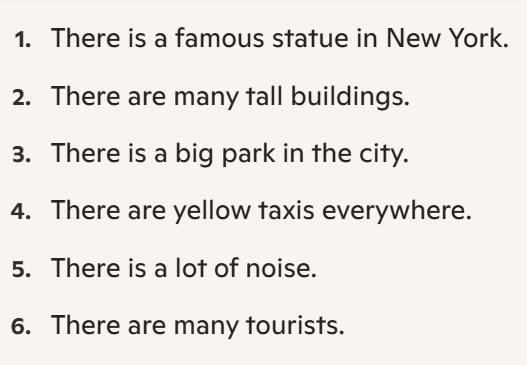
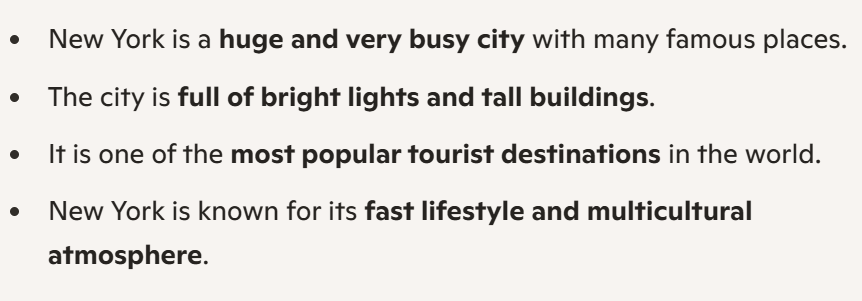
New York City is one of the most famous cities in the world. It is a huge and very busy place with tall buildings, bright lights, and people from many countries. The city is known for its yellow taxis, crowded streets, and famous places like the Statue of Liberty, Times Square, and Central Park.

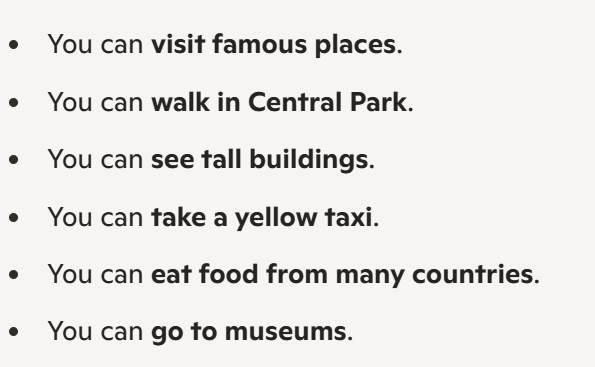
There are many attractions in New York. You can visit museums, walk in a big park, see skyscrapers, or try food from around the world. There is always something happening in the city, and it is full of energy and interesting things to see.

New York is different from most cities because it is very modern, very fast, and full of life. Many tourists visit it every year because there are so many things to do and explore.

Co można robić w Nowym Jorku?

MODELE ZDAŃ

SIMPLE SENTENCE
Opisywanie miasta
THERE IS / THERE ARE
THERE IS / THERE ARE – bardziej rozbudowane
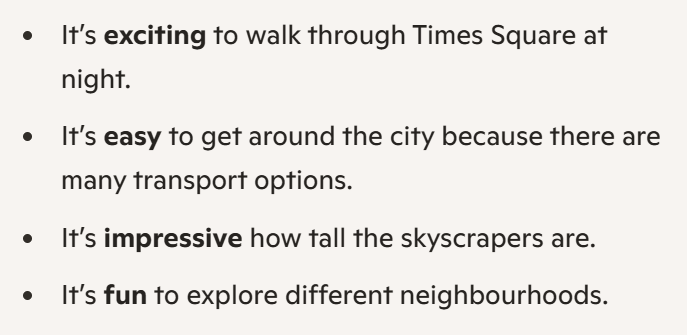
Czynności – YOU CAN…
Porównania – COMPARATIVES / SUPERLATIVES
Opisywanie wrażeń – IT’S…
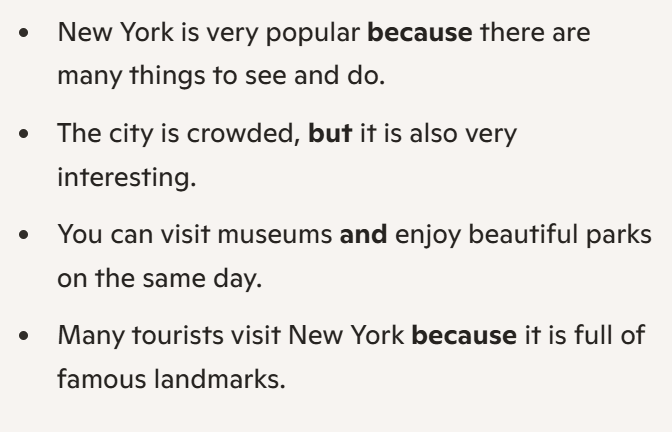
Łączenie zdań – BECAUSE / AND / BUT
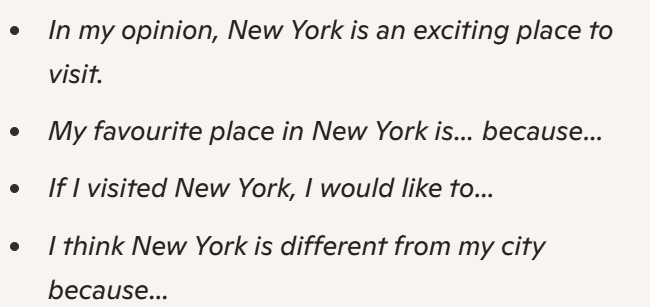
Mini‑modele do krótkich wypowiedzi ustnych
Categories
Lekcje klasa 6

Famous people

Klasa 6

Sir Edmund Hillary
Wolfgan Amadeus Mozart
Coco Chanel
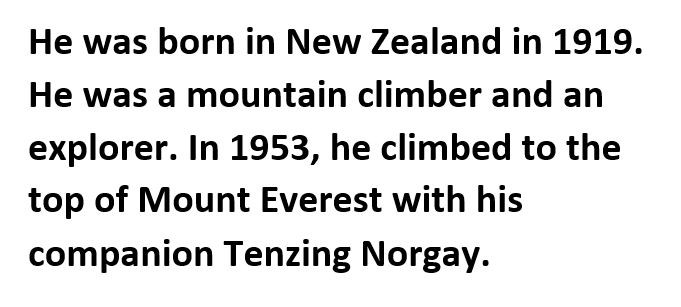
Sir Edmund Hillary

He was born in New Zealand.

He was born in 1919.

He was a mountain climber and an explorer.

He climbed to the top of Mount Everest.

Tenzing Norgay climbed Mount Everest with him.

He came from New Zealand.

He was a mountain climber and an explorer.

He reached the top of Mount Everest.

His climbing companion was Tenzing Norgay.

He climbed Mount Everest in 1953.

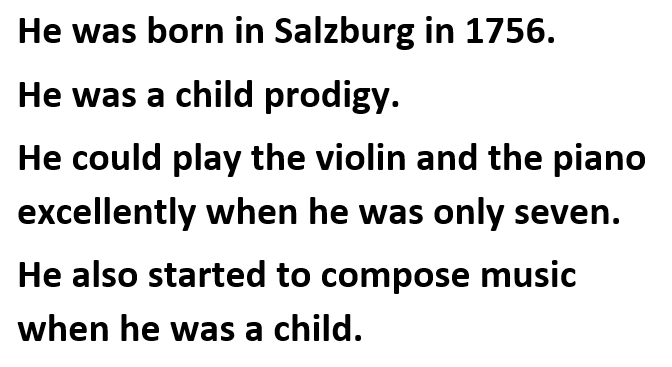
Wolfgan Amadeus Mozart

He was born in Salzburg.

He was born in 1756.

He was a child prodigy.

He could play the violin and the piano.

He was seven years old when he could play them excellently.

He started composing music when he was a child.

He could play the violin and the piano at the age of seven.

Yes, he was very talented as a child.

His birthplace was Salzburg.

He started composing music when he was a child.

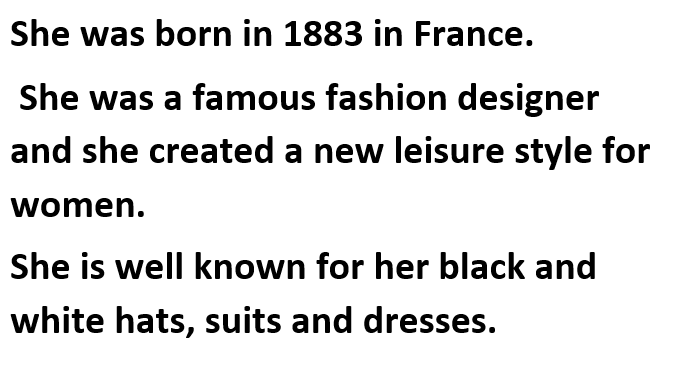
Coco Chanel – odpowiedzi

She was born in France.

She was born in 1883.

She was a famous fashion designer.

She created a new leisure style for women.

She introduced a new leisure style for women.

She is well known for her black and white hats, suits and dresses.

Her famous hats, suits and dresses were black and white.

Yes, she was a famous fashion designer.

She was born in France.

She designed hats, suits and dresses for women.

Categories
Lekcje klasa 6

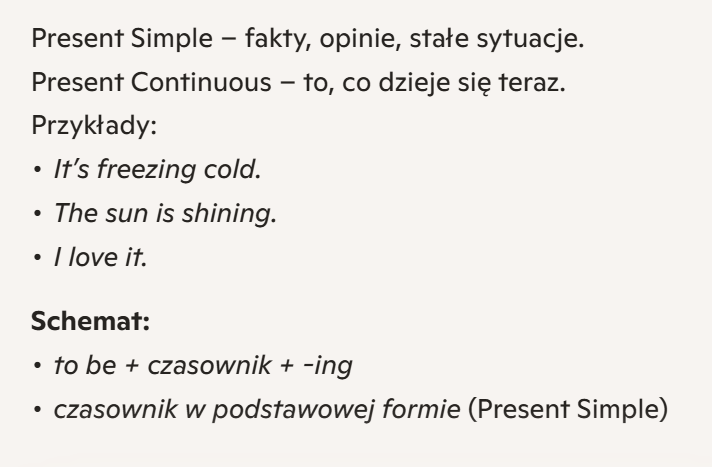
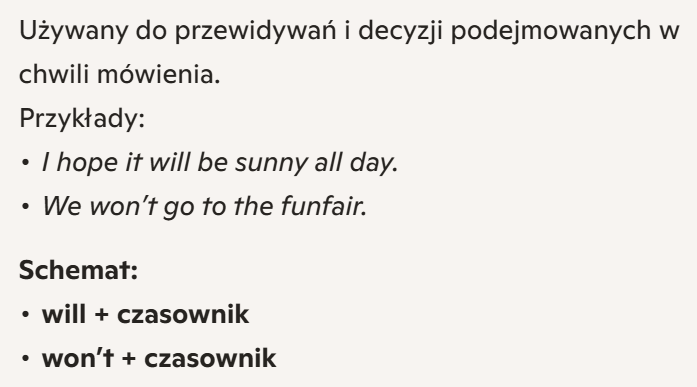
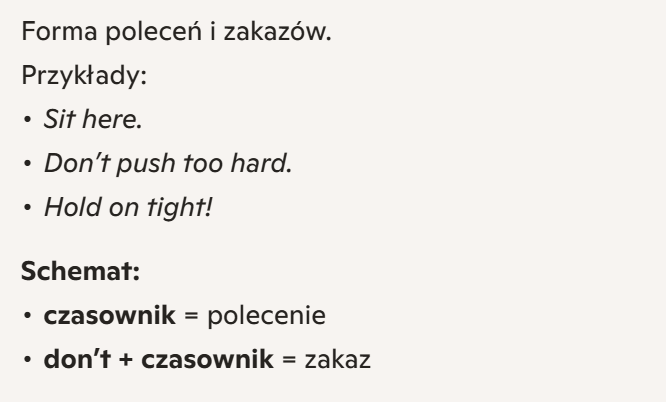
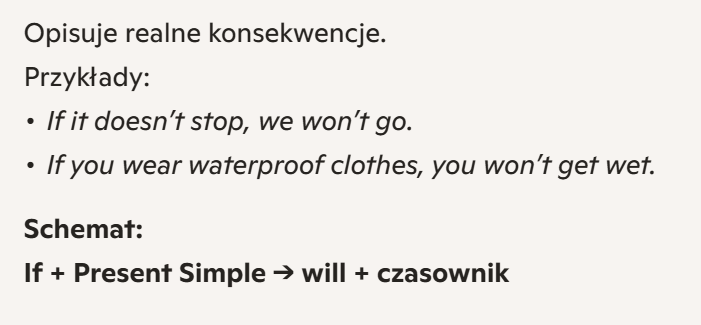
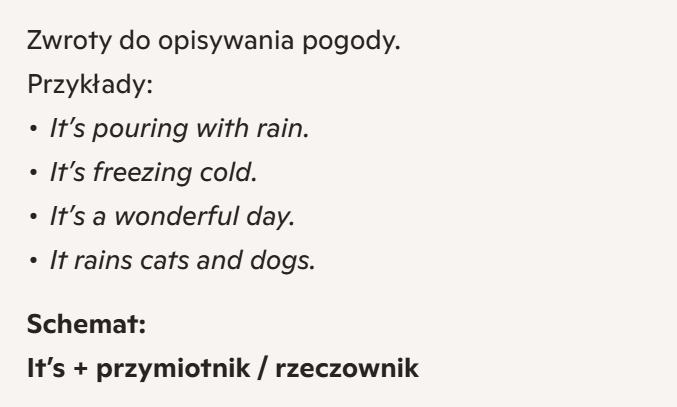
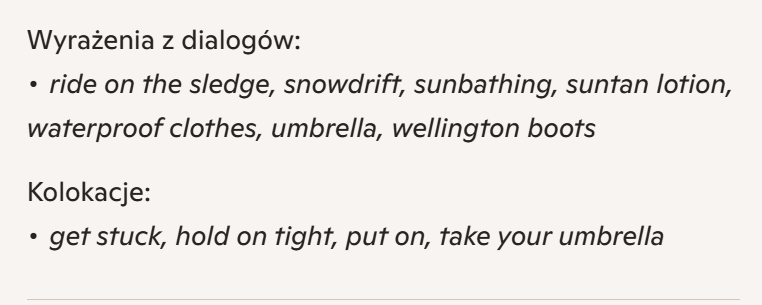
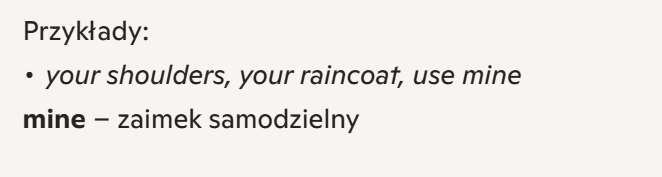
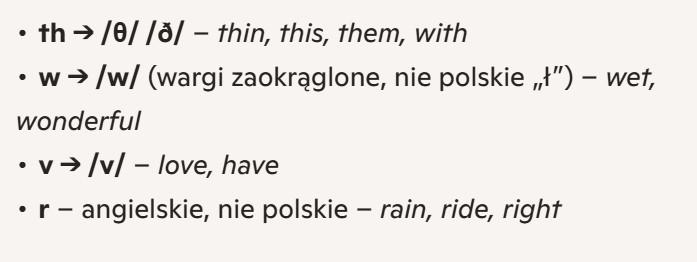
Come rain or shine (1,2,3)

NOTATKA GRAMATYCZNA

Konstrukcja „It’s + -ing” (Present Continuous dla pogody)
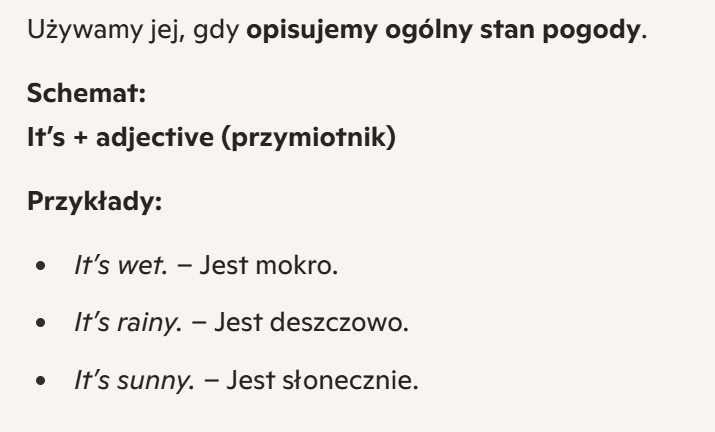
Konstrukcja „It’s + przymiotnik” (opis pogody)
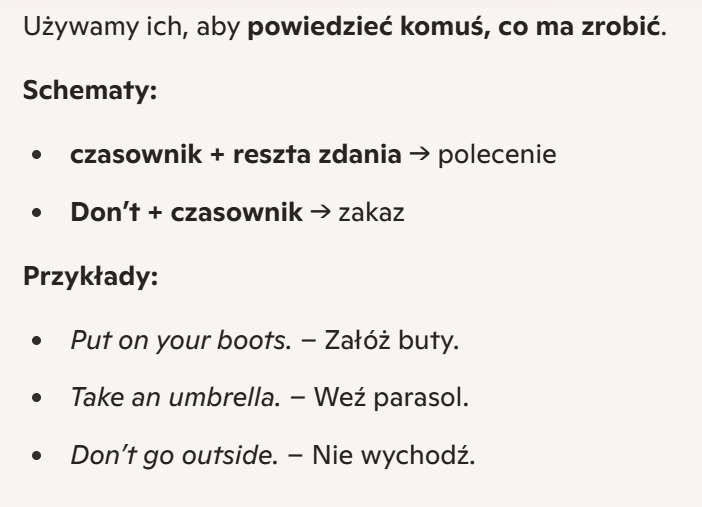
Polecenia i rady (imperatives)
Categories
Lekcje klasa 5

Destination (3)

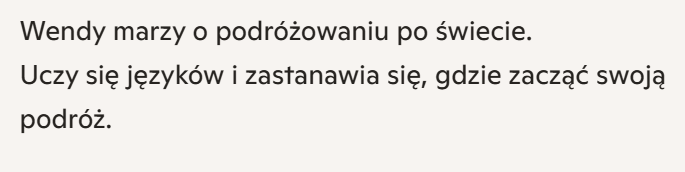
Klasa 5 Wendy’s plans

Wendy: When I grow up, Mum, I’m going to travel all over the world.

Mum: Where are you going to go first?

Mum: Well, how about going to Europe first? You’re learning French and German at school, so you can talk to people in France and Germany.

Wendy: I don’t know. I look at this globe every day but I don’t know where I’m going to start my journey!

Wendy: Good idea. But I’m going to learn Chinese too, so I can visit China!

Tłumaczenie

Wendy: Kiedy dorosnę, mamo, zamierzam podróżować po całym świecie.

Mum: Dokąd pojedziesz najpierw?

Mum: A może najpierw pojedziesz do Europy? Uczysz się francuskiego i niemieckiego, więc możesz rozmawiać z ludźmi we Francji i Niemczech.

Wendy: Nie wiem. Patrzę na ten globus codziennie, ale nie wiem, gdzie zacząć moją podróż.

Wendy: Dobry pomysł. Ale zamierzam też uczyć się chińskiego, żeby móc odwiedzić Chiny!

O czym jest dialog?
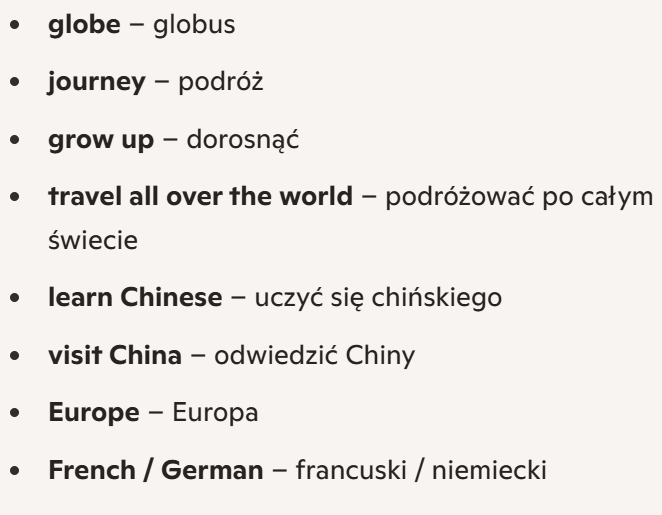
Useful words (ważne słowa)
Present Continuous – plany na przyszłość
Categories
Lekcje klasa 8

Language is fun

Klasa 8

Answer: a clock
Answer: a clock
Answer: a bottle
Answer: a coin
Answer: a piano
Answer: a table
Answer: a needle
Answer: corn / a cornfield
Answer: a shoe
Answer: a river
Answer: a comb
Answer: a garbage truck
Answer: a towel
Answer: your age
Answer: a cold
Answer: a mushroom
Answer: a teapot
Answer: a book
Answer: a telephone
Answer: a book
Answer: a chair
Answer: a river
Answer: a hurricane
Answer: a bell
Answer: a button
Answer: your legs
Answer: a zipper
Answer: a river
Answer: a bed
Answer: a book
Answer: a mannequin
Answer: a phone keyboard key
Answer: a zebra crossing
Answer: a rhinoceros
Answer: a car
Answer: a chair / desk with wheels
Answer: a bus stop
Answer: a fish
Answer: a chair
Answer: a lamp
Answer: an airplane
Answer: a turtle
Answer: an elephant
Answer: a kite
Answer: a computer
Answer: a river
Answer: a pineapple
Answer: a book (book jacket)
Answer: a piano
Answer: a cat
Categories
Lekcje klasa 4

A postcard

Klasa 4

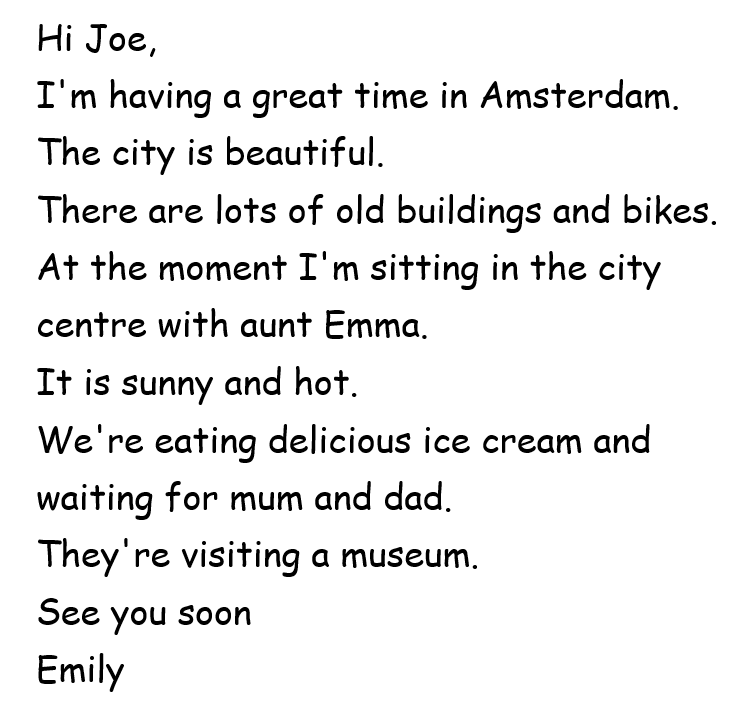
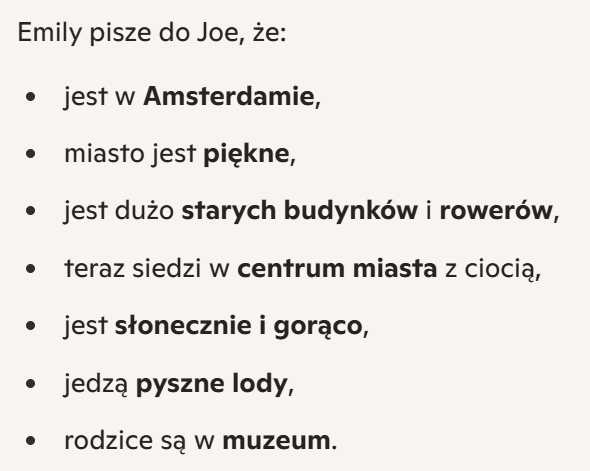
Pocztówka od Emily

Co to jest postcard?
Najważniejsze informacje z pocztówki
Useful words (ważne słowa z tekstu)

city – miasto

beautiful – piękne

old buildings – stare budynki

bikes – rowery

city centre – centrum miasta

sunny – słonecznie

hot – gorąco

ice cream – lody

museum – muzeum

aunt – ciocia

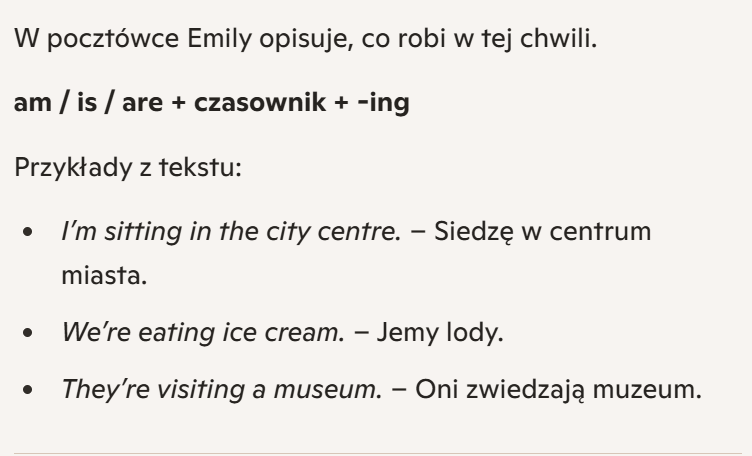
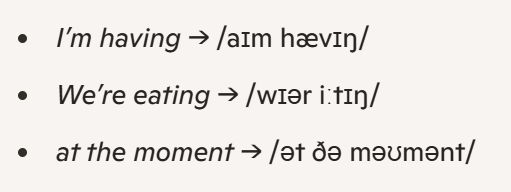
Present Continuous – co się dzieje TERAZ
Trudności w wymowie

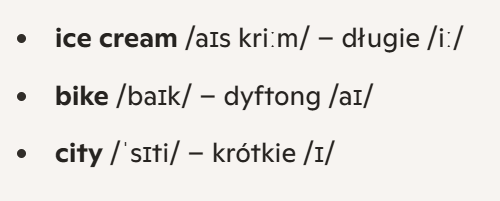
Długie i krótkie samogłoski
Połączenia wyrazów
Nazwy własne
Categories
Lekcje klasa 3

A SCHOOL TRIP

Klasa 3

What is a school trip?
Useful words (ważne słowa z tekstu)

countryside – wieś

farm – farma

forest – las

birds – ptaki

animals – zwierzęta

trees – drzewa

flowers – kwiaty

herbs – zioła

insects – owady

ants – mrówki

butterflies – motyle

campfire – ognisko

outdoor games – gry na dworze

What are they doing? (co robią?)

We’re visiting a farm. – Odwiedzamy farmę.

We’re walking in the forest. – Spacerujemy po lesie.

We’re taking photos. – Robimy zdjęcia.

We’re learning the names of the birds. – Uczymy się nazw ptaków.

We can ask questions. – Możemy zadawać pytania.

We can smell the flowers. – Możemy wąchać kwiaty.

We can look for insects. – Możemy szukać owadów.

We can make campfires. – Możemy robić ogniska.

We can play outdoor games. – Możemy grać na dworze.

Grammar – Present Continuous (co się dzieje TERAZ)

Categories
Lekcje klasa 5

Destination (2)

Klasa 5

What is a destination?
Useful phrases
Grammar focus – going to (plany)
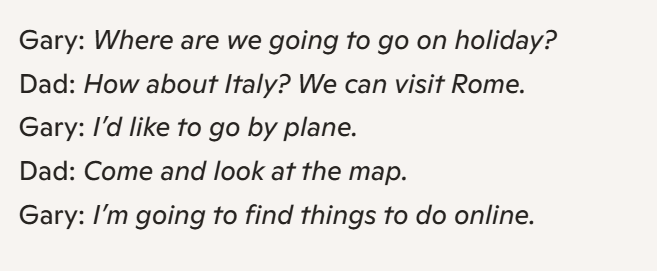
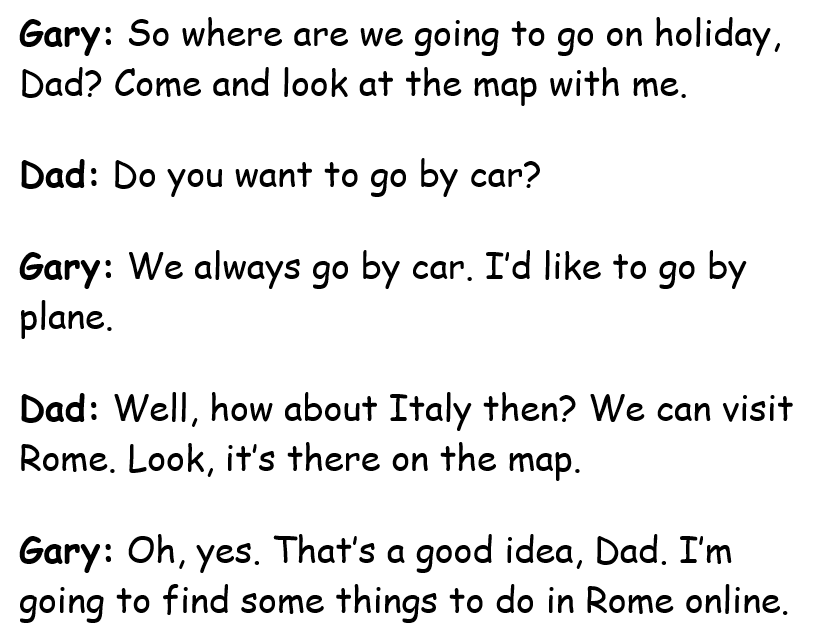
Mini‑dialog (z lekcji – uproszczony)
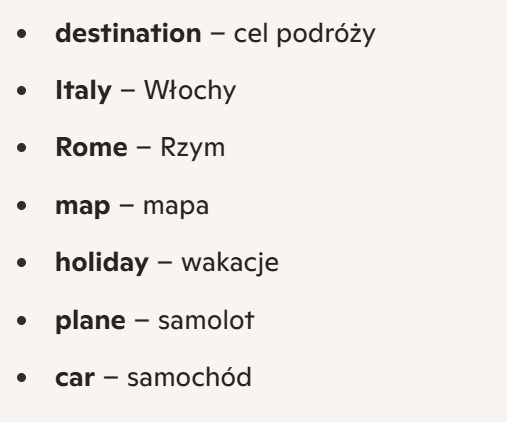
Vocabulary – miejsca i kierunki podróży
Krótkie wyrażenia językowe

go on holiday – jechać na wakacje

go by car – jechać samochodem

go by plane – lecieć samolotem

look at the map – patrzeć na mapę

come and look – chodź i zobacz

how about Italy – a może Włochy

visit Rome – odwiedzić Rzym

find things to do – znaleźć rzeczy do zrobienia

on the map – na mapie

good idea – dobry pomysł

where are we going to go – dokąd pojedziemy

I’d like to – chciałbym

that’s a good idea – to dobry pomysł

go on a trip – jechać na wycieczkę

choose a destination – wybrać cel podróży

plan the holiday – planować wakacje

look online – szukać w internecie

travel to Italy – podróżować do Włoch

find a place – znaleźć miejsce

look at the map with me – popatrz na mapę ze mną

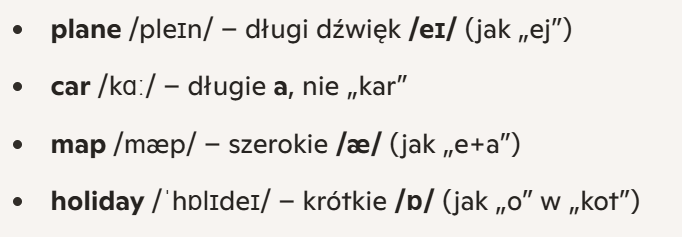
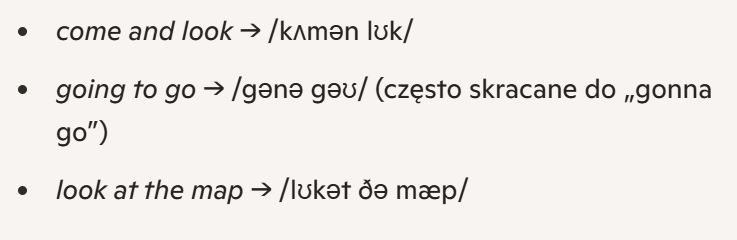
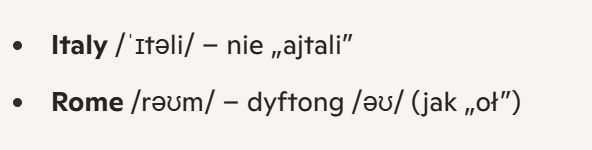
Trudności w wymowie
Łączenie wyrazów w mowie
Nazwy własne
Categories
Lekcje klasa 7

Getting around Manchester

Klasa 7 Poruszanie się po Manchesterze

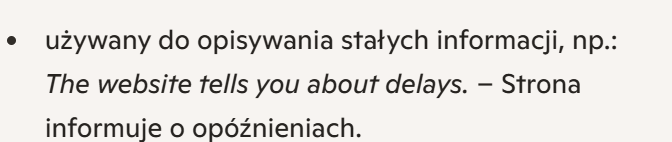
Manchester is an increasingly cool place to live or to visit. Now, getting around has never been easier thanks to more and more means of transport. A fantastic website, Transport for Greater Manchester (tfgm.com), will help you get to where you need to go. The website will tell you about the latest delays caused by accidents or road works. It will even tell you when there is a big football match so you can avoid traffic jams. And don’t forget that you can travel by bus or bike all-round the city centre. Isn’t that a cool way to arrive at the match?

Manchester has a great bus service, with buses covering the city centre as well as nearby towns. You can use the website’s Route Explorer to help you plan your bus route. Just type in where you want to go and you will see your choices. It will also tell you where the buses link up with trains and trams.

If you want to get fit, how about cycling? A new bike scheme, introduced in 2017, allows you to register using an app. After that, you just pick up one of the many bikes that you’ll find on the streets and ride it to wherever you want to go. Then you just leave it for the next cyclist to pick up. For you and for them, it’s very cheap, and it’s very convenient!

Tłumaczenie

Poruszanie się po Manchesterze

Manchester staje się coraz fajniejszym miejscem do życia lub odwiedzenia. Teraz poruszanie się po mieście jest łatwiejsze niż kiedykolwiek dzięki coraz większej liczbie środków transportu. Fantastyczna strona internetowa Transport for Greater Manchester (tfgm.com) pomoże ci dotrzeć tam, gdzie potrzebujesz. Strona poinformuje cię o najnowszych opóźnieniach spowodowanych wypadkami lub robotami drogowymi. Powie ci nawet, kiedy odbywa się duży mecz piłkarski, abyś mógł uniknąć korków. A nie zapominaj, że możesz podróżować autobusem lub rowerem po całym centrum miasta. Czy to nie świetny sposób, żeby dotrzeć na mecz?
Manchester ma świetną komunikację autobusową, a autobusy obsługują zarówno centrum miasta, jak i pobliskie miasteczka. Możesz skorzystać z Route Explorera na stronie, aby zaplanować swoją trasę autobusową. Wpisz tylko, dokąd chcesz jechać, a zobaczysz dostępne możliwości. Strona pokaże ci także, gdzie autobusy łączą się z pociągami i tramwajami.

Słownictwo potrzebne do zrozumienia tekstu

Transport i miasto
Komunikacja miejska
Internet i aplikacje

Gramatyka w tekście

Present Simple – fakty i działanie usług
Present Continuous – sytuacje dziejące się teraz
Bezokolicznik z „to”
Typowe zwroty z tekstu

Trudności w wymowie w tekście

Samogłoski długie i krótkie
Głoski trudne dla Polaków
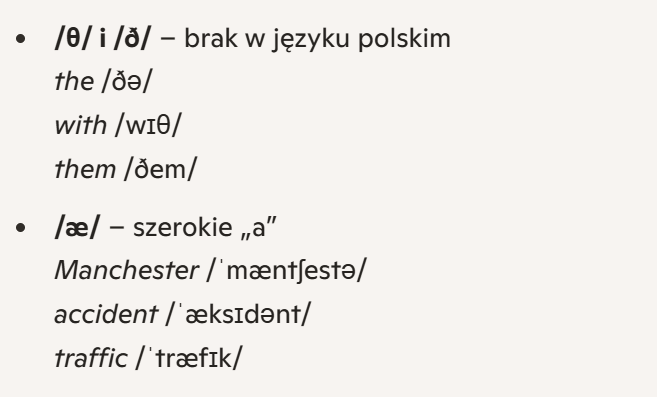
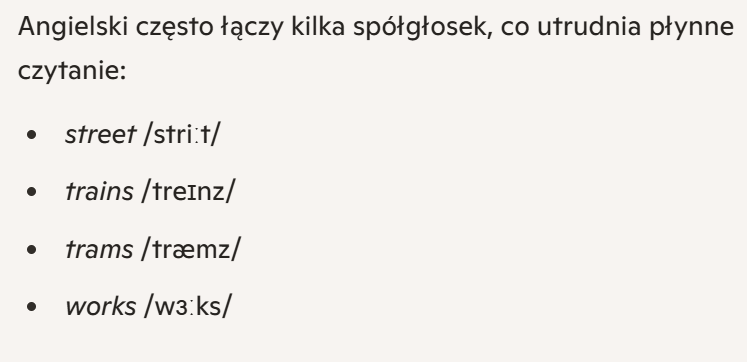
Połączenia spółgłoskowe
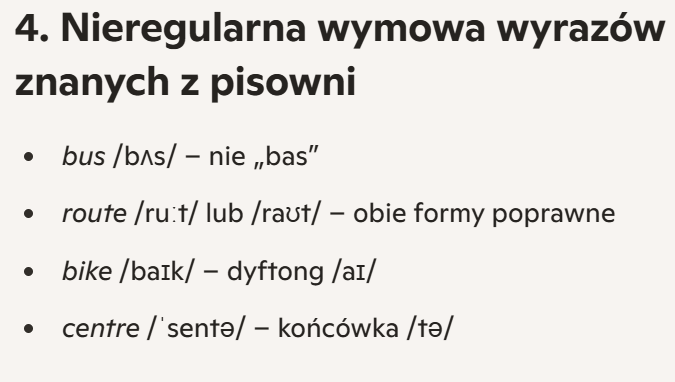
Nieregularna wymowa wyrazów znanych z pisowni
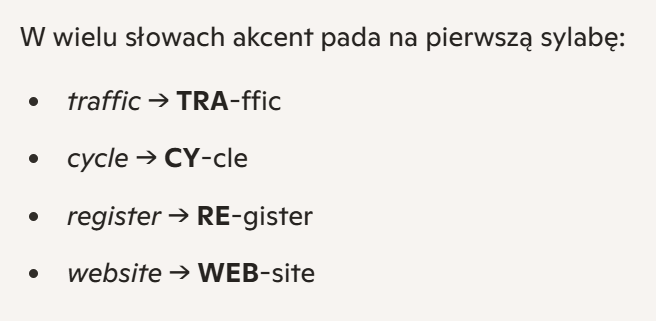
Akcent wyrazowy
Łączenie wyrazów w mowie (connected speech)
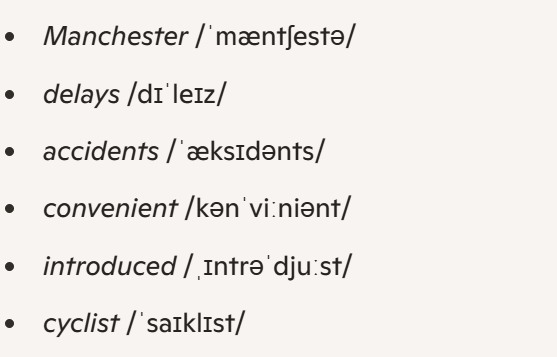
Trudne słowa z tekstu – wymowa
Krótkie wyrażenia językowe

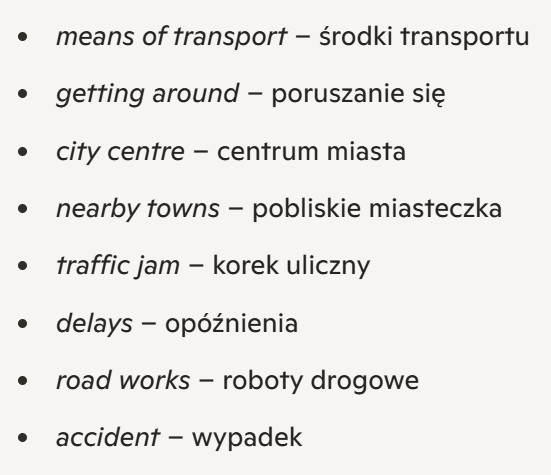
getting around – poruszanie się

means of transport – środki transportu

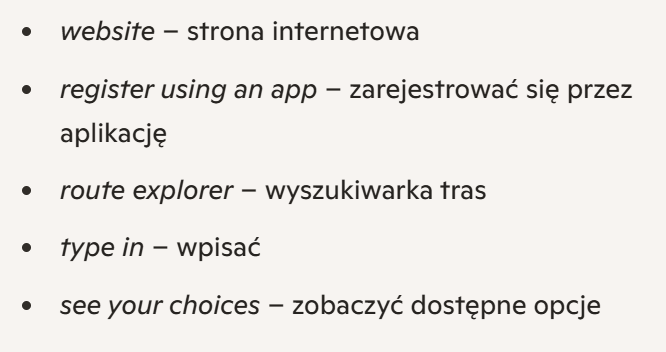
a fantastic website – fantastyczna strona internetowa

the latest delays – najnowsze opóźnienia

caused by accidents – spowodowane wypadkami

caused by road works – spowodowane robotami drogowymi

avoid traffic jams – unikać korków

a big football match – duży mecz piłkarski

travel by bus – podróżować autobusem

travel by bike – podróżować rowerem

all-round the city centre – po całym centrum miasta

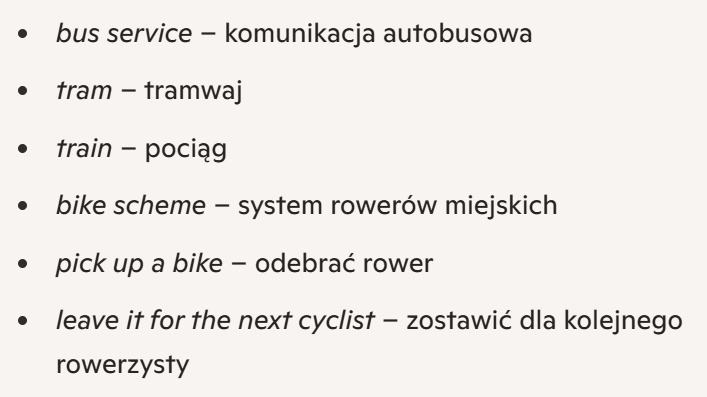
a great bus service – świetna komunikacja autobusowa

covering the city centre – obejmująca centrum miasta

nearby towns – pobliskie miasteczka

plan your route – zaplanować trasę

route explorer – wyszukiwarka tras

type in where you want to go – wpisz, dokąd chcesz jechać

see your choices – zobacz swoje możliwości

link up with trains – łączyć się z pociągami

link up with trams – łączyć się z tramwajami

get fit – nabrać kondycji

a new bike scheme – nowy system rowerowy

introduced in 2017 – wprowadzony w 2017 roku

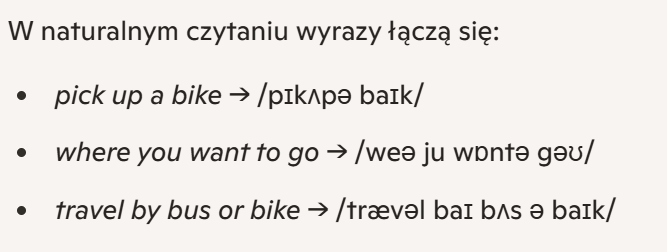
register using an app – zarejestrować się przez aplikację

pick up a bike – odebrać rower

on the streets – na ulicach

ride it wherever you want – jechać, dokąd chcesz

leave it for the next cyclist – zostawić dla kolejnego rowerzysty

very convenient – bardzo wygodne

very cheap – bardzo tanie

get to where you need to go – dotrzeć tam, gdzie trzeba

find information quickly – szybko znaleźć informacje

avoid busy areas – unikać zatłoczonych miejsc

arrive at the match – dotrzeć na mecz

many bikes available – wiele dostępnych rowerów

helpful transport tools – pomocne narzędzia transportowe

choose the best route – wybrać najlepszą trasę

find the nearest stop – znaleźć najbliższy przystanek

check for delays – sprawdzić opóźnienia

move around the city easily – łatwo poruszać się po mieście

Categories
Lekcje klasa 1

Food

Klasa 1 Unit 7

Categories
Lekcje klasa 3

We must hurry (2)

Klasa 3

Co trzeba wiedzieć, aby zrozumieć dialog?

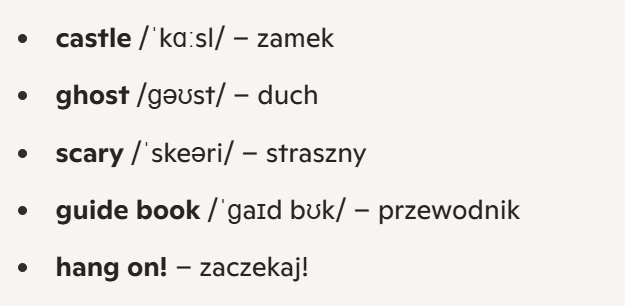
Słownictwo z dialogu

Zwroty potrzebne do zrozumienia dialogu
Godziny – proste rozumienie

Gramatyka na poziomie klasy 3

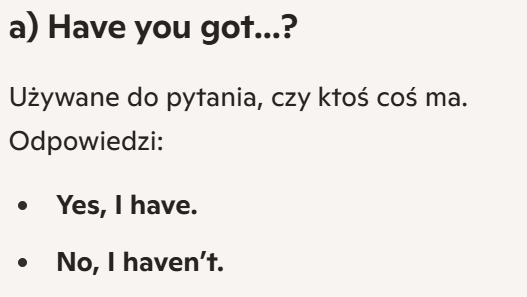
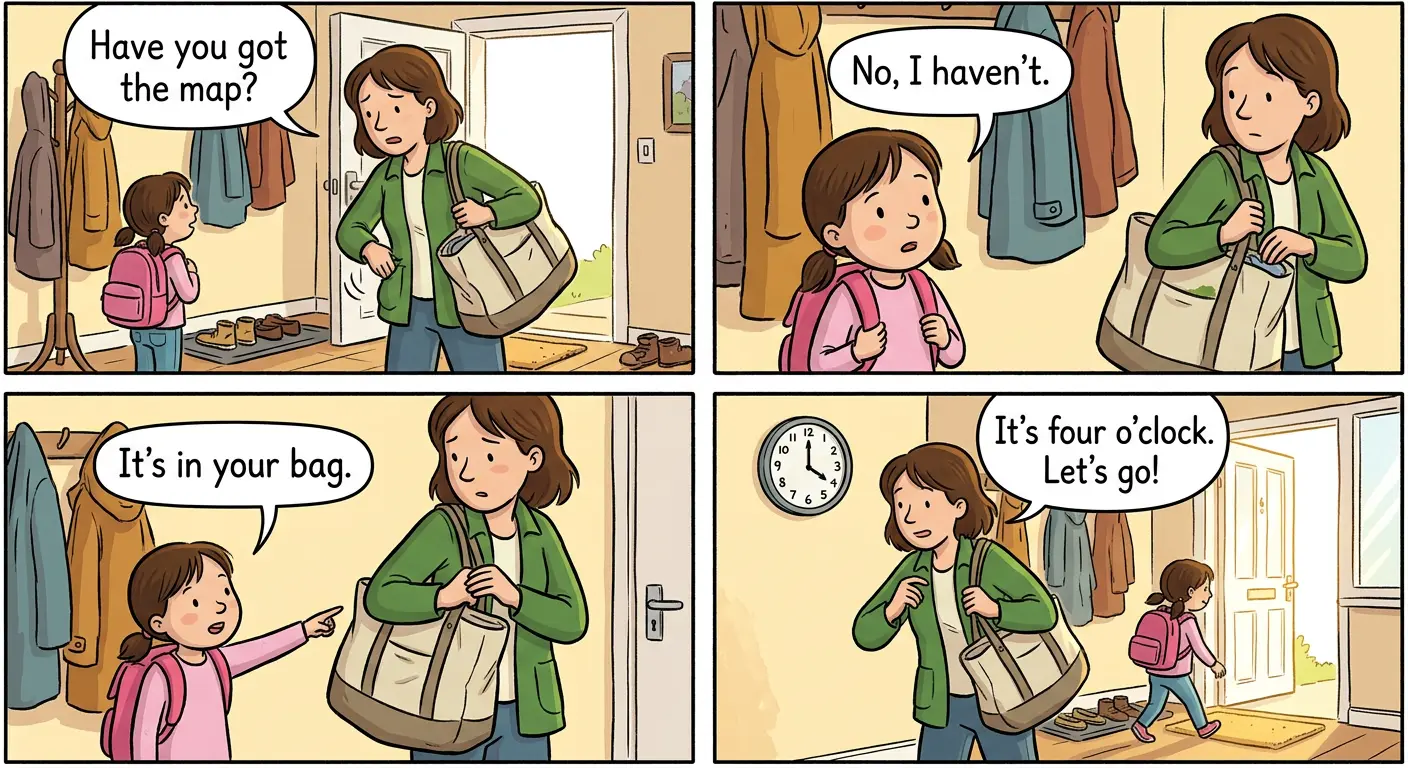
Have you got…?
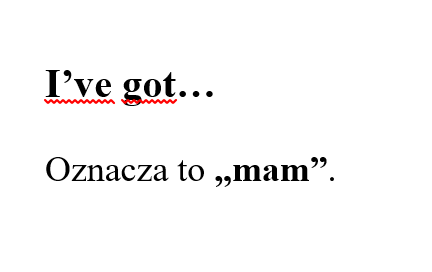
I’ve got…
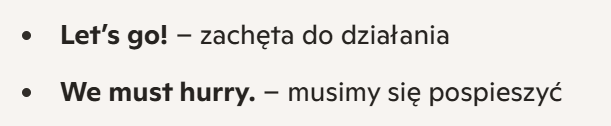
Proste polecenia
Categories
Lekcje klasa 2

Review 8

Klasa 2

Categories
Lekcje klasa 4

On holiday in Scotland (2)

Klasa 4 Dialogi – potrzebne słownictwo, gramatyka i wymowa

Słownictwo z dialogów

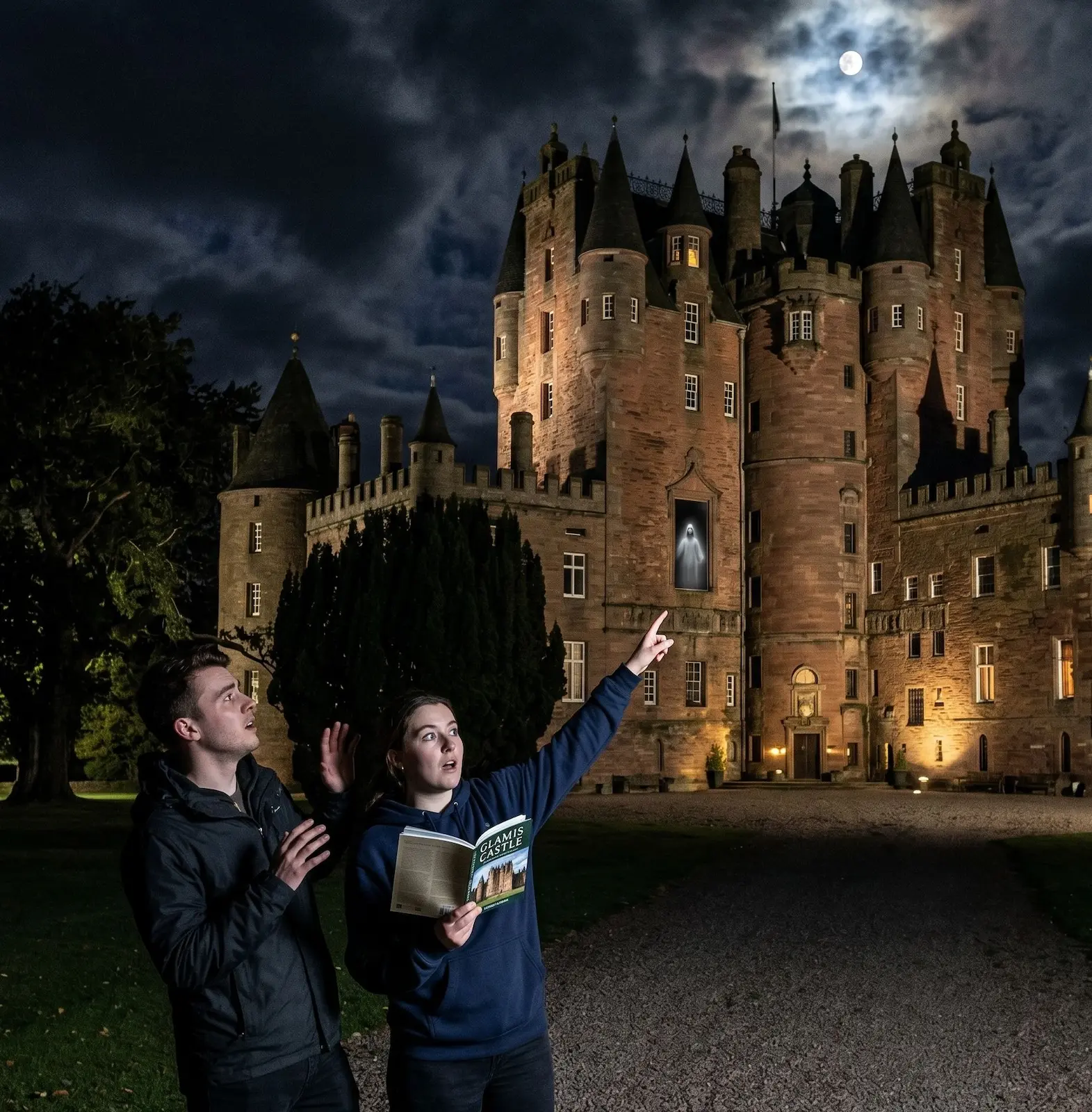
Zamki i strachy
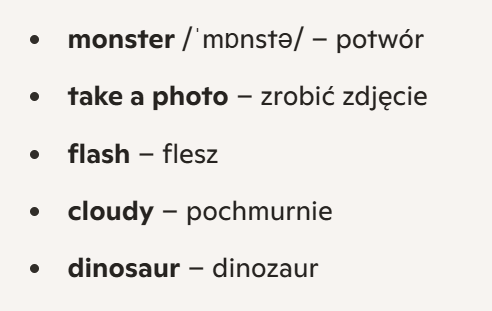
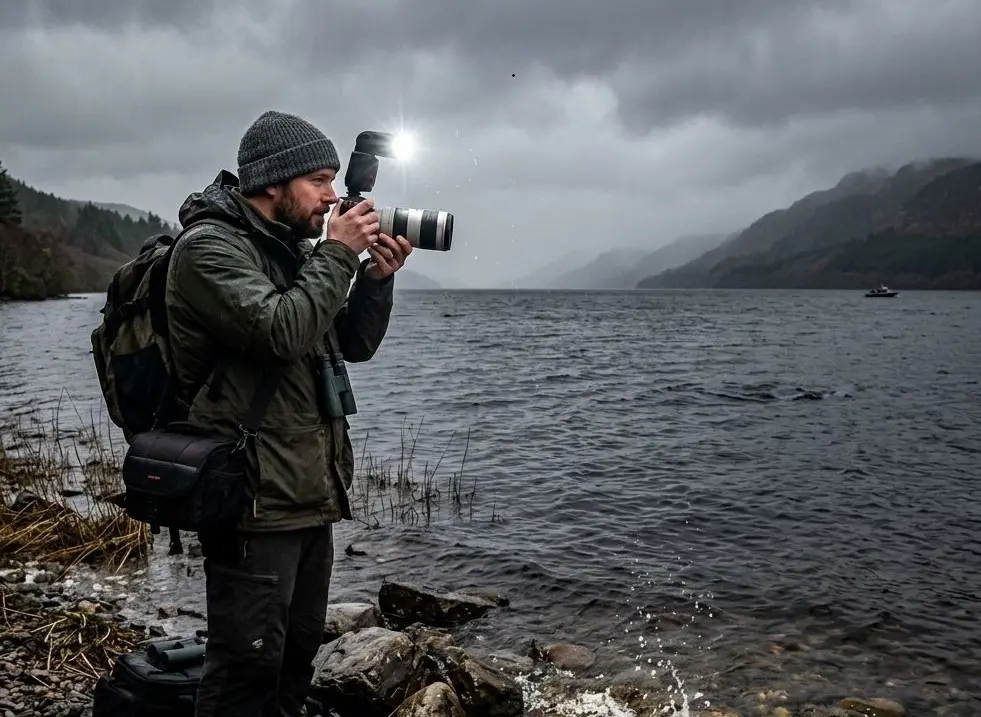
Potwory i pogoda
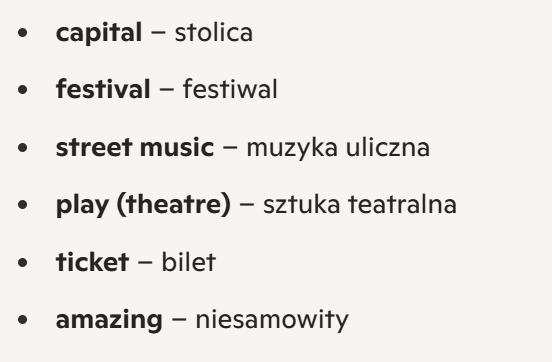
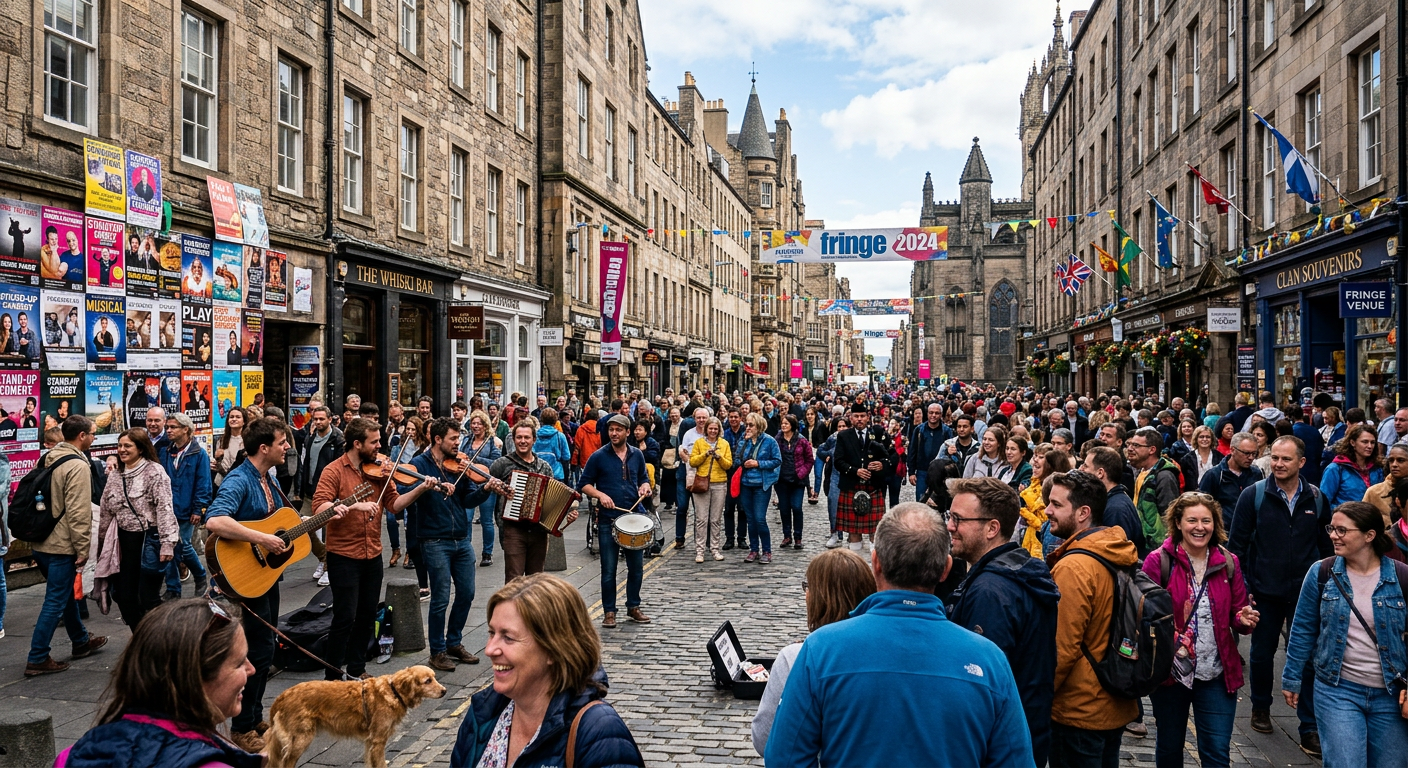
Miasto i festiwal

Gramatyka użyta w dialogach

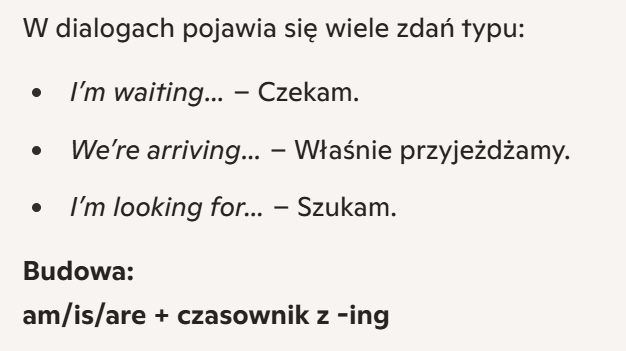
Present Continuous – czynności TERAZ
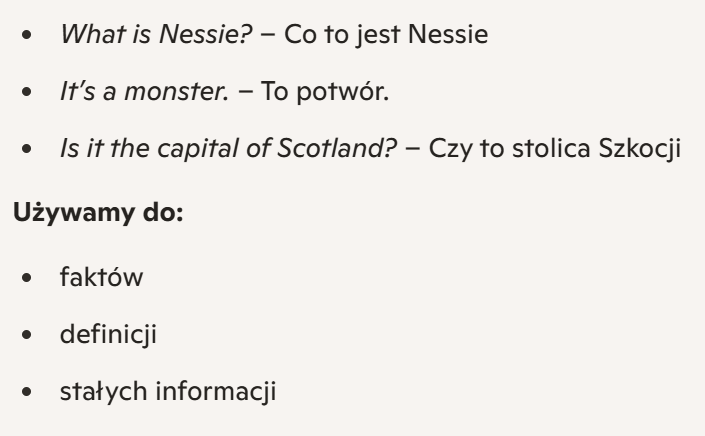
Present Simple – fakty i definicje
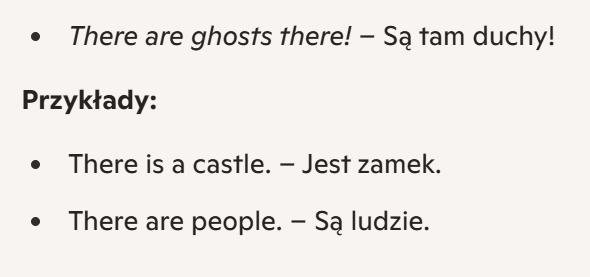
There is / There are – „jest / są”
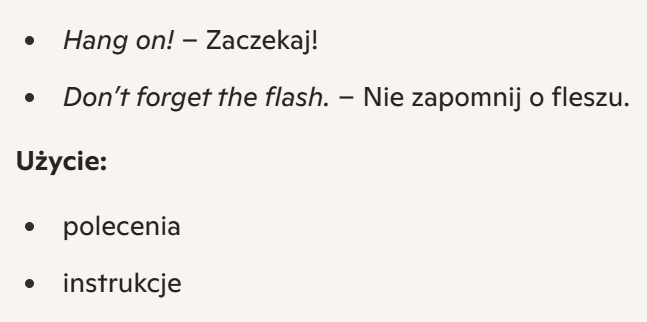
Tryb rozkazujący (imperative)

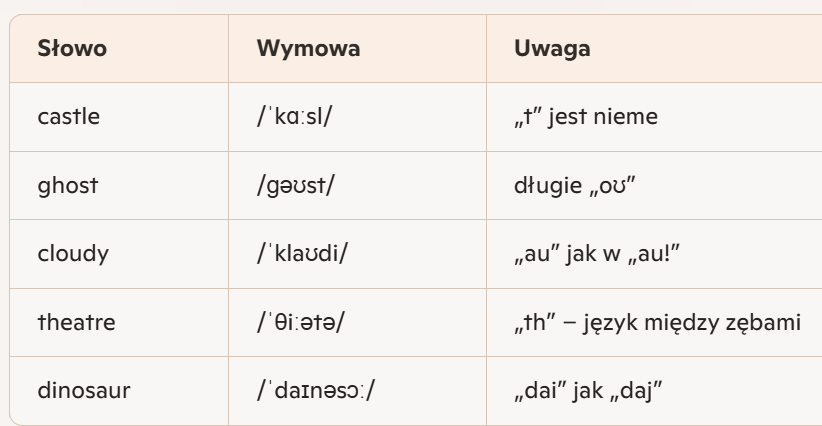
Wymowa

Wymowa – ważne słowa

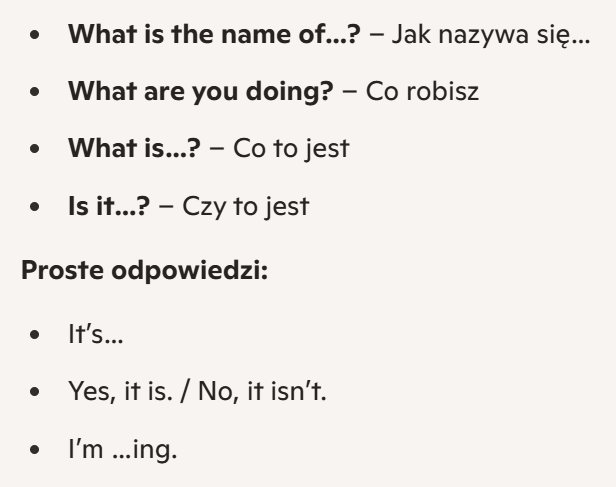
Przydatne pytania

Pytania z dialogów
Categories
Lekcje klasa 6

Come rain or shine

Klasa 6 GRAMATYKA

Present Simple & Present Continuous
Future with WILL
Imperative
First Conditional
Weather expressions
Słownictwo i kolokacje
Zaimki osobowe i dzierżawcze

Klasa 6 WYMOWA

Trudne dźwięki
Końcówka -ing
Contractions
Akcent wyrazowy
Intonacja
Connected speech
pouring with rain
hold on tight
we’ll be dry even if
/w/ – angielskie „w”
Polskie „ł”

Categories
Lekcje klasa 5

Destination (1)

Klasa 5

Girl: Excuse me. Can you tell me the way to the museum?

Woman: Of course. You are here at the moment. Walk straight on and go past the park. Then turn left and walk to the traffic lights and cross the street. Turn right and walk down North Street for about five minutes. The museum is on the right.

b. Trisha: Thank you!

Tłumaczenie

Dziewczyna: Przepraszam. Czy może mi pani powiedzieć, jak dojść do muzeum?

Kobieta: Oczywiście. Jesteś teraz tutaj. Idź prosto i minij park. Potem skręć w lewo i idź do świateł, a następnie przejdź przez ulicę. Skręć w prawo i idź w dół North Street przez około pięć minut. Muzeum jest po prawej stronie.

Dziewczyna: Dziękuję!

Can – pytania o możliwość / prośby o pomoc
Przyimki i wyrażenia kierunku (prepositions of movement)
Przyimki miejsca (prepositions of place)
Wyrażenia czasu i dystansu
Prosty czas teraźniejszy w instrukcjach (imperative)
Zaimki osobowe i podstawowe struktury
Categories
Lekcje klasa 6

Come rain or shine

Klasa 6 Czy deszcz, czy słońce.

– Who wants to ride on the sledge next?

– I do! This snow is brilliant! It’s freezing cold, but I love it!

– Sit here, Jonas. Bob, sit behind him.

– OK. Don’t push too hard. We don’t want to get stuck in that snowdrift again!

– Too late! Let’s push them, Harry! Hold on tight!

Categories
Lekcje klasa 6

Ants are amazing insects.

Klasa 6

Ants are amazing insects.

There are over 12,000 kinds of ants around the world. They have six legs, big heads and strong jaws. They are very strong – they can lift and carry things which are much heavier than their own body.

Ants belong to the same group of insects as wasps and bees.

Their homes are called nests. Ant nests are usually underground in the soil, but some ants live in trees.

The most important ant is the queen. She has thousands of eggs.

The ants we usually see are the workers – they look for food, look after the baby ants, build and look after the nest and do many other jobs.

Ants use chemical substances to communicate. These substances can tell other ants where danger or food is.

Ants usually eat seeds and other insects. Army ants even eat birds and small mammals.

The ant in the photo is a leaf‑cutter ant. These ants live in South and Central America. They cut leaves with their jaws, but they don’t eat them. They carry them to their nests and use them to grow food!

Categories
Lekcje klasa 5

The Grand Canyon (2)

Klasa 5

Categories
Lekcje klasa 6

First Conditional

Klasa 6

First Conditional – klasa 6

Używamy First Conditional, gdy mówimy o realnej przyszłości – o sytuacjach, które mogą się wydarzyć, jeśli spełni się warunek.

1. Kiedy używamy First Conditional?
  • Mówimy o przyszłości.
  • Warunek musi się najpierw spełnić.
  • Wynik jest możliwy, ale nie pewny.
  • Przykład: If it rains, we will stay at home.
2. Budowa zdania – schemat

IF + Present Simple, WILL + bezokolicznik

  • If + warunek – If it rains
  • will + verb – we will stay at home.

Przykłady:

  • If it rains, we will stay at home.
  • If you study, you will pass the test.
  • We will stay at home if it rains.
3. Tabela – dwie części zdania
Część zdania Czas Przykład
IF + warunek Present Simple If you study
wynik will + verb you will pass.
4. Przykładowe zdania (klasa 6)
  • If it rains, we will stay at home.
  • If you study hard, you will get a good mark.
  • If you don’t hurry, you will miss the bus.
  • If I’m tired, I will go to bed early.
  • If we finish the project, the teacher will be happy.
  • If you eat too much, you will feel sick.
  • If she forgets her homework, she will get a minus.
  • If they win the match, they will celebrate.
  • If you help me, I will help you.
  • If he doesn’t clean his room, his mom will be angry.
5. Typowe błędy
  • ❌ If it will rain, we will stay at home.
    ✔️ If it rains, we will stay at home.
  • ❌ If you will help me, I will help you.
    ✔️ If you help me, I will help you.
  • Po IF nie używamy WILL.
6. Mini‑ćwiczenie

Uzupełnij zdania:

  1. If you ______ (be) late, the teacher ______ (be) angry.
  2. If it ______ (snow), we ______ (make) a snowman.
  3. If I ______ (finish) my homework, I ______ (play) games.
  4. If they ______ (not study), they ______ (fail) the test.
  5. If we ______ (go) to the shop, we ______ (buy) snacks.
7. Krótka ściąga

IF + Present Simple → WILL + bezokolicznik

Mówimy o przyszłości, która jest możliwa.

First Conditional – zdania z tłumaczeniem

If it rains, we will stay at home. Jeśli będzie padać, zostaniemy w domu.
If you study hard, you will get a good mark. Jeśli będziesz się uczyć, dostaniesz dobrą ocenę.
If you don’t hurry, you will miss the bus. Jeśli się nie pospieszysz, spóźnisz się na autobus.
If I’m tired, I will go to bed early. Jeśli będę zmęczony, pójdę spać wcześniej.
If we finish the project, the teacher will be happy. Jeśli skończymy projekt, nauczyciel będzie zadowolony.
If you eat too much, you will feel sick. Jeśli zjesz za dużo, poczujesz się źle.
If she forgets her homework, she will get a minus. Jeśli zapomni pracy domowej, dostanie minusa.
If they win the match, they will celebrate. Jeśli wygrają mecz, będą świętować.
If you help me, I will help you. Jeśli mi pomożesz, ja pomogę tobie.
If he doesn’t clean his room, his mom will be angry. Jeśli nie posprząta pokoju, jego mama będzie zła.
If we go to the park, we will play football. Jeśli pójdziemy do parku, zagramy w piłkę.
If you drink this tea, you will feel better. Jeśli wypijesz tę herbatę, poczujesz się lepiej.
If the weather is nice, we will have a picnic. Jeśli pogoda będzie ładna, zrobimy piknik.
If she studies, she will pass the test. Jeśli będzie się uczyć, zda test.
If you don’t wear a coat, you will get cold. Jeśli nie założysz kurtki, zmarzniesz.
If you call me later, I will tell you everything. Jeśli zadzwonisz do mnie później, powiem ci wszystko.
If we leave now, we will catch the train. Jeśli wyjdziemy teraz, zdążymy na pociąg.
If he eats breakfast, he will have more energy. Jeśli zje śniadanie, będzie miał więcej energii.
If they don’t stop talking, the teacher will get angry. Jeśli nie przestaną rozmawiać, nauczyciel się zdenerwuje.
If you practise every day, you will improve. Jeśli będziesz ćwiczyć codziennie, zrobisz postępy.
If she takes an umbrella, she won’t get wet. Jeśli weźmie parasolkę, nie zmoknie.
If we don’t hurry, we will be late. Jeśli się nie pospieszymy, spóźnimy się.
If you open the window, the room will get cold. Jeśli otworzysz okno, pokój zrobi się zimny.
If he studies more, he will understand the lesson. Jeśli będzie więcej się uczyć, zrozumie lekcję.
If they invite me, I will come. Jeśli mnie zaproszą, przyjdę.
If you touch the dog gently, it will be friendly. Jeśli pogłaszczesz psa delikatnie, będzie przyjazny.
If we buy tickets today, we will save money. Jeśli kupimy bilety dzisiaj, zaoszczędzimy pieniądze.
If she doesn’t eat lunch, she will be hungry later. Jeśli nie zje lunchu, będzie później głodna.
If you close the door quietly, nobody will hear you. Jeśli zamkniesz drzwi cicho, nikt cię nie usłyszy.
If it gets dark, we will turn on the lights. Jeśli się ściemni, włączymy światła.
Categories
Lekcje klasa 7

Podróżowanie i turystyka

Klasa 7

Categories
Lekcje klasa 2

I am wearing a helmet

Klasa 2

Categories
Lekcje klasa 2

8/2 Vocabulary

Categories
Domyślna kategoria

Próba

Kliknij, aby rozwinąć

To jest przykładowa zawartość.

Widzisz, jak płynnie się rozwija?

Categories
Lekcje klasa 3

We must hurry

Klasa 3

Mum: Where are you, Jane? We must hurry. We can’t be late. Our train leaves at half past four. Girl: I’m waiting in the car, mum.

Mum: Have you got your backpack?
Girl: Yes, I have. I’ve got my camera, my phone, my swimsuit, my hat, my book, a bottle of water and some snacks.

Mum: Have you got the map?
Jane: No, I haven’t. It’s in your bag.
Mum: It’s four o’clock. Let’s go!

Jane: Mum, have you got the tickets, the money and our passports?

Mum: What? Oh no! I haven’t got my bag. It’s at home!
Jane: Well, let’s go back and get it. We must hurry!

Categories
Lekcje klasa 4

On holiday in Scotland

Klasa 4

What is the name of this castle?
  • What is the name of this castle?
  • Hang on! I’m looking for it in the guide book. It’s Glamis castle. There are ghosts there!
  • No way! That’s scary.

What are you doing?
  • What are you doing now?
  • I’m waiting to take a photo of Nessie.
    What is Nessie?
  • It’s a monster that lives here in Loch Ness.
  • Cool! Maybe it’s a dinosaur! Don’t forget the flash. It’s very cloudy today.
  • Good idea.
We’re arriving in Edinburgh now.

We’re arriving in Edinburgh now.
Is it the capital of Scotland?
Yes, it is. The Edinburgh Festival is happening here at the moment.
Brilliant! We can see plays, listen to street music and watch films here.
I know. It’s absolutely amazing! Look. I’ve got a ticket for the theatre.
You lucky thing!

Categories
Lekcje klasa 6

Zadania

Klasa 6

Categories
Lekcje klasa 6

That’s rubbish

Pollution is a serious problem for the environment. It puts plants and animals in danger. Conservationists say that something must be done.

Rubbish is one of the problems. When you drive in the countryside, you see rubbish on the sides of the road. When you go for a walk in the woods, you see litter from picnics on the grass. When you look in rivers, you see plastic or glass drink bottles, cans and wrappers in the water.

Rubbish not only looks horrible, but it is also dangerous for the environment. Lots of wild animals get injured or trapped because of litter. They can also get sick from eating it by mistake. Toxins from litter pollute water that the animals drink, and they get into the soil.

The result is that many plants and animals die because the rubbish and pollution kill them. So if you care about the environment, don’t drop litter. Don’t throw it away carelessly. Remember to sort your rubbish and put it in the recycling bins. If we recycle more, there will be less rubbish in the world.

Looking after the environment starts at home. If everyone does something, the world will be a better place.

Streszczenie

Zanieczyszczenie środowiska jest poważnym problemem i zagraża roślinom oraz zwierzętom. Wiele osób uważa, że trzeba zacząć działać. Jednym z największych problemów są śmieci. Widać je przy drogach, w lasach i w rzekach — plastikowe i szklane butelki, puszki czy papierki.

Śmieci nie tylko brzydko wyglądają, ale są też niebezpieczne. Dzikie zwierzęta mogą się zranić, zaplątać albo zachorować, gdy przypadkowo je zjedzą. Toksyczne substancje z odpadów zanieczyszczają wodę i glebę, co prowadzi do śmierci wielu roślin i zwierząt.

Dlatego ważne jest, aby nie śmiecić, nie wyrzucać odpadów byle gdzie, segregować je i wrzucać do odpowiednich pojemników. Jeśli będziemy więcej recyklingować, śmieci będzie mniej. Dbaniem o środowisko powinniśmy zajmować się już w domu — jeśli każdy zrobi coś małego, świat stanie się lepszym miejscem.

Klasa 6

Categories
Lekcje klasa 4

Holiday snapshots

Klasa 4

A Trip to New York City!

John’s Holiday in New York

Welcome to Manhattan!

My name is John and I am on holiday in New York with my family. We are staying in a hotel in Manhattan. There are tall skyscrapers everywhere.

Central Park

In the centre of New York there is a big park called Central Park. I am looking at it at the moment from my hotel room. There is a lake, a zoo and two ice-skating rinks.

Sunny Day in the Park

It is a sunny day and lots of people are jogging there right now.

Monsters from the Past!

My favourite place in New York is the American Museum of Natural History. There are dinosaur skeletons in it

The Space Ball

There is also an Earth and Space theatre. It looks like a ball.

Icons of New York

You can also see the Statue of Liberty in the port, and Times Square in the centre of New York.

Broadway Adventure!

The theatres are also great here. We have got tickets to see a play at a Broadway theatre tomorrow. I can’t wait!

Categories
Lekcje klasa 4

Present Continuous (czas teraźniejszy ciągły)

Klasa 4

Kiedy używamy Present Continuous?
Jak budujemy zdania twierdzące?
Przykłady
Jak budujemy zdania przeczące?
Wyrażenia czasu używane z Present Continuous
Categories
Lekcje klasa 8

The World of Apps

Warm-up

  • What are your favourite smartphone apps?
  • How much time do you spend using apps every day?
  • Can you imagine a day without your phone? Why / Why not?

2. Vocabulary (Słownictwo)

  • user-friendly – przyjazny dla użytkownika
  • to download / to upload – pobierać / przesyłać (np. na serwer)
  • features – funkcje, cechy charakterystyczne
  • notifications – powiadomienia
  • to subscription fee – opłata abonamentowa
  • in-app purchases – zakupy w aplikacji
  • to update – aktualizować
  • addictive – uzależniający

3. Reading & Discussion

Text: Are We Too Dependent on Apps? Nowadays, there is an app for everything. We use them to chat with friends, track our fitness goals, learn foreign languages, and even order food. Many apps are free of charge, but they often contain pop-up ads or offer in-app purchases. Some software developers create games that are highly addictive, making users spend hours staring at their screens. Useful features like push notifications remind us about important tasks, but they can also be very distracting. It is important to find a balance between the digital world and real life.

Tłumaczenie

Czy jesteśmy zbyt zależni od aplikacji? W dzisiejszych czasach istnieje aplikacja do wszystkiego. Używamy ich, aby rozmawiać z przyjaciółmi, śledzić nasze cele fitness, uczyć się języków obcych, a nawet zamawiać jedzenie. Wiele aplikacji jest bezpłatnych, ale często zawierają wyskakujące reklamy lub oferują zakupy w aplikacji. Niektórzy twórcy oprogramowania tworzą gry, które są bardzo uzależniające, sprawiając, że użytkownicy spędzają godziny, wpatrując się w ekrany. Przydatne funkcje, takie jak powiadomienia push, przypominają nam o ważnych zadaniach, ale mogą też być bardzo rozpraszające. Ważne jest, aby znaleźć równowagę między światem cyfrowym a prawdziwym życiem.

Pytania do tekstu:

  1. What do we use apps for according to the text?
  2. How do “free” apps make money?
  3. What is the danger of some mobile games?
Categories
Lekcje klasa 5

Grand Canyon

The Grand Canyon is one of the world’s seven natural wonders. It’s a long deep valley of the Colorado River. It is in Arizona, in the USA. The canyon is 446 kilometres long and, in some places, it is two kilometres deep.

Wielki Kanion jest jednym z siedmiu cudów natury na świecie. To długa, głęboka dolina rzeki Kolorado. Znajduje się w Arizonie, w USA. Kanion ma 446 kilometrów długości, a w niektórych miejscach ma dwa kilometry głębokości.

The view from the top of the canyon is amazing. There is a glass bridge called Skywalk and you can walk on it and look down and see the bottom of the canyon under you. The rocks have got beautiful colours there. Some visitors like hiking and explore the canyon on foot and others go down the river by boat. You can even go rafting on the river.

Widok ze szczytu kanionu jest niesamowity. Jest tam szklany most o nazwie Skywalk i możesz po nim chodzić oraz spojrzeć w dół, żeby zobaczyć dno kanionu pod sobą. Skały mają tam piękne kolory. Niektórzy odwiedzający lubią wędrować i zwiedzać kanion pieszo, a inni spływają w dół rzeki łodzią. Można nawet popłynąć pontonem (rafting).

About four million people visit the Grand Canyon every year. But you must be careful there. It is a dangerous place because the rocks are very hard to climb. Also the sun is very hot in the canyon, and there is not a lot of shade. You have to take a bottle of water with you and a hat.

Około czterech milionów ludzi odwiedza Wielki Kanion każdego roku. Ale trzeba tam uważać. To niebezpieczne miejsce, ponieważ skały są bardzo trudne do wspinania. Słońce w kanionie jest też bardzo gorące, a cienia jest niewiele. Trzeba zabrać ze sobą butelkę wody i kapelusz.
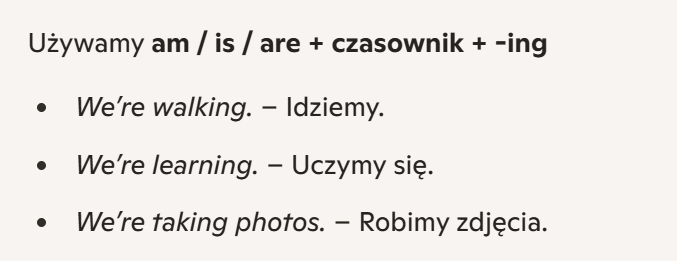
Pytania

Where is the Grand Canyon?
It is in Arizona, in the USA.
How long is the Grand Canyon?
It is 446 kilometres long.
How deep is the canyon in some places?
It is two kilometres deep.
What is the Skywalk?
It is a glass bridge where you can look down and see the bottom.
What can visitors do in the Grand Canyon?
They can hike, explore on foot, go by boat, or go rafting.
How many people visit the Grand Canyon every year?
About four million people.
Why must visitors be careful?
Because the rocks are hard to climb and the sun is very hot.
What should visitors take with them?
A bottle of water and a hat.
Categories
Lekcje klasa 6

Zero Conditional (Zerowy tryb warunkowy)

Klasa 6

Zero Conditional – Zerowy tryb warunkowy

Zero Conditional opisuje fakty, reguły i sytuacje zawsze prawdziwe. Używamy go, gdy wynik jest pewny.

1. Kiedy używamy Zero Conditional?

Używamy go, gdy mówimy o prawdach ogólnych, naukowych faktach, zasadach i rutynowych reakcjach.

Pokaż przykłady

If you heat water, it boils. – Jeśli podgrzewasz wodę, ona wrze.
Uzasadnienie: fakt naukowy, zawsze prawdziwy.

If you mix red and blue, you get purple. – Jeśli zmieszasz czerwony i niebieski, otrzymasz fioletowy.
Uzasadnienie: stała zasada.
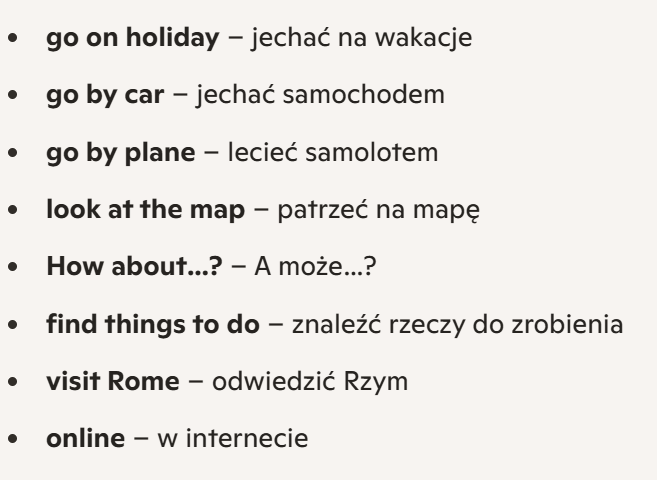
If you don’t water plants, they die. – Jeśli nie podlewasz roślin, one umierają.
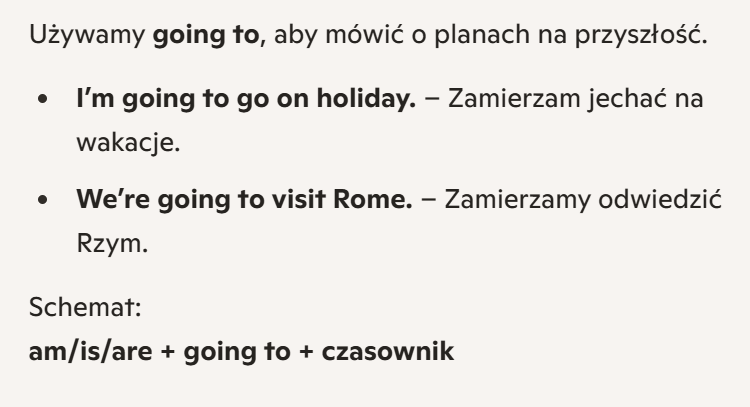
Uzasadnienie: naturalna konsekwencja.
If it rains, the grass gets wet. – Jeśli pada, trawa robi się mokra.
Uzasadnienie: logiczny, pewny skutek.

If you touch fire, you get burned. – Jeśli dotkniesz ognia, oparzysz się.
Uzasadnienie: zawsze prawdziwa reakcja.

2. Budowa Zero Conditional

W obu częściach zdania używamy Present Simple.

Pokaż schemat

If + Present Simple, Present Simple

If you study, you learn. – Jeśli się uczysz, uczysz się (zdobywasz wiedzę).
Uzasadnienie: ogólna zasada.

If people exercise, they feel better. – Jeśli ludzie ćwiczą, czują się lepiej.
Uzasadnienie: powtarzalna zależność.

3. Kiedy NIE używamy Zero Conditional?

Nie używamy go do mówienia o przyszłości, planach czy sytuacjach jednorazowych.

Pokaż przykłady błędów

❌ If it rains, we will stay home. – To nie Zero Conditional (to First Conditional).
✔ If it rains, the grass gets wet. – Zero Conditional, bo to fakt.

❌ If I see Tom today, I tell him.
✔ If I see Tom today, I will tell him. – przyszłość → First Conditional.

4. Typowe zastosowania

Pokaż listę

• fakty naukowe
• prawa natury
• instrukcje i przepisy
• reakcje organizmu
• ogólne zasady i reguły
• powtarzalne skutki

5. Krótka ściąga

Pokaż ściągę

Zero Conditional = zawsze prawda
If + Present Simple, Present Simple

Używamy do faktów, zasad i naturalnych konsekwencji.